9CLR image
Deposition Date 2024-07-12
Release Date 2024-12-18
Last Version Date 2025-09-10
Entry Detail
PDB ID:
9CLR
Keywords:
Title:
Hydroxynitrile Lyase from Hevea brasiliensis with Seventy-one Mutations
Biological Source:
Source Organism:
Host Organism:
Method Details:
Experimental Method:
Resolution:
1.99 Å
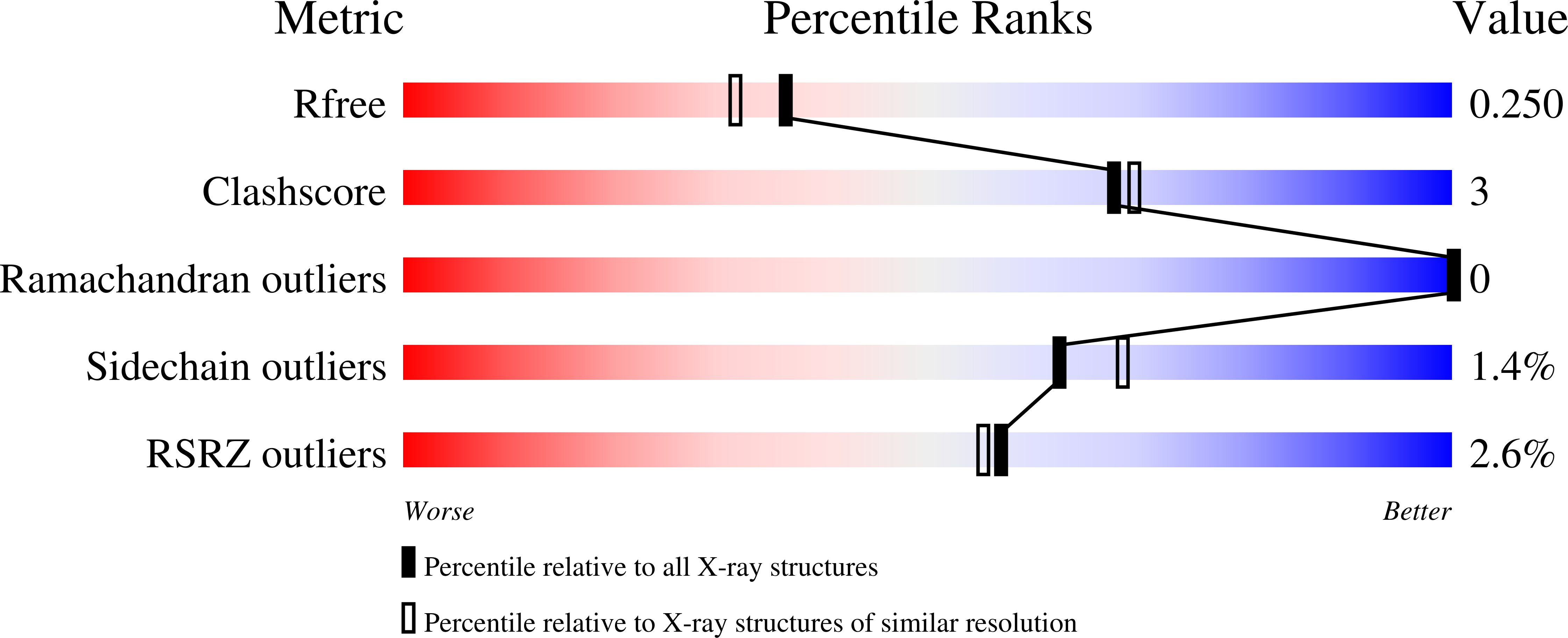
R-Value Free:
0.25
R-Value Work:
0.22
R-Value Observed:
0.22
Space Group:
P 21 21 21
Macromolecular Entities
Structures with similar UniProt ID
Protein Blast
Polymer Type:polypeptide(L)
Molecule:Seventy-one-substitution variants of hydroxynitrile lyase
Mutagens:I9V, T11G, I12A, I18S, E79H, C81L, L84M, H103L, N104A, S105A, V106F, V118L, L121Y, M122N, F125T, D127N, Y133F, L146M, K147F, L148F, L152F, N156K, T173V, G176S, Q180M, E208K, I209G, F210I, L211P, K236M, L237A, and Q238M
Chain IDs:A, B
Chain Length:270
Number of Molecules:2
Biological Source:Hevea brasiliensis
Primary Citation
Crystal structures of 40- and 71-substitution variants of hydroxynitrile lyase from rubber tree.
Acta Crystallogr D Struct Biol 81 511 523 (2025)
PMID: 40864494 DOI: 10.1107/S2059798325007065

Abstact

Hydroxynitrile lyase from Hevea brasiliensis (HbHNL) and the esterase SABP2 from Nicotiana tabacum share the α/β-hydrolase fold, a Ser-His-Asp catalytic triad and 44% sequence identity, yet catalyze different reactions. Prior studies showed that three active-site substitutions in HbHNL conferred weak esterase activity. To investigate how regions beyond the active site influence catalytic efficiency and active-site geometry, we engineered HbHNL variants with increasing numbers of substitutions to match SABP2. Variant HNL16 has all amino acids within 6.5 Å of the active site identical to SABP2, HNL40 those within 10 Å and HNL71 those within 14 Å. HNL16 exhibited poor esterase activity, whereas both HNL40 and HNL71 showed efficient esterase catalysis, demonstrating that residues beyond the immediate active site are critical for functional conversion. X-ray structures of HNL40 and HNL71 reveal a progressive shift in backbone positions toward those of SABP2, with r.m.s.d. values of 0.51 Å (HNL40) and 0.41 Å (HNL71) over the Cα atoms, and even smaller r.m.s.d.s within the active-site region. Both HNL40 and HNL71 show a restored oxyanion hole and an additional tunnel connecting the active site to the protein surface. This work demonstrates the essential role of distant, indirectly acting residues to catalysis in α/β-hydrolase enzymes.

Legend

Protein

Chemical

Disease

Primary Citation of related structures
Feedback Form
Name
Email
Institute
Feedback