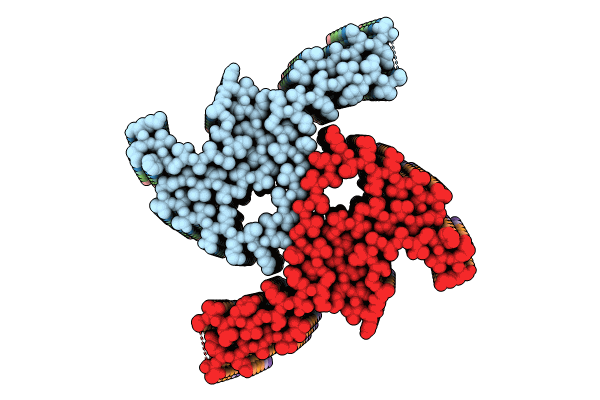
9CK3 image
Deposition Date 2024-07-08
Release Date 2024-07-24
Last Version Date 2025-08-20
Entry Detail
PDB ID:
9CK3
Title:
Cryo-EM structure of in-vitro alpha-synuclein fibril
Biological Source:
Source Organism(s):
Homo sapiens (Taxon ID: 9606)
Expression System(s):
Method Details:
Experimental Method:
Resolution:
2.04 Å
Aggregation State:
FILAMENT
Reconstruction Method:
HELICAL
Macromolecular Entities
Structures with similar UniProt ID
Protein Blast
Polymer Type:polypeptide(L)
Molecule:Alpha-synuclein
Gene (Uniprot):SNCA
Chain IDs:A, B, C (auth: E), D (auth: F), E (auth: C), F (auth: D), G, H, I (auth: K), J (auth: L), K (auth: I), L (auth: J)
Chain Length:140
Number of Molecules:12
Biological Source:Homo sapiens
Ligand Molecules
Primary Citation
High-resolution Cryo-EM Structure Determination of a-Synuclein-A Prototypical Amyloid Fibril.
Bio Protoc 15 e5171 e5171 (2025)
PMID: 39959285 DOI: 10.21769/BioProtoc.5171

Abstact

The physiological role of a-synuclein (a-syn), an intrinsically disordered presynaptic neuronal protein, is believed to impact the release of neurotransmitters through interactions with the SNARE complex. However, under certain cellular conditions that are not well understood, a-syn will self-assemble into β-sheet-rich fibrils that accumulate and form insoluble neuronal inclusions. Studies of patient-derived brain tissues have concluded that these inclusions are associated with Parkinson's disease, the second most common neurodegenerative disorder, and other synuclein-related diseases called synucleinopathies. In addition, repetitions of specific mutations to the SNCA gene, the gene that encodes a-syn, result in an increased disposition for synucleinopathies. The latest advances in cryo-EM structure determination and real-space helical reconstruction methods have resulted in over 60 in vitro structures of a-syn fibrils solved to date, with a handful of these reaching a resolution below 2.5 Å. Here, we provide a protocol for a-syn protein expression, purification, and fibrilization. We detail how sample quality is assessed by negative stain transmission electron microscopy (NS-TEM) analysis and followed by sample vitrification using the Vitrobot Mark IV vitrification robot. We provide a detailed step-by-step protocol for high-resolution cryo-EM structure determination of a-syn fibrils using RELION and a series of specialized helical reconstruction tools that can be run within RELION. Finally, we detail how ChimeraX, Coot, and Phenix are used to build and refine a molecular model into the high-resolution cryo-EM map. This workflow resulted in a 2.04 Å structure of a-syn fibrils with excellent resolution of residues 36-97 and an additional island of density for residues 15-22 that had not been previously reported. This workflow should serve as a starting point for individuals new to the neurodegeneration and structural biology fields. Together, this procedure lays the foundation for advanced structural studies of a-syn and other amyloid fibrils. Key features • In vitro fibril amplification method yielding twisting fibrils that span several micrometers in length and are suitable for cryo-EM structure determination. • High-throughput cryo-EM data collection of neurodegenerative fibrils, such as alpha-synuclein. • Use of RELION implementations of helical reconstruction algorithms to generate high-resolution 3D structures of a-synuclein fibrils. • Brief demonstration of the use of ChimeraX, Coot, and Phenix for molecular model building and refinement.

Legend

Protein

Chemical

Disease

Primary Citation of related structures
Feedback Form
Name
Email
Institute
Feedback