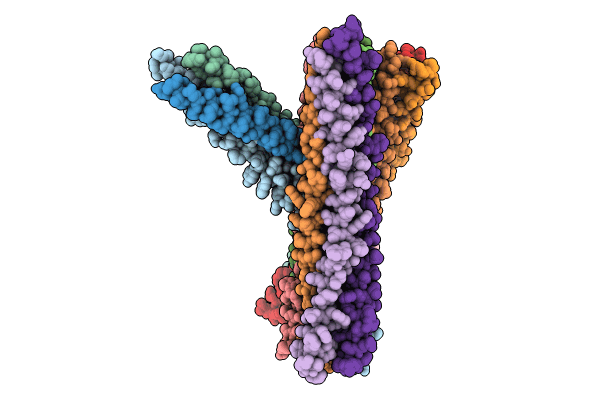
9CJL image
Deposition Date 2024-07-06
Release Date 2024-10-02
Last Version Date 2024-10-02
Entry Detail
PDB ID:
9CJL
Title:
Molecular basis of TMED9 dodecamer
Biological Source:
Source Organism:
Homo sapiens (Taxon ID: 9606)
Host Organism:
Method Details:
Experimental Method:
Resolution:
5.50 Å
Aggregation State:
PARTICLE
Reconstruction Method:
SINGLE PARTICLE

Macromolecular Entities
Structures with similar UniProt ID
Protein Blast
Polymer Type:polypeptide(L)
Molecule:Transmembrane emp24 domain-containing protein 9
Gene (Uniprot):TMED9
Chain IDs:A, B, C, D, E, F, G, H, I, J, K, L
Chain Length:235
Number of Molecules:12
Biological Source:Homo sapiens
Ligand Molecules
Primary Citation
Molecular basis of TMED9 oligomerization and entrapment of misfolded protein cargo in the early secretory pathway.
Sci Adv 10 eadp2221 eadp2221 (2024)
PMID: 39303030 DOI: 10.1126/sciadv.adp2221

Abstact

Intracellular accumulation of misfolded proteins causes serious human proteinopathies. The transmembrane emp24 domain 9 (TMED9) cargo receptor promotes a general mechanism of cytotoxicity by entrapping misfolded protein cargos in the early secretory pathway. However, the molecular basis for this TMED9-mediated cargo retention remains elusive. Here, we report cryo-electron microscopy structures of TMED9, which reveal its unexpected self-oligomerization into octamers, dodecamers, and, by extension, even higher-order oligomers. The TMED9 oligomerization is driven by an intrinsic symmetry mismatch between the trimeric coiled coil domain and the tetrameric transmembrane domain. Using frameshifted Mucin 1 as an example of aggregated disease-related protein cargo, we implicate a mode of direct interaction with the TMED9 luminal Golgi-dynamics domain. The structures suggest and we confirm that TMED9 oligomerization favors the recruitment of coat protein I (COPI), but not COPII coatomers, facilitating retrograde transport and explaining the observed cargo entrapment. Our work thus reveals a molecular basis for TMED9-mediated misfolded protein retention in the early secretory pathway.

Legend

Protein

Chemical

Disease

Primary Citation of related structures
Feedback Form
Name
Email
Institute
Feedback