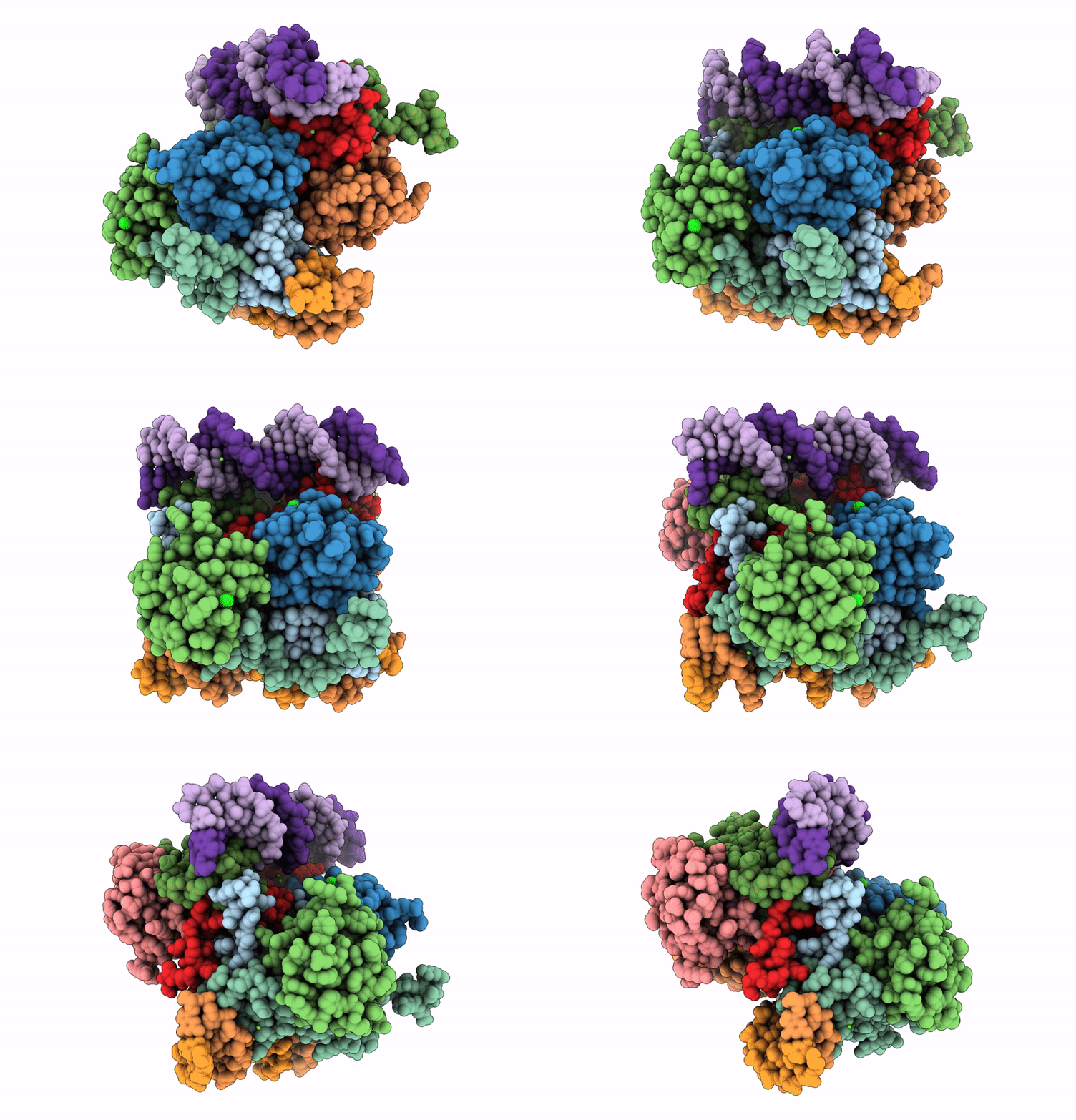
9CHL image
Deposition Date 2024-07-01
Release Date 2025-07-02
Last Version Date 2026-01-14
Entry Detail
PDB ID:
9CHL
Title:
P. vulgaris tetrameric HigBA- operator 2 DNA
Biological Source:
Source Organism(s):
Proteus vulgaris (Taxon ID: 585)
Expression System(s):
Method Details:
Experimental Method:
Resolution:
2.40 Å
R-Value Free:
0.22
R-Value Work:
0.17
Space Group:
C 1 2 1
Macromolecular Entities
Structures with similar UniProt ID
Protein Blast
Polymer Type:polypeptide(L)
Molecule:Antitoxin HigA
Gene (Uniprot):higA
Chain IDs:A, C, G (auth: E), I (auth: G)
Chain Length:104
Number of Molecules:4
Biological Source:Proteus vulgaris
Structures with similar UniProt ID
Protein Blast
Polymer Type:polypeptide(L)
Molecule:Endoribonuclease HigB
Gene (Uniprot):higB
Chain IDs:B, D, H (auth: F), J (auth: H)
Chain Length:93
Number of Molecules:4
Biological Source:Proteus vulgaris
Polymer Type:polydeoxyribonucleotide
Molecule:DNA (5'-D(*GP*TP*AP*TP*TP*AP*CP*AP*CP*AP*CP*CP*AP*TP*GP*TP*AP*AP*TP*AP*C)-3')
Chain IDs:E (auth: I), K
Chain Length:21
Number of Molecules:2
Biological Source:Proteus vulgaris
Polymer Type:polydeoxyribonucleotide
Molecule:DNA (5'-D(*GP*TP*AP*TP*TP*AP*CP*AP*TP*GP*GP*TP*GP*TP*GP*TP*AP*AP*TP*AP*C)-3')
Chain IDs:F (auth: J), L
Chain Length:21
Number of Molecules:2
Biological Source:Proteus vulgaris
Modified Residue
Compound ID Chain ID Parent Comp ID Details 2D Image
MSE A MET modified residue
Primary Citation
Antitoxin control of optimal transcriptional repression in the atypical HigB-HigA toxin-antitoxin system from Proteus vulgaris.
Nucleic Acids Res. 53 ? ? (2025)
PMID: 40671524 DOI: 10.1093/nar/gkaf610

Abstact

Bacterial toxin-antitoxin (TA) pairs transcriptionally autoregulate their expression via a repression/derepression mechanism in response to changing environmental conditions. The structural diversity of TA systems influences the mechanisms of transcriptional regulation. Here, we define the molecular mechanism for the plasmid-encoded HigB-HigA TA pair originally identified in a post-operative infection with antibiotic-resistant Proteus vulgaris. We determine DNA binding and promoter activity by the HigB-HigA complex supported by structural biology and molecular dynamics simulations of an elusive DNA operator-TA repressor complex. To define the optimal oligomeric TA repressor-DNA operator complex required for derepression, we engineered a dedicated trimeric HigB-HigA2 complex that represses transcription more than 26-fold as compared to the tetrameric HigB2-HigA2. These results expand the known diversity of how the HigB-HigA TA family is autoregulated.

Legend

Protein

Chemical

Disease

Primary Citation of related structures
Feedback Form
Name
Email
Institute
Feedback