9CG9 image
Deposition Date 2024-06-28
Release Date 2025-07-02
Last Version Date 2026-01-14
Entry Detail
PDB ID:
9CG9
Title:
Cryo-EM structure of an HMGB1 box bound to nucleosome at SHL-2
Biological Source:
Source Organism(s):
Xenopus laevis (Taxon ID: 8355)
Homo sapiens (Taxon ID: 9606)
synthetic construct (Taxon ID: 32630)
Expression System(s):
Method Details:
Experimental Method:
Resolution:
2.94 Å
Aggregation State:
PARTICLE
Reconstruction Method:
SINGLE PARTICLE
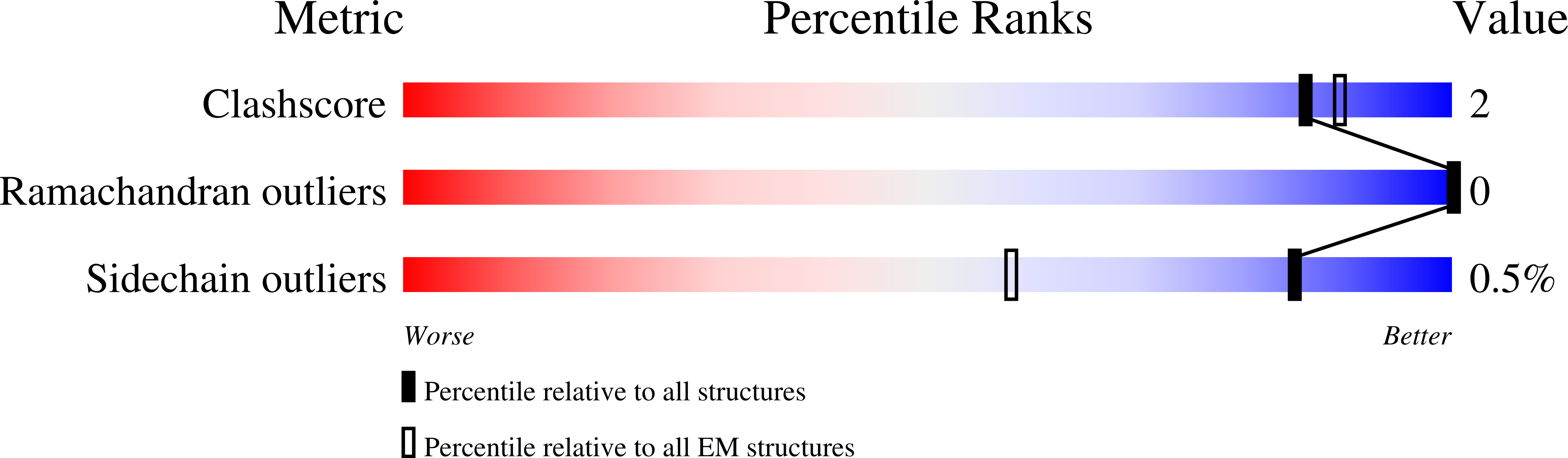
Macromolecular Entities
Structures with similar UniProt ID
Protein Blast
Polymer Type:polypeptide(L)
Molecule:Histone H3.2
Mutagens:G102A, C110A
Chain IDs:A, E
Chain Length:135
Number of Molecules:2
Biological Source:Xenopus laevis
Structures with similar UniProt ID
Protein Blast
Polymer Type:polypeptide(L)
Molecule:Histone H4
Chain IDs:B, F
Chain Length:102
Number of Molecules:2
Biological Source:Xenopus laevis
Structures with similar UniProt ID
Protein Blast
Polymer Type:polypeptide(L)
Molecule:Histone H2A type 1
Mutagens:G99R, A123S
Chain IDs:C, G
Chain Length:129
Number of Molecules:2
Biological Source:Xenopus laevis
Structures with similar UniProt ID
Protein Blast
Polymer Type:polypeptide(L)
Molecule:Histone H2B
Mutagens:S32T
Chain IDs:D, H
Chain Length:122
Number of Molecules:2
Biological Source:Xenopus laevis
Polymer Type:polydeoxyribonucleotide
Molecule:Widom 601 DNA reverse strand (147-mer)
Chain IDs:I
Chain Length:154
Number of Molecules:1
Biological Source:synthetic construct
Polymer Type:polydeoxyribonucleotide
Molecule:Widom 601 DNA forward strand (147-mer)
Chain IDs:J
Chain Length:154
Number of Molecules:1
Biological Source:synthetic construct
Structures with similar UniProt ID
Protein Blast
Polymer Type:polypeptide(L)
Molecule:High mobility group protein B1
Gene (Uniprot):HMGB1
Chain IDs:K
Chain Length:217
Number of Molecules:1
Biological Source:Homo sapiens
Ligand Molecules
Primary Citation
HMGB1 deforms nucleosomal DNA to generate a dynamic chromatin environment counteracting the effects of linker histone.
Sci Adv 11 eads4473 eads4473 (2025)
PMID: 40815652 DOI: 10.1126/sciadv.ads4473

Abstact

The essential architectural protein HMGB1 increases accessibility of nucleosomal DNA and counteracts the effects of linker histone H1. However, HMGB1 is less abundant than H1 and binds nucleosomes more weakly, raising the question of how it competes with H1. Here, we find that HMGB1 increases nucleosomal DNA accessibility without displacing H1. HMGB1 also increases the dynamics of condensed, H1-bound chromatin. Unexpectedly, cryo-electron microscopy structures show HMGB1 bound at internal locations on nucleosomes and local DNA distortion. These sites are away from where H1 binds, explaining how HMGB1 and H1 can co-occupy a nucleosome. Our findings suggest a model where HMGB1 counteracts the effects of H1 by distorting nucleosomal DNA and disrupting interactions of the H1 carboxyl-terminal tail with DNA. Compared to mutually exclusive binding, co-occupancy by HMGB1 and H1 allows greater diversity in dynamic chromatin states. More generally, these results explain how architectural proteins acting at the nucleosome scale can have large effects on chromatin dynamics at the mesoscale.

Legend

Protein

Chemical

Disease

Primary Citation of related structures
Feedback Form
Name
Email
Institute
Feedback