9C9I image
Deposition Date 2024-06-14
Release Date 2024-12-04
Last Version Date 2024-12-04
Entry Detail
PDB ID:
9C9I
Keywords:
Title:
Structure of the TSC1:WIPI3 complex
Biological Source:
Source Organism:
Homo sapiens (Taxon ID: 9606)
Host Organism:
Method Details:
Experimental Method:
Resolution:
3.18 Å
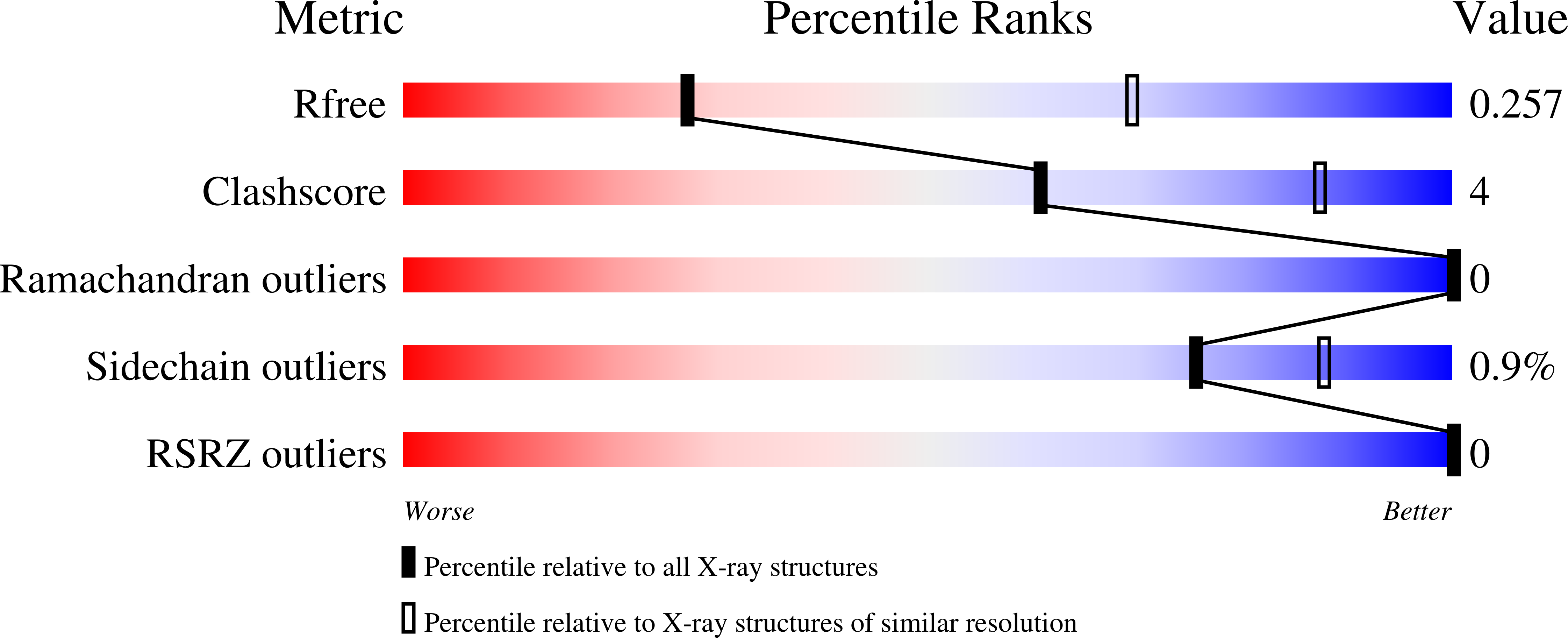
R-Value Free:
0.25
R-Value Work:
0.19
R-Value Observed:
0.20
Space Group:
P 41
Macromolecular Entities
Structures with similar UniProt ID
Protein Blast
Polymer Type:polypeptide(L)
Molecule:WD repeat domain phosphoinositide-interacting protein 3
Gene (Uniprot):WDR45B
Chain IDs:A, B (auth: C), C (auth: E), D (auth: G)
Chain Length:316
Number of Molecules:4
Biological Source:Homo sapiens
Structures with similar UniProt ID
Protein Blast
Polymer Type:polypeptide(L)
Molecule:Hamartin
Gene (Uniprot):TSC1
Chain IDs:E (auth: X), F (auth: B), G (auth: D), H (auth: F), I (auth: H)
Chain Length:34
Number of Molecules:5
Biological Source:Homo sapiens
Ligand Molecules
Primary Citation
Structure of the human TSC:WIPI3 lysosomal recruitment complex.
Sci Adv 10 eadr5807 eadr5807 (2024)
PMID: 39565846 DOI: 10.1126/sciadv.adr5807

Abstact

Tuberous sclerosis complex (TSC) is targeted to the lysosomal membrane, where it hydrolyzes RAS homolog-mTORC1 binding (RHEB) from its GTP-bound to GDP-bound state, inhibiting mechanistic target of rapamycin complex 1 (mTORC1). Loss-of-function mutations in TSC cause TSC disease, marked by excessive tumor growth. Here, we overcome a high degree of continuous conformational heterogeneity to determine the 2.8-Å cryo-electron microscopy (cryo-EM) structure of the complete human TSC in complex with the lysosomal recruitment factor WD repeat domain phosphoinositide-interacting protein 3 (WIPI3). We discover a previously undetected amino-terminal TSC1 HEAT repeat dimer that clamps onto a single TSC wing and forms a phosphatidylinositol phosphate (PIP)-binding pocket, which specifically binds monophosphorylated PIPs. These structural advances provide a model by which WIPI3 and PIP-signaling networks coordinate to recruit TSC to the lysosomal membrane to inhibit mTORC1. The high-resolution TSC structure reveals previously unrecognized mutational hotspots and uncovers crucial insights into the mechanisms of TSC dysregulation in disease.

Legend

Protein

Chemical

Disease

Primary Citation of related structures
Feedback Form
Name
Email
Institute
Feedback