9BYS image
Deposition Date 2024-05-24
Release Date 2025-06-11
Last Version Date 2025-12-24
Entry Detail
PDB ID:
9BYS
Keywords:
Title:
Structure of human MAIT BV28 TCR in complex with human MR1-5-OP-RU
Biological Source:
Source Organism(s):
Homo sapiens (Taxon ID: 9606)
Expression System(s):
Method Details:
Experimental Method:
Resolution:
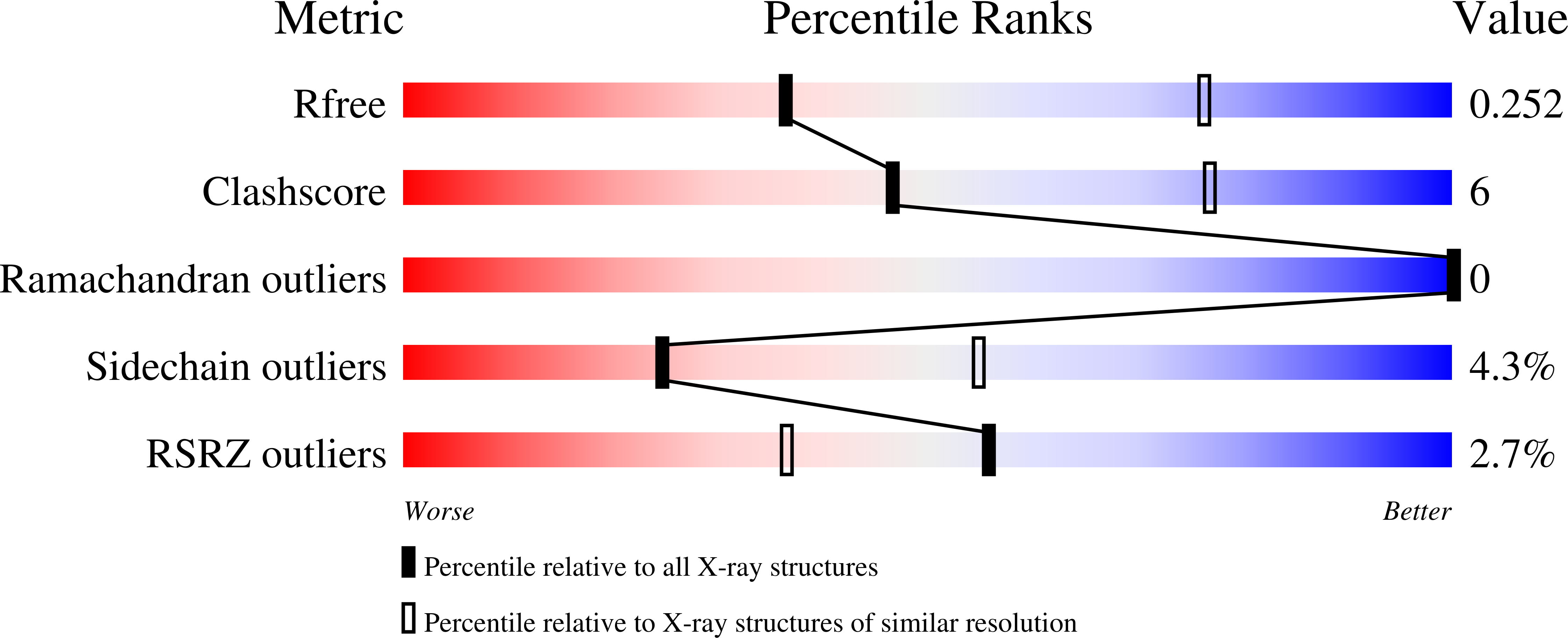
3.10 Å
R-Value Free:
0.25
R-Value Work:
0.22
R-Value Observed:
0.22
Space Group:
P 41 21 2
Macromolecular Entities
Structures with similar UniProt ID
Protein Blast
Polymer Type:polypeptide(L)
Molecule:Major histocompatibility complex class I-related gene protein
Gene (Uniprot):MR1
Chain IDs:A
Chain Length:271
Number of Molecules:1
Biological Source:Homo sapiens
Polymer Type:polypeptide(L)
Molecule:TCR beta chain
Chain IDs:B (auth: AAAB)
Chain Length:244
Number of Molecules:1
Biological Source:Homo sapiens
Polymer Type:polypeptide(L)
Molecule:TCR alpha chain
Chain IDs:C (auth: AAAC)
Chain Length:204
Number of Molecules:1
Biological Source:Homo sapiens
Structures with similar UniProt ID
Protein Blast
Polymer Type:polypeptide(L)
Molecule:Beta-2-microglobulin
Gene (Uniprot):B2M
Chain IDs:D (auth: AAAD)
Chain Length:100
Number of Molecules:1
Biological Source:Homo sapiens
Primary Citation
A molecular basis underpinning TRBV28 + T-cell receptor recognition of MR1-antigen.
J.Biol.Chem. 301 110416 110416 (2025)
PMID: 40570962 DOI: 10.1016/j.jbc.2025.110416

Abstact

Mucosal-associated invariant T (MAIT) cells express a TRAV1-2+ T-cell receptor (TCR) that recognizes microbial vitamin B2 derivatives presented by the major histocompatibility complex class I-related molecule (MR1). Most MAIT TCRs incorporate a biased TCR-β repertoire, predominantly TRBV20-1 and TRBV6, but some utilize other trbv genes, including TRBV28. A second conserved, albeit less frequent TRAV36+ TRBV28+ T-cell population exhibits MAIT-like phenotypic features but use a markedly distinct mode of MR1-antigen (Ag) recognition compared with MAIT TCR-MR1 binding. Nevertheless, our understanding of how differing TCR gene usage results in altered MR1 binding modes remains incomplete. Here, binding studies demonstrated differential affinities and Ag specificities between TRBV6+ and TRBV28+ MR1-restricted TCRs. Alanine-scanning mutagenesis on the TRAV36-TRBV28 TCR revealed a strong dependence on germline-encoded residues within the highly selected complementarity-determining region 3α loop, similar to TRAV1-2-TRBV6 TCRs, and further alanine-scanning mutagenesis experiments demonstrate differential energetic footprints by these TCRs atop MR1. We determined the crystal structure of a MAIT TRAV1-2-TRBV28+ TCR-MR1-5-OP-RU ternary complex. This structure revealed a docking mode conserved amongst other TRAV1-2+ MAIT TCRs, with the trbv28-encoded TCR-β chain adopting highly distinct docking modes between the TRAV1-2+ and TRAV36+ TCRs. This indicates that the TCR-α chain dictates the positioning and role of the TCR-β chain. Taken together, these findings provide new molecular insights into MR1-Ag-driven selection of paired TCR-α and TCR-β chains.

Legend

Protein

Chemical

Disease

Primary Citation of related structures
Feedback Form
Name
Email
Institute
Feedback