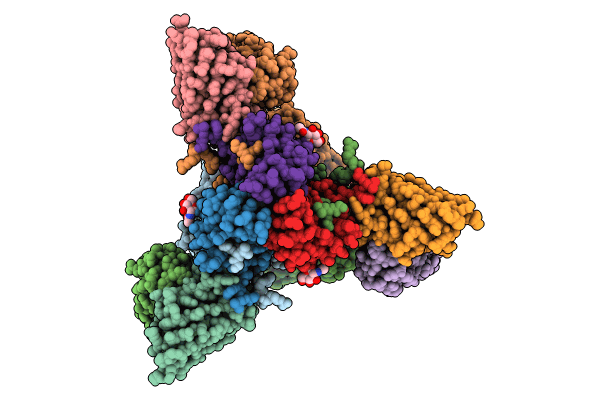
9BU8 image
Deposition Date 2024-05-16
Release Date 2024-11-27
Last Version Date 2025-01-22
Entry Detail
PDB ID:
9BU8
Title:
Vaccine elicited Fab c115.131 with influenza H10 JD13 HA trimer
Biological Source:
Source Organism:
Influenza A virus (Taxon ID: 11320)
Homo sapiens (Taxon ID: 9606)
Host Organism:
Method Details:
Experimental Method:
Resolution:
3.96 Å
Aggregation State:
PARTICLE
Reconstruction Method:
SINGLE PARTICLE

Macromolecular Entities
Structures with similar UniProt ID
Protein Blast
Polymer Type:polypeptide(L)
Molecule:Hemagglutinin HA1
Gene (Uniprot):HA
Chain IDs:A, E, J
Chain Length:325
Number of Molecules:3
Biological Source:Influenza A virus
Structures with similar UniProt ID
Protein Blast
Polymer Type:polypeptide(L)
Molecule:Hemagglutinin HA2
Gene (Uniprot):HA
Chain IDs:B, G, L
Chain Length:230
Number of Molecules:3
Biological Source:Influenza A virus
Polymer Type:polypeptide(L)
Molecule:Fab c115.131 heavy chain
Chain IDs:C, F, I
Chain Length:121
Number of Molecules:3
Biological Source:Homo sapiens
Polymer Type:polypeptide(L)
Molecule:Fab c115.131 light chain
Chain IDs:D, H, K
Chain Length:107
Number of Molecules:3
Biological Source:Homo sapiens
Ligand Molecules
Primary Citation
Vaccination with different group 2 influenza subtypes alters epitope targeting and breadth of hemagglutinin stem-specific human B cells.
Sci Transl Med 17 eadr8373 eadr8373 (2025)
PMID: 39742506 DOI: 10.1126/scitranslmed.adr8373

Abstact

The conserved influenza hemagglutinin stem, which is a target of cross-neutralizing antibodies, is now used in vaccine strategies focused on protecting against influenza pandemics. Antibody responses to group 1 stem have been extensively characterized, but little is known about group 2. Here, we characterized the stem-specific repertoire of individuals vaccinated with one of three group 2 influenza subtypes (H3, H7, or H10). Epitope mapping revealed two epitope supersites on the group 2 stem. Antibodies targeting the central epitope were broadly cross-reactive, whereas antibodies targeting the lower epitope had narrower breadth but higher potency against H3 subtypes. The ratio of B cells targeting each of the supersites varied with the vaccine subtype, leading to differences in the cross-reactivity of the B cell response. Our findings suggest that vaccine strategies targeting both group 2 stem epitopes would be complementary, eliciting broader and more potent protection against both seasonal and pandemic influenza strains.

Legend

Protein

Chemical

Disease

Primary Citation of related structures
Feedback Form
Name
Email
Institute
Feedback