9BNR image
Deposition Date 2024-05-02
Release Date 2024-07-24
Last Version Date 2024-11-20
Entry Detail
PDB ID:
9BNR
Keywords:
Title:
4-(2-isothiocyanatoethyl)benzenesulfonamide complexed with Macrophage Migration Inhibitory Factor
Biological Source:
Source Organism:
Homo sapiens (Taxon ID: 9606)
Method Details:
Experimental Method:
Resolution:
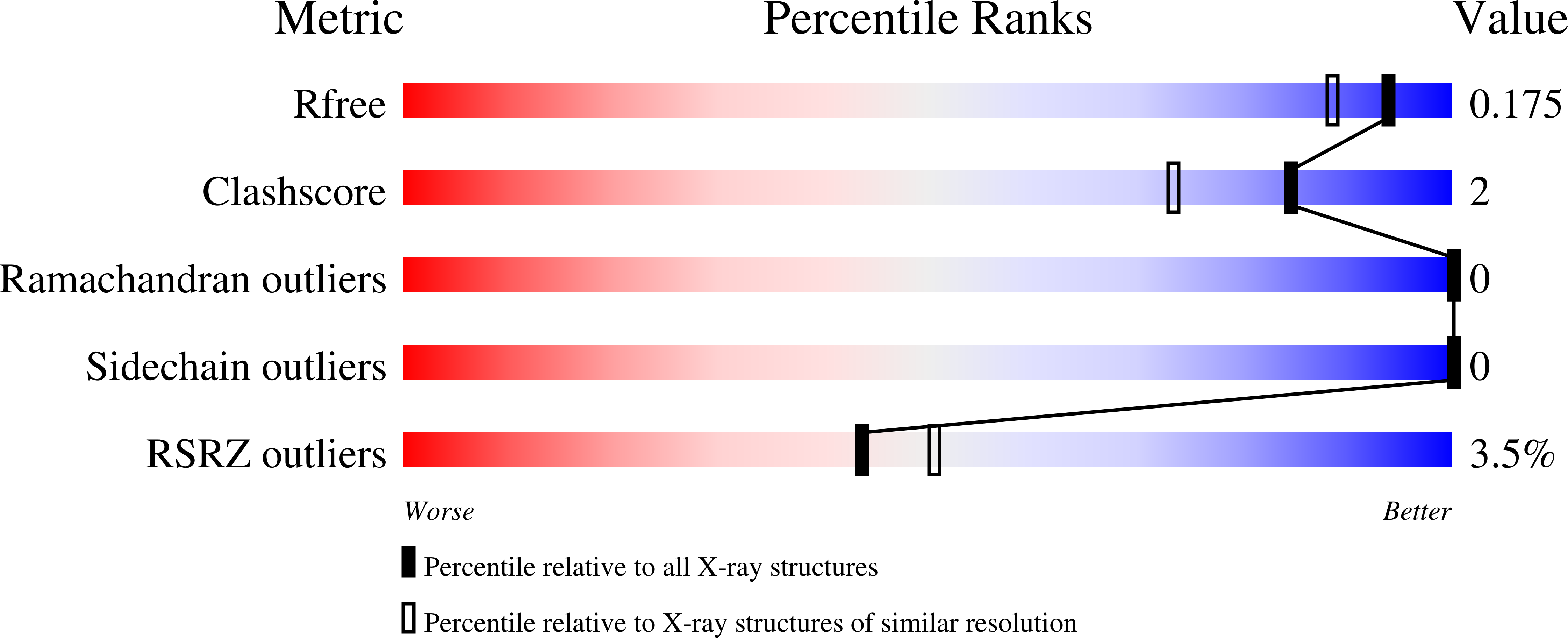
1.53 Å
R-Value Free:
0.17
R-Value Work:
0.16
R-Value Observed:
0.16
Space Group:
P 31 2 1
Macromolecular Entities
Structures with similar UniProt ID
Protein Blast
Polymer Type:polypeptide(L)
Molecule:Macrophage migration inhibitory factor
Gene (Uniprot):MIF
Chain IDs:A, B, C
Chain Length:114
Number of Molecules:3
Biological Source:Homo sapiens
Primary Citation
Covalent Isothiocyanate Inhibitors of Macrophage Migration Inhibitory Factor as Potential Colorectal Cancer Treatments.
Chemmedchem 19 e202400394 e202400394 (2024)
PMID: 38977403 DOI: 10.1002/cmdc.202400394

Abstact

Macrophage migration inhibitory factor (MIF) is a proinflammatory cytokine that has roles in innate and adaptive human immune responses, as well as inflammation. MIF exerts its biological activity by binding to the cell surface receptor CD74 as well as intracellular signalling proteins. MIF also possesses keto-enol tautomerase activity. Inhibition of the tautomerase activity has been associated with loss of biological activity of MIF and a potential anticancer target. Isothiocyanates (ITCs) are a class of compounds present in cruciferous vegetables that inhibit the MIF tautomerase activity via covalent modification of the N-terminal proline. A range of substituted ITCs featuring benzyl, phenethyl and phenyl propyl isothiocyanates were designed, synthesised and tested to determine any structure activity relationship for inhibiting MIF. Crystal structures of covalent compounds 8 and 9 in complex with rhMIF revealed key hydrogen bonding and edge-to-face π stacking interactions. Compound 9 and 11 with sub micromolar activity were tested in the NCI60 cancer cell lines panel. Both compounds showed tissue-specific reduced growth in colon and renal cancer cell lines, while one of these showed potent, dose-dependent inhibition of growth against all seven colon cancer cell lines (GI50<2.5 μM) and all eight renal cancer cell lines (GI50<2.2 μM).

Legend

Protein

Chemical

Disease

Primary Citation of related structures
Feedback Form
Name
Email
Institute
Feedback