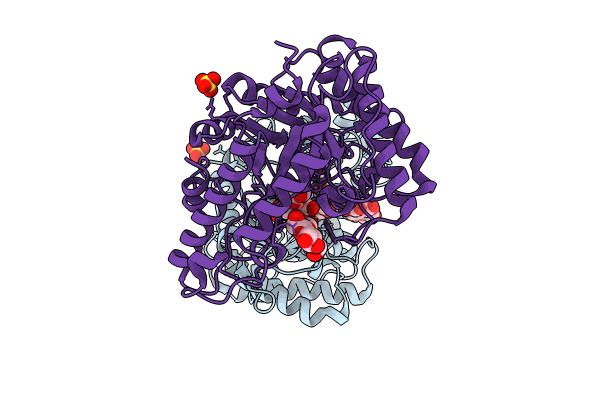
9BMK image
Deposition Date 2024-05-02
Release Date 2024-10-09
Last Version Date 2024-10-09
Entry Detail
PDB ID:
9BMK
Keywords:
Title:
GH5_4 endo-beta(1,3/1,4)-glucanase E331A from Segatella copri in complex with cellotriose
Biological Source:
Source Organism:
Host Organism:
Method Details:
Experimental Method:
Resolution:
2.21 Å
R-Value Free:
0.24
R-Value Work:
0.22
R-Value Observed:
0.22
Space Group:
P 32 2 1
Macromolecular Entities
Structures with similar UniProt ID
Protein Blast
Polymer Type:polypeptide(L)
Molecule:Cellulase (Glycosyl hydrolase family 5)
Gene (Uniprot):PREVCOP_05101
Mutagens:E331A
Chain IDs:A, B
Chain Length:366
Number of Molecules:2
Biological Source:Segatella copri DSM 18205
Ligand Molecules
Peptide-like Molecules
PRD_900021
Primary Citation
The molecular basis of cereal mixed-linkage beta-glucan utilization by the human gut bacterium Segatella copri.
J.Biol.Chem. 300 107625 107625 (2024)
PMID: 39122003 DOI: 10.1016/j.jbc.2024.107625

Abstact

Mixed-linkage β(1,3)/β(1,4)-glucan (MLG) is abundant in the human diet through the ingestion of cereal grains and is widely associated with healthful effects on metabolism and cholesterol levels. MLG is also a major source of fermentable glucose for the human gut microbiota (HGM). Bacteria from the family Prevotellaceae are highly represented in the HGM of individuals who eat plant-rich diets, including certain indigenous people and vegetarians in postindustrial societies. Here, we have defined and functionally characterized an exemplar Prevotellaceae MLG polysaccharide utilization locus (MLG-PUL) in the type-strain Segatella copri (syn. Prevotella copri) DSM 18205 through transcriptomic, biochemical, and structural biological approaches. In particular, structure-function analysis of the cell-surface glycan-binding proteins and glycoside hydrolases of the S. copri MLG-PUL revealed the molecular basis for glycan capture and saccharification. Notably, syntenic MLG-PULs from human gut, human oral, and ruminant gut Prevotellaceae are distinguished from their counterparts in Bacteroidaceae by the presence of a β(1,3)-specific endo-glucanase from glycoside hydrolase family 5, subfamily 4 (GH5_4) that initiates MLG backbone cleavage. The definition of a family of homologous MLG-PULs in individual species enabled a survey of nearly 2000 human fecal microbiomes using these genes as molecular markers, which revealed global population-specific distributions of Bacteroidaceae- and Prevotellaceae-mediated MLG utilization. Altogether, the data presented here provide new insight into the molecular basis of β-glucan metabolism in the HGM, as a basis for informing the development of approaches to improve the nutrition and health of humans and other animals.

Legend

Protein

Chemical

Disease

Primary Citation of related structures
Feedback Form
Name
Email
Institute
Feedback