8ZMD image
Deposition Date 2024-05-23
Release Date 2025-05-28
Last Version Date 2025-12-10
Entry Detail
PDB ID:
8ZMD
Title:
Protease-activated receptor-2 (PAR2)/Gq complex
Biological Source:
Source Organism:
Homo sapiens (Taxon ID: 9606)
Host Organism:
Method Details:
Experimental Method:
Resolution:
3.25 Å
Aggregation State:
PARTICLE
Reconstruction Method:
SINGLE PARTICLE
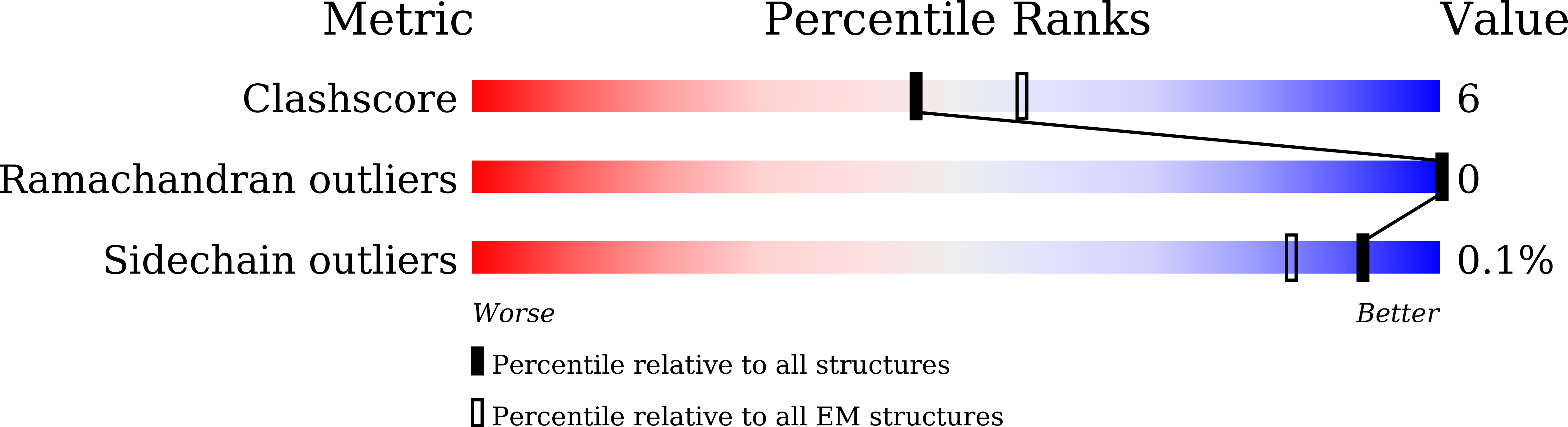
Macromolecular Entities
Polymer Type:polypeptide(L)
Molecule:engineered G alpha q
Chain IDs:A
Chain Length:362
Number of Molecules:1
Biological Source:Homo sapiens
Structures with similar UniProt ID
Protein Blast
Polymer Type:polypeptide(L)
Molecule:Guanine nucleotide-binding protein G(I)/G(S)/G(T) subunit beta-1
Gene (Uniprot):GNB1
Chain IDs:B
Chain Length:345
Number of Molecules:1
Biological Source:Homo sapiens
Structures with similar UniProt ID
Protein Blast
Polymer Type:polypeptide(L)
Molecule:Guanine nucleotide-binding protein G(I)/G(S)/G(O) subunit gamma-2
Gene (Uniprot):GNG2
Chain IDs:C (auth: G)
Chain Length:71
Number of Molecules:1
Biological Source:Homo sapiens
Structures with similar UniProt ID
Protein Blast
Polymer Type:polypeptide(L)
Molecule:Proteinase-activated receptor 2
Gene (Uniprot):F2RL1
Chain IDs:D (auth: R)
Chain Length:397
Number of Molecules:1
Biological Source:Homo sapiens
Ligand Molecules
Primary Citation
Structural basis of protease-activated receptor 2 activation and biased agonism.
Cell Discov 11 96 96 (2025)
PMID: 41330898 DOI: 10.1038/s41421-025-00851-8

Abstact

Protease-activated receptor 2 (PAR2) is a transmembrane receptor that is irreversibly activated by proteolytic cleavage of its N-terminus via extracellular proteases, resulting in the release of the tethered ligand (TL), which binds to and activates the receptor. PAR2 plays a pivotal role in the inflammatory response and pain sensation and is a promising drug target for treating arthritis, asthma, and neuronal pain. Here, we present the cryo-electron microscopy structures of active PAR2 complexed with miniGs/q and miniG13. Combining functional assays with structural analysis, our study revealed that TL forms a parallel β-sheet with the extracellular loop 2 of PAR2 to engage the receptor. The binding of TL triggers a conformational rearrangement in the transmembrane core, releasing the inhibitory ion lock and allowing receptor activation. Furthermore, we provide structural insights into the engagement of Gq and G13 with PAR2, highlighting that a hydrophobic interaction mediated by the last methionine residue of Gα13 is crucial for G13 coupling selectivity. In combination with molecular dynamics simulations and mutagenesis, we identified the I39TL3/D62N-term interaction at the pocket side of the receptor as a key determinant of G13 signaling. Disrupting this interaction significantly inhibits G13 signaling while preserving Gq activity, enabling us to design a biased peptide ligand that selectively activates Gq signaling. The information revealed in this study provides a framework for understanding PAR2 signaling and offers a rational basis for the design of biased PAR2 ligands.

Legend

Protein

Chemical

Disease

Primary Citation of related structures
Feedback Form
Name
Email
Institute
Feedback