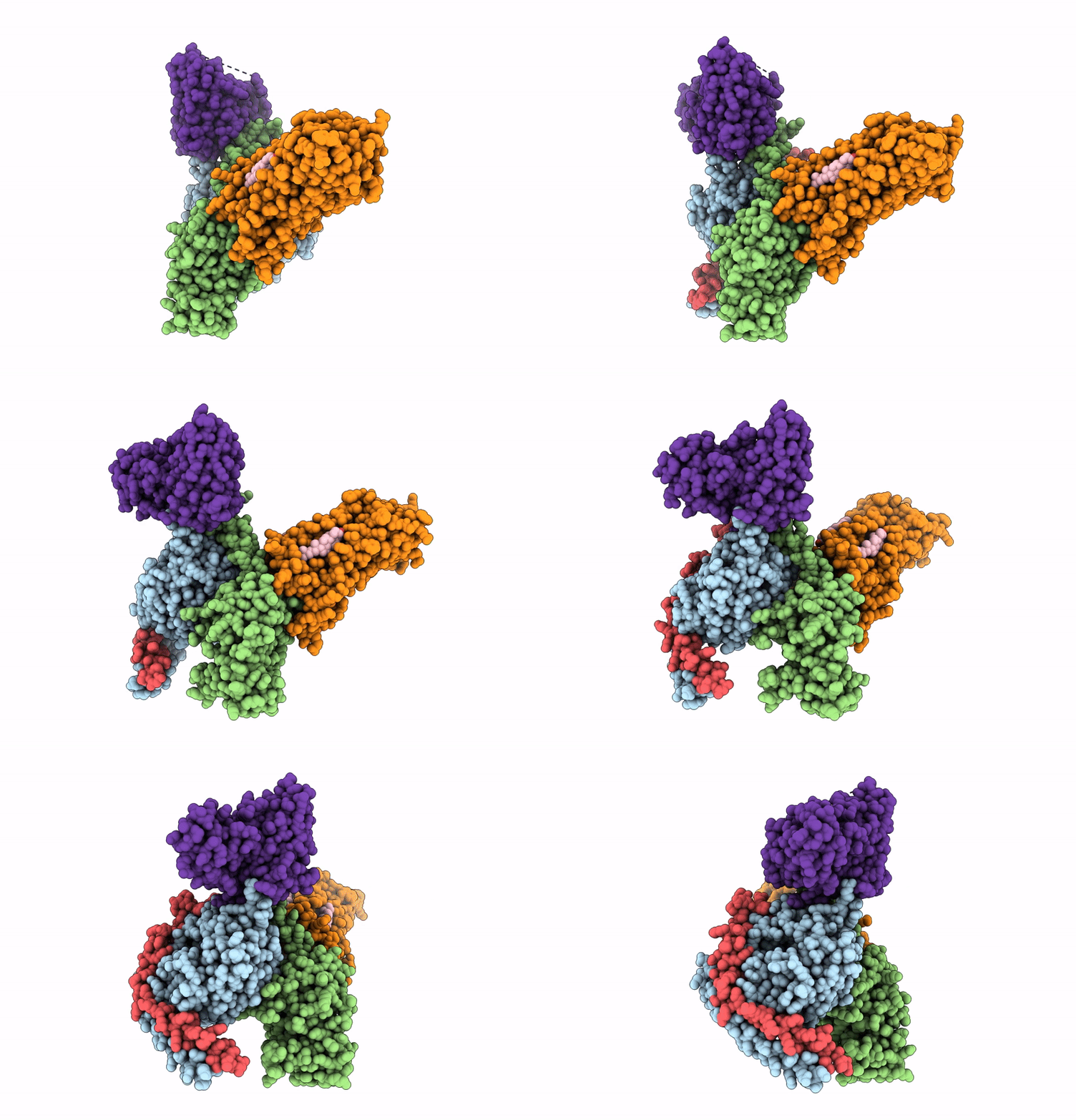
8Z9P image
Deposition Date 2024-04-23
Release Date 2025-07-09
Last Version Date 2026-01-14
Entry Detail
PDB ID:
8Z9P
Title:
Cryo-EM structure of human GPR4-Gi complex
Biological Source:
Source Organism(s):
Rattus norvegicus (Taxon ID: 10116)
Bos taurus (Taxon ID: 9913)
Homo sapiens (Taxon ID: 9606)
synthetic construct (Taxon ID: 32630)
Method Details:
Experimental Method:
Resolution:
2.50 Å
Aggregation State:
PARTICLE
Reconstruction Method:
SINGLE PARTICLE

Macromolecular Entities
Structures with similar UniProt ID
Protein Blast
Polymer Type:polypeptide(L)
Molecule:Guanine nucleotide-binding protein G(I)/G(S)/G(T) subunit beta-1
Gene (Uniprot):Gnb1
Chain IDs:A (auth: B)
Chain Length:345
Number of Molecules:1
Biological Source:Rattus norvegicus
Structures with similar UniProt ID
Protein Blast
Polymer Type:polypeptide(L)
Molecule:Guanine nucleotide-binding protein G(i) subunit alpha-1
Gene (Uniprot):GNAI1
Mutagens:S47N,G203A,E245A,A326S
Chain IDs:D (auth: C)
Chain Length:354
Number of Molecules:1
Biological Source:Homo sapiens
Structures with similar UniProt ID
Protein Blast
Polymer Type:polypeptide(L)
Molecule:Guanine nucleotide-binding protein G(I)/G(S)/G(O) subunit gamma-2
Gene (Uniprot):GNG2
Chain IDs:B (auth: G)
Chain Length:70
Number of Molecules:1
Biological Source:Bos taurus
Structures with similar UniProt ID
Protein Blast
Polymer Type:polypeptide(L)
Molecule:G-protein coupled receptor 4
Gene (Uniprot):GPR4
Chain IDs:C (auth: R)
Chain Length:303
Number of Molecules:1
Biological Source:Homo sapiens
Polymer Type:polypeptide(L)
Molecule:single Fab chain (svFv16)
Chain IDs:E (auth: S)
Chain Length:250
Number of Molecules:1
Biological Source:synthetic construct
Ligand Molecules
Primary Citation
Proton perception and activation of a proton-sensing GPCR.
Mol.Cell 85 1640 1657.e8 (2025)
PMID: 40215960 DOI: 10.1016/j.molcel.2025.02.030

Abstact

Maintaining pH at cellular, tissular, and systemic levels is essential for human health. Proton-sensing GPCRs regulate physiological and pathological processes by sensing the extracellular acidity. However, the molecular mechanism of proton sensing and activation of these receptors remains elusive. Here, we present cryoelectron microscopy (cryo-EM) structures of human GPR4, a prototypical proton-sensing GPCR, in its inactive and active states. Our studies reveal that three extracellular histidine residues are crucial for proton sensing of human GPR4. The binding of protons induces substantial conformational changes in GPR4's ECLs, particularly in ECL2, which transforms from a helix-loop to a β-turn-β configuration. This transformation leads to the rearrangements of H-bond network and hydrophobic packing, relayed by non-canonical motifs to accommodate G proteins. Furthermore, the antagonist NE52-QQ57 hinders human GPR4 activation by preventing hydrophobic stacking rearrangement. Our findings provide a molecular framework for understanding the activation mechanism of a human proton-sensing GPCR, aiding future drug discovery.

Legend

Protein

Chemical

Disease

Primary Citation of related structures
Feedback Form
Name
Email
Institute
Feedback