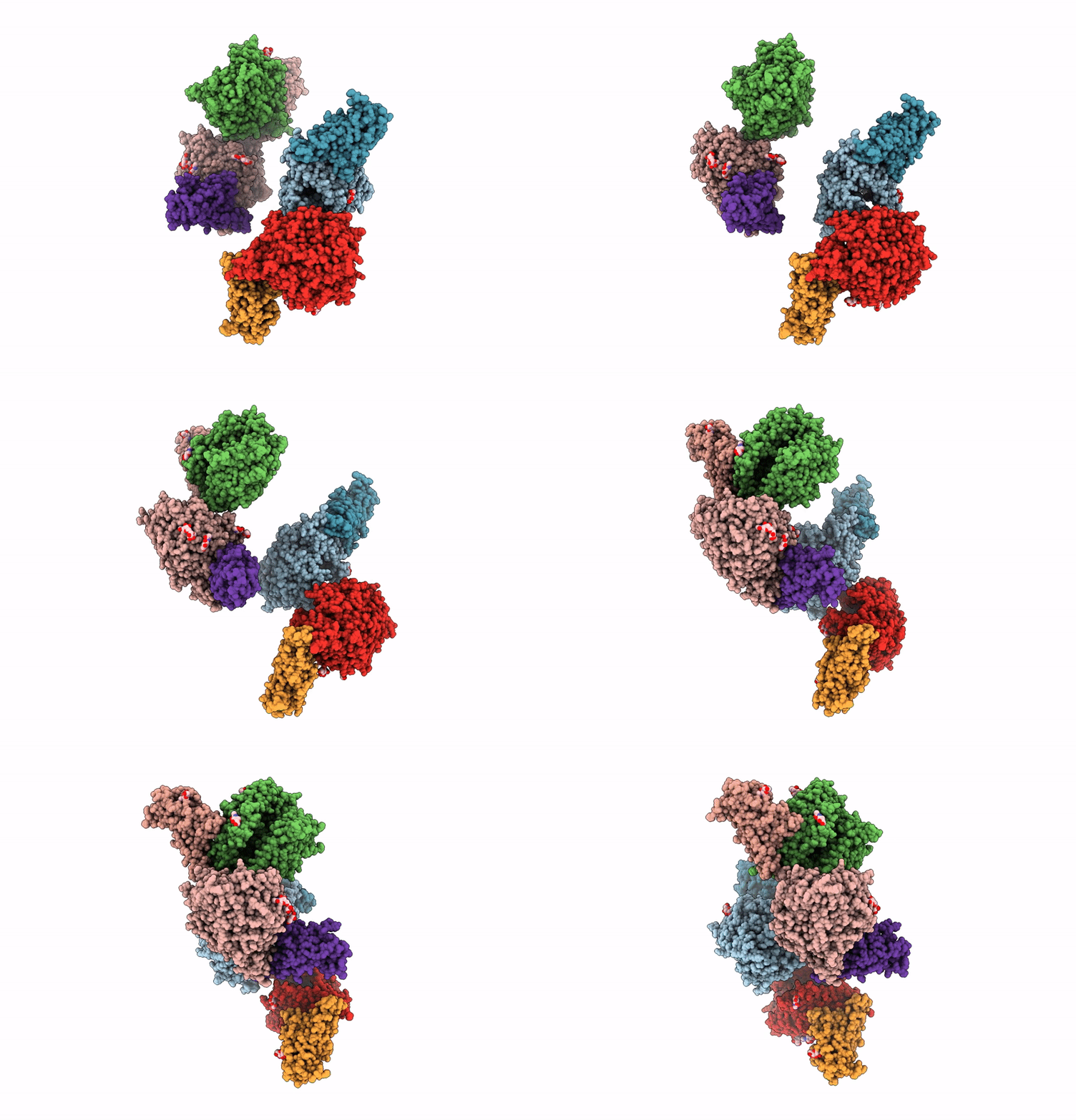
8Z9L image
Deposition Date 2024-04-23
Release Date 2025-04-30
Last Version Date 2025-05-14
Entry Detail
PDB ID:
8Z9L
Title:
Crystal structure of SARS-CoV-2 RBD bound to Rhinolophus affinis ACE2
Biological Source:
Method Details:
Experimental Method:
Resolution:
3.60 Å
R-Value Free:
0.27
R-Value Work:
0.24
R-Value Observed:
0.24
Space Group:
P 21 21 21

Macromolecular Entities
Structures with similar UniProt ID
Protein Blast
Polymer Type:polypeptide(L)
Molecule:Angiotensin-converting enzyme
Chain IDs:A (auth: B), C (auth: I), E (auth: O), G (auth: U)
Chain Length:598
Number of Molecules:4
Biological Source:Rhinolophus affinis
Structures with similar UniProt ID
Protein Blast
Polymer Type:polypeptide(L)
Molecule:Spike protein S1
Gene (Uniprot):S
Chain IDs:B (auth: F), D (auth: L), F (auth: R), H (auth: X)
Chain Length:197
Number of Molecules:4
Biological Source:Severe acute respiratory syndrome coronavirus 2
Ligand Molecules
Primary Citation
Molecular mechanisms of RaTG13 and SARS-CoV-2 RBD bound to Rhinolophus affinis bat ACE2.
Protein Sci. 34 e70117 e70117 (2025)
PMID: 40260962 DOI: 10.1002/pro.70117

Abstact

The discovery of the RaTG13 coronavirus in Rhinolophus affinis bats in 2013, sharing 96.3% genome homology with severe acute respiratory syndrome coronavirus 2 (SARS-CoV-2), suggested bats as the origin of SARS-CoV-2. Although both human angiotensin-converting enzyme 2 (hACE2) and Rhinolophus affinis bat ACE2 (bACE2-Ra, seven polymorphic variants named 01-07) are known to serve as entry receptors for these coronaviruses, the binding mechanism of RaTG13 receptor binding domain (RBD) bound to bACE2-Ra remains poorly understood. Here, we found that RaTG13 RBD bound to bACE2-Ra-07 with a weaker affinity (2.42 μM) compared with SARS-CoV-2 RBD (372 nM). Additional glycosylation at residue N370 of RaTG13 had little influence on bACE2-Ra-07 binding by RaTG13 RBD. Crystal structures of the SARS-CoV-2 and RaTG13 N370Q RBD bound to bACE2-Ra-07 were solved. Interface analysis and surface plasmon resonance (SPR) assay indicated that residue substitutions at 493, 498, 501, and 505 may play a more important role in the cross-species recognition of bACE2-Ra-07 by the SARS-CoV-2 RBD. Besides, the N370Q mutation enhanced the binding affinity between the RBD of pangolin coronavirus isolated from Guangxi (PCoV-GX) and the bACE2-Ra-07 receptor by over 10-fold. Furthermore, the recently prevalent SARS-CoV-2 variant RBDs extensively retained the interaction with the bACE2-Ra-07 receptor. Our findings give new lights on the cross-species evolution of SARS-CoV-2 and prompt the urgency to monitor the circulation of coronaviruses in bats to better prevent future spillover.

Legend

Protein

Chemical

Disease

Primary Citation of related structures
Feedback Form
Name
Email
Institute
Feedback