8Z62 image
Deposition Date 2024-04-18
Release Date 2024-10-16
Last Version Date 2024-10-16
Entry Detail
PDB ID:
8Z62
Keywords:
Title:
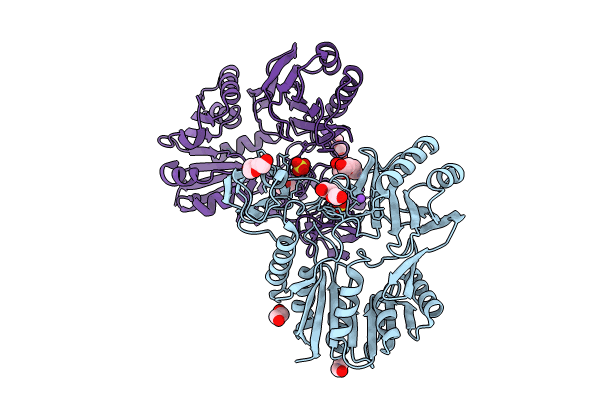
Crystal structure of rRNA (uracil-C5)-methyltransferase from Pyrococcus horikoshii OT3
Biological Source:
Source Organism:
Method Details:
Experimental Method:
Resolution:
3.20 Å
R-Value Free:
0.23
R-Value Work:
0.16
R-Value Observed:
0.17
Space Group:
P 21 21 21

Macromolecular Entities
Structures with similar UniProt ID
Protein Blast
Polymer Type:polypeptide(L)
Molecule:23S rRNA (uracil(747)-C(5))-methyltransferase
Gene (Uniprot):PH1259
Chain IDs:A, B
Chain Length:412
Number of Molecules:2
Biological Source:Pyrococcus horikoshii OT3
Primary Citation
Decoding Substrate Selectivity of an Archaeal RlmCD-like Methyltransferase Through Its Salient Traits.
Biochemistry 63 2477 2492 (2024)
PMID: 39350642 DOI: 10.1021/acs.biochem.4c00401

Abstact

5-Methyluridine (m5U) rRNA modifications frequently occur at U747 and U1939 (Escherichia coli numbering) in domains II and IV of the 23S rRNA in Gram-negative bacteria, with the help of S-adenosyl-l-methionine (SAM)-dependent rRNA methyltransferases (MTases), RlmC and RlmD, respectively. In contrast, Gram-positive bacteria utilize a single SAM-dependent rRNA MTase, RlmCD, to modify both corresponding sites. Notably, certain archaea, specifically within the Thermococcales group, have been found to possess two genes encoding SAM-dependent archaeal (tRNA and rRNA) m5U (Arm5U) MTases. Among these, a tRNA-specific Arm5U MTase (PabTrmU54) has already been characterized. This study focused on the structural and functional characterization of the rRNA-specific Arm5U MTase from the hyperthermophilic archaeon Pyrococcus horikoshii (PhRlmCD). An in-depth structural examination revealed a dynamic hinge movement induced by the replacement of the iron-sulfur cluster with disulfide bonds, obstructing the substrate-binding site. It revealed distinctive characteristics of PhRlmCD, including elongated positively charged loops in the central domain and rotational variations in the TRAM domain, which influence substrate selectivity. Additionally, the results suggested that two potential mini-rRNA fragments interact in a similar manner with PhRlmCD at a positively charged cleft at the interface of domains and facilitate dual MTase activities akin to the protein RlmCD. Altogether, these observations showed that Arm5U MTases originated from horizontal gene transfer events, most likely from Gram-positive bacteria.

Legend

Protein

Chemical

Disease

Primary Citation of related structures
Feedback Form
Name
Email
Institute
Feedback