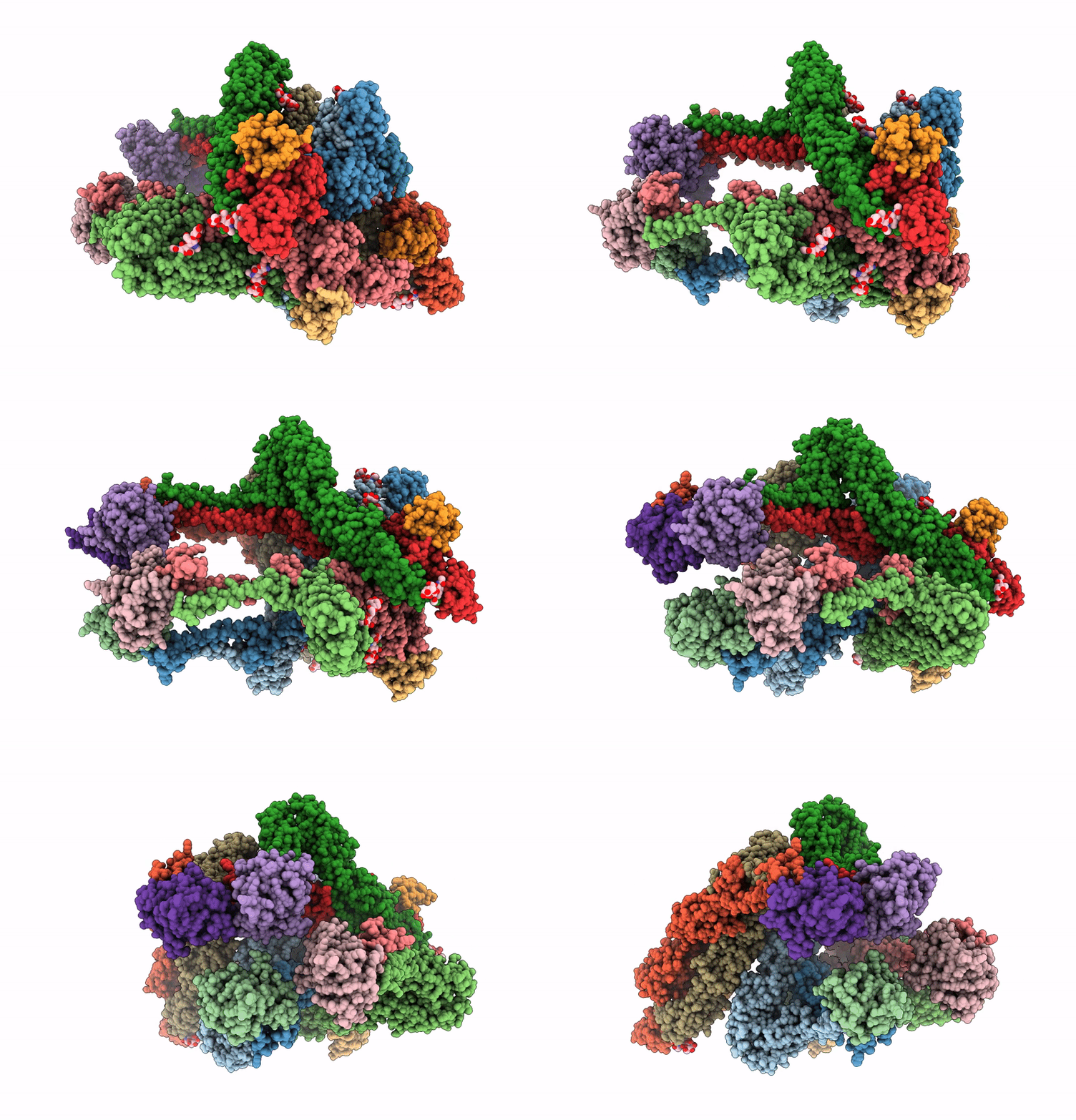
8YVY image
Deposition Date 2024-03-29
Release Date 2024-12-11
Last Version Date 2026-01-28
Entry Detail
PDB ID:
8YVY
Keywords:
Title:
Semliki Forest virus virion
Biological Source:
Source Organism(s):
Method Details:
Experimental Method:
Resolution:
3.02 Å
Aggregation State:
PARTICLE
Reconstruction Method:
SINGLE PARTICLE
Macromolecular Entities
Structures with similar UniProt ID
Protein Blast
Polymer Type:polypeptide(L)
Molecule:Spike glycoprotein E1
Chain IDs:A, E (auth: F), F (auth: G), G (auth: H)
Chain Length:438
Number of Molecules:4
Biological Source:Semliki Forest virus 4
Structures with similar UniProt ID
Protein Blast
Polymer Type:polypeptide(L)
Molecule:Spike glycoprotein E2
Chain IDs:B, H (auth: I), I (auth: J), J (auth: K)
Chain Length:418
Number of Molecules:4
Biological Source:Semliki Forest virus 4
Structures with similar UniProt ID
Protein Blast
Polymer Type:polypeptide(L)
Molecule:Spike glycoprotein E3
Chain IDs:C, K (auth: L), L (auth: M), M (auth: N)
Chain Length:52
Number of Molecules:4
Biological Source:Semliki Forest virus 4
Structures with similar UniProt ID
Protein Blast
Polymer Type:polypeptide(L)
Molecule:capsid protein
Chain IDs:D, N (auth: O), O (auth: P), P (auth: Q)
Chain Length:161
Number of Molecules:4
Biological Source:Semliki Forest virus 4
Ligand Molecules
Primary Citation
Structural insights into Semiliki forest virus receptor binding modes indicate novel mechanism of virus endocytosis.
Plos Pathog. 20 e1012770 e1012770 (2024)
PMID: 39705215 DOI: 10.1371/journal.ppat.1012770

Abstact

The Very Low-Density Lipoprotein Receptor (VLDLR) is an entry receptor for the prototypic alphavirus Semliki Forest Virus (SFV). However, the precise mechanisms underlying the entry of SFV into cells mediated by VLDLR remain unclear. In this study, we found that of the eight class A (LA) repeats of the VLDLR, only LA2, LA3, and LA5 specifically bind to the native SFV virion while synergistically promoting SFV cell attachment and entry. Furthermore, the multiple cryo-electron microscopy structures of VLDLR-SFV complexes and mutagenesis studies have demonstrated that under physiological conditions, VLDLR primarily binds to E1-DIII of site-1, site-2, and site-1' at the twofold symmetry axes of SFV virion through LA2, LA3, and LA5, respectively. These findings unveil a novel mechanism for viral entry mediated by receptors, suggesting that conformational transitions in VLDLR induced by multivalent binding of LAs facilitate cellular internalization of SFV, with significant implications for the design of antiviral therapeutics.

Legend

Protein

Chemical

Disease

Primary Citation of related structures
Feedback Form
Name
Email
Institute
Feedback