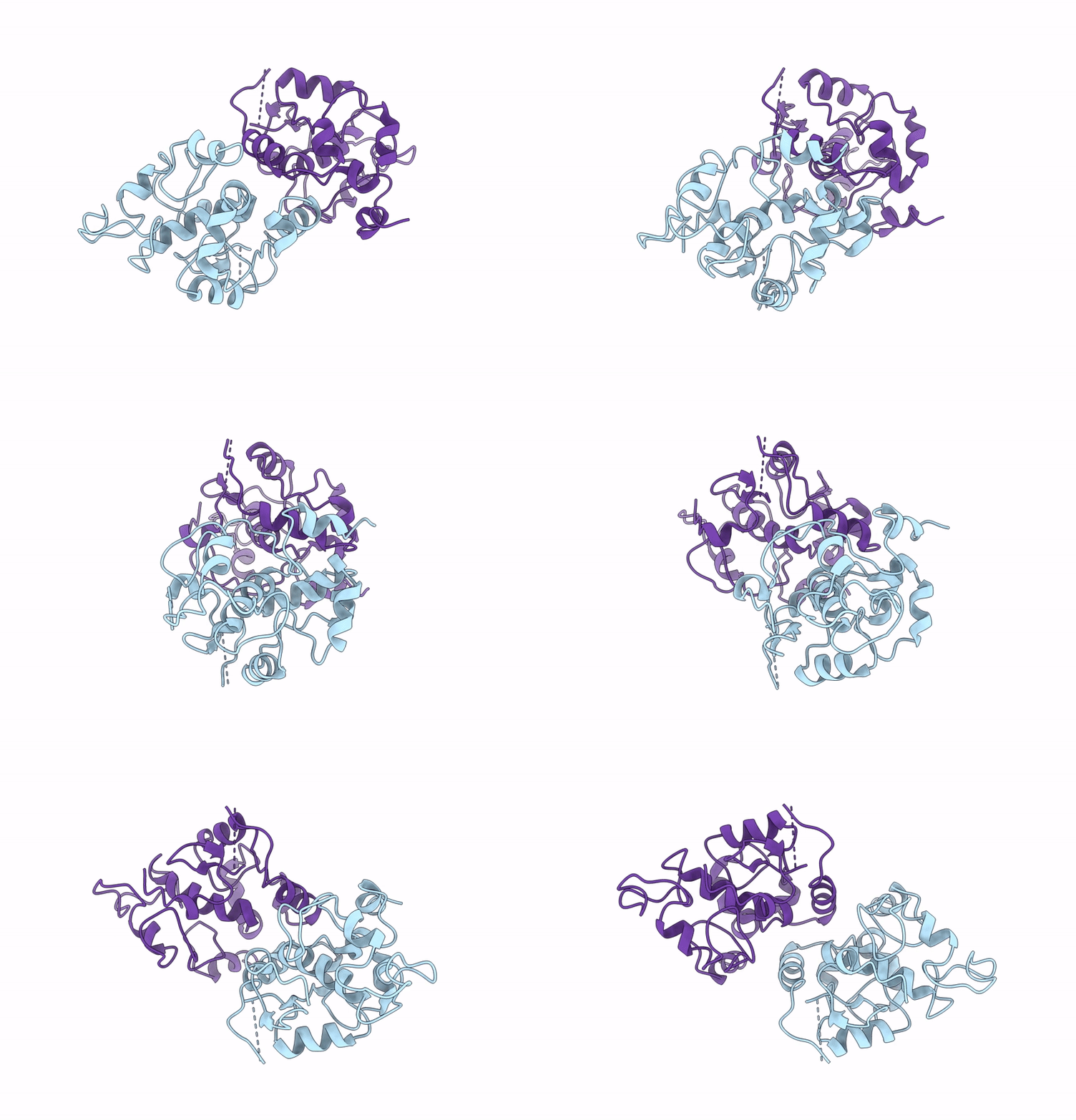
8YTC image
Deposition Date 2024-03-25
Release Date 2025-02-26
Last Version Date 2025-07-02
Entry Detail
PDB ID:
8YTC
Keywords:
Title:
PML-RBCC dimer
Biological Source:
Source Organism:
Homo sapiens (Taxon ID: 9606)
Host Organism:
Method Details:
Experimental Method:
Resolution:
5.30 Å
Aggregation State:
PARTICLE
Reconstruction Method:
SINGLE PARTICLE
Macromolecular Entities
Structures with similar UniProt ID
Protein Blast
Polymer Type:polypeptide(L)
Molecule:Protein PML
Gene (Uniprot):PML
Chain IDs:A, B
Chain Length:211
Number of Molecules:2
Biological Source:Homo sapiens
Ligand Molecules
Primary Citation
Cryo-EM structure of PML RBCC dimer reveals CC-mediated octopus-like nuclear body assembly mechanism.
Cell Discov 10 118 118 (2024)
PMID: 39587079 DOI: 10.1038/s41421-024-00735-3

Abstact

Promyelocytic leukemia protein (PML) nuclear bodies (NBs) are essential in regulating tumor suppression, antiviral response, inflammation, metabolism, aging, and other important life processes. The re-assembly of PML NBs might lead to an ~100% cure of acute promyelocytic leukemia. However, until now, the molecular mechanism underpinning PML NB biogenesis remains elusive due to the lack of structural information. In this study, we present the cryo-electron microscopy (cryo-EM) structure of the PML dimer at an overall resolution of 5.3 Å, encompassing the RING, B-box1/2 and part of the coiled-coil (RBCC) domains. The integrated approach, combining crosslinking and mass spectrometry (XL-MS) and functional analyses, enabled us to observe a unique folding event within the RBCC domains. The RING and B-box1/2 domains fold around the α3 helix, and the α6 helix serves as a pivotal interface for PML dimerization. More importantly, further characterizations of the cryo-EM structure in conjugation with AlphaFold2 prediction, XL-MS, and NB formation assays, help unveil an unprecedented octopus-like mechanism in NB assembly, wherein each CC helix of a PML dimer (PML dimer A) interacts with a CC helix from a neighboring PML dimer (PML dimer B) in an anti-parallel configuration, ultimately leading to the formation of a 2 µm membrane-less subcellular organelle.

Legend

Protein

Chemical

Disease

Primary Citation of related structures
Feedback Form
Name
Email
Institute
Feedback