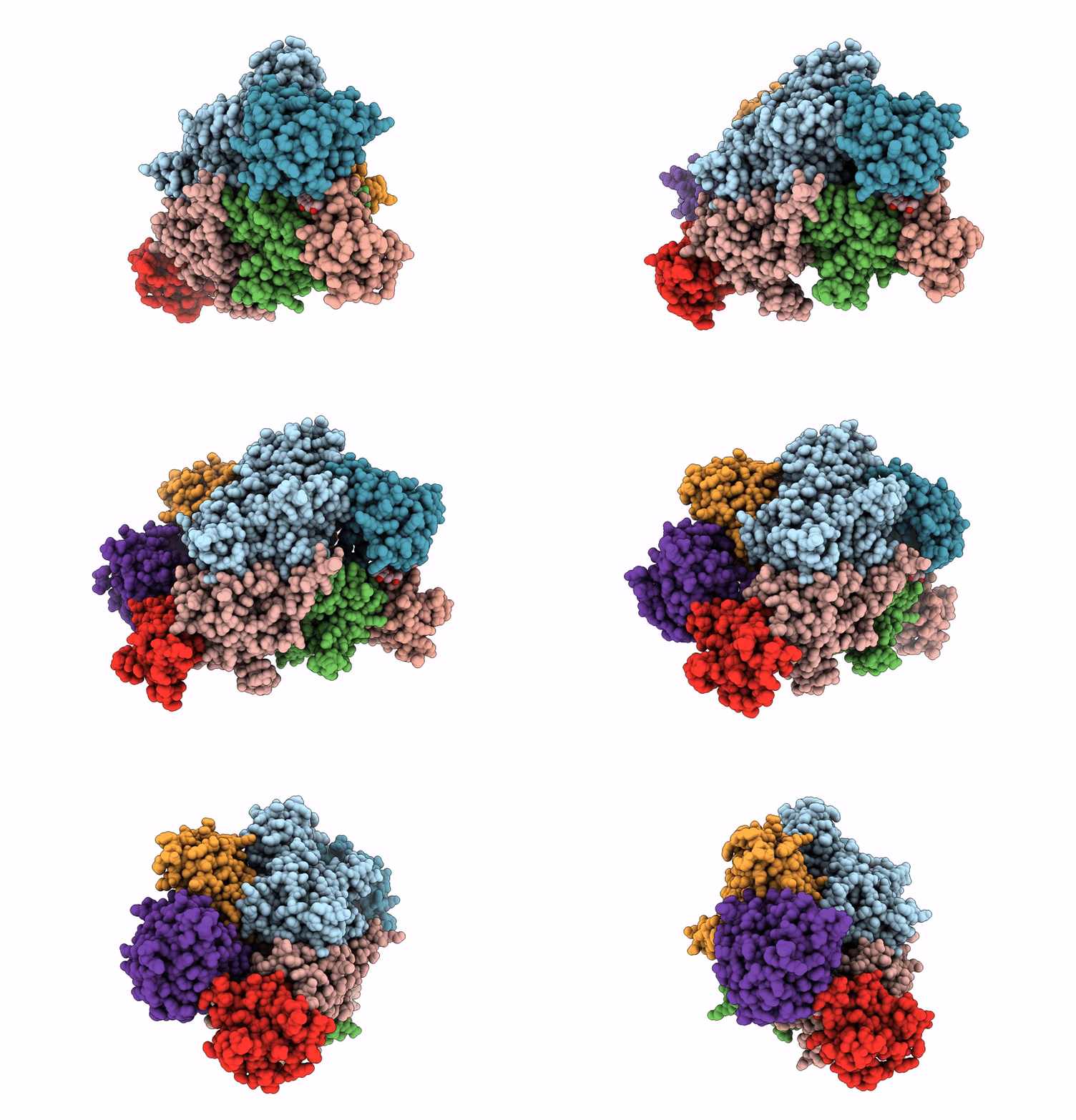
8YS6 image
Deposition Date 2024-03-22
Release Date 2025-07-02
Last Version Date 2026-01-21
Entry Detail
PDB ID:
8YS6
Keywords:
Title:
Helicobacter pylori OorDABC in complex with Napabucasin
Biological Source:
Source Organism(s):
Expression System(s):
Method Details:
Experimental Method:
Resolution:
3.03 Å
Aggregation State:
PARTICLE
Reconstruction Method:
SINGLE PARTICLE

Macromolecular Entities
Polymer Type:polypeptide(L)
Molecule:2-oxoglutarate synthase subunit alpha
Chain IDs:B (auth: A), F (auth: G)
Chain Length:375
Number of Molecules:2
Biological Source:Helicobacter pylori
Polymer Type:polypeptide(L)
Molecule:2-oxoglutarate:acceptor oxidoreductase
Chain IDs:D (auth: B), H (auth: I)
Chain Length:186
Number of Molecules:2
Biological Source:Helicobacter pylori
Structures with similar UniProt ID
Protein Blast
Polymer Type:polypeptide(L)
Molecule:2-oxoglutarate ferredoxin oxidoreductase subunit beta
Gene (Uniprot):korB
Chain IDs:C, G (auth: H)
Chain Length:273
Number of Molecules:2
Biological Source:Helicobacter pylori
Polymer Type:polypeptide(L)
Molecule:2-oxoglutarate:acceptor oxidoreductase
Chain IDs:A (auth: D), E (auth: F)
Chain Length:113
Number of Molecules:2
Biological Source:Helicobacter pylori
Primary Citation
2-oxoglutarate:acceptor oxidoreductase-catalyzed redox cycling effectively targets coccoid forms of Helicobacter pylori.
Nat Commun 16 6965 6965 (2025)
PMID: 40730563 DOI: 10.1038/s41467-025-62477-4

Abstact

Helicobacter pylori, a globally significant pathogen, plays a central etiological role in diverse gastric pathologies ranging from chronic gastritis and peptic ulcers to gastric adenocarcinoma. Although conventional antibiotics effectively inhibit or kill growing helical H. pylori, metabolically dormant coccoid forms of H. pylori exhibit considerable tolerance, posing a persistent and clinically significant challenge. Here, we report napabucasin (2-acetylfuro-1,4-naphthoquinone) as a redox-cycling antibiotic with potent bactericidal activity against both drug-resistant helical and coccoid forms of H. pylori. Notably, napabucasin does not induce acquired resistance in vitro and demonstrates superior efficacy compared to standard triple therapy in murine infection models. Mechanistic studies reveal that napabucasin acts through 2-oxoglutarate:acceptor oxidoreductase (OOR)-catalyzed futile redox cycling, generating bactericidal levels of reactive oxygen species (ROS). Compared to menaquinone 6, a proposed physiological electron acceptor, napabucasin exhibits enhanced oxidative capacity. Structural, biochemical, and microbiological analyses identify Leu44 and Lys46 within the OorD subunit as critical residues for napabucasin recognition and catalysis. These findings establish OOR-mediated redox cycling as a robust antimicrobial strategy that sustains endogenous ROS production to combat refractory H. pylori infections.

Legend

Protein

Chemical

Disease

Primary Citation of related structures
Feedback Form
Name
Email
Institute
Feedback