8YKI image
Deposition Date 2024-03-05
Release Date 2024-06-12
Last Version Date 2024-06-12
Entry Detail
PDB ID:
8YKI
Keywords:
Title:
FGFR-1 in complex with ligand tasurgratinib
Biological Source:
Source Organism:
Homo sapiens (Taxon ID: 9606)
Host Organism:
Method Details:
Experimental Method:
Resolution:
2.79 Å
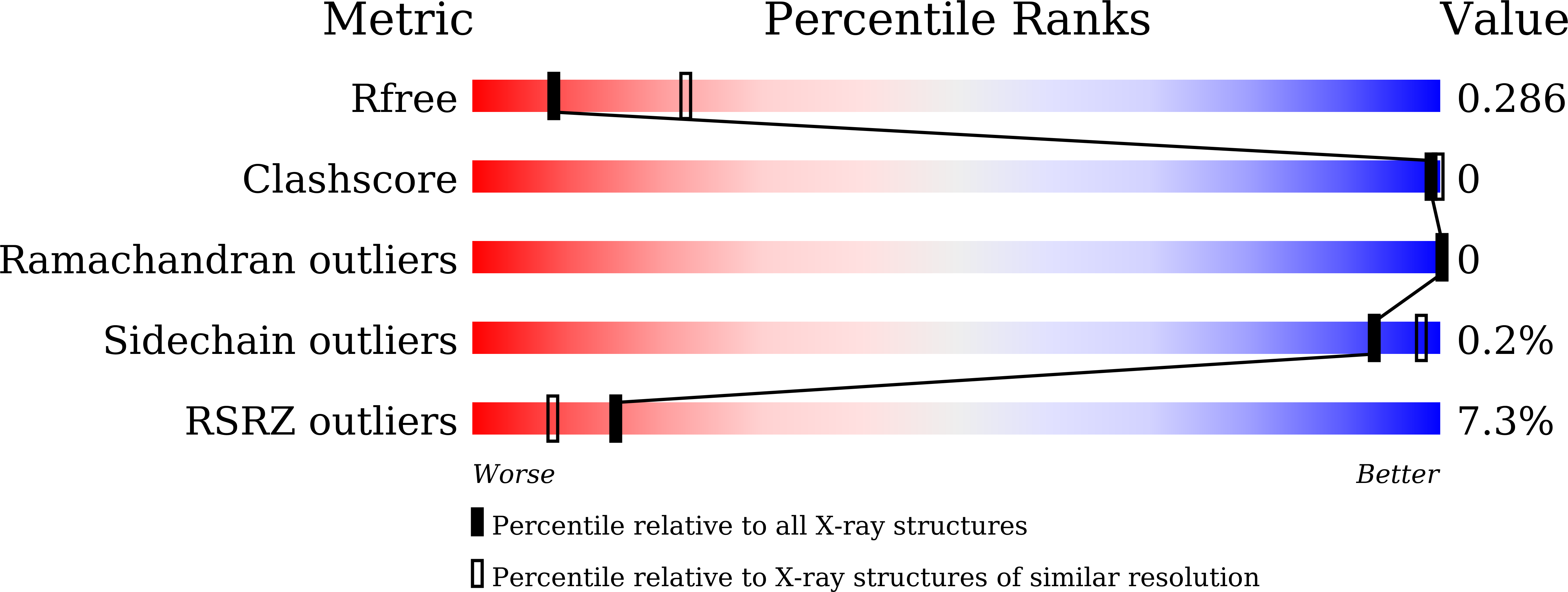
R-Value Free:
0.28
R-Value Work:
0.24
R-Value Observed:
0.24
Space Group:
C 1 2 1
Macromolecular Entities
Structures with similar UniProt ID
Protein Blast
Polymer Type:polypeptide(L)
Molecule:Fibroblast growth factor receptor 1
Gene (Uniprot):FGFR1
Mutagens:C488A
Chain IDs:A, B
Chain Length:317
Number of Molecules:2
Biological Source:Homo sapiens
Primary Citation
Antitumor Activity of Tasurgratinib as an Orally Available FGFR1-3 Inhibitor in Cholangiocarcinoma Models With FGFR2-fusion.
Anticancer Res. 44 2393 2406 (2024)
PMID: 38821585 DOI: 10.21873/anticanres.17046

Abstact

BACKGROUND/AIM Cholangiocarcinoma (CCA) is an aggressive tumor with limited treatment options especially in 2nd line or later treatments. Targeting fibroblast growth factor receptor (FGFR) 2 has recently emerged as a promising treatment option for patients with CCA harboring FGFR2-fusion. This study investigated the antitumor activities of tasurgratinib as an orally available FGFR1-3 inhibitor, in preclinical FGFR2-driven CCA models. MATERIALS AND METHODS Antitumor activities of tasurgratinib were examined in vitro and in vivo using NIH/3T3 cells expressing FGFR2-fusion as FGFR2-driven CCA models, and in vivo using a CCA patient-derived xenograft model. The molecular mechanism of action of tasurgratinib was elucidated through co-crystal structure analysis with FGFR1, manual complex model analysis with FGFR2, and binding kinetics analysis with FGFR2. Furthermore, the cell-based inhibitory activities against acquired resistant FGFR2 mutations in patients with CCA treated with FGFR inhibitors were evaluated. RESULTS Tasurgratinib showed antitumor activity in preclinical FGFR2-driven CCA models by inhibiting the FGFR signaling pathway in vitro and in vivo. Furthermore, cell-based target engagement assays indicated that tasurgratinib had potent inhibitory activities against FGFR2 mutations, such as N549H/K, which are the major acquired mutations in CCA. We also confirmed that tasurgratinib exhibited fast association and slow dissociation kinetics with FGFR2, binding to the ATP-binding site and the neighboring region, and adopting an Asp-Phe-Gly (DFG)-"in" conformation. CONCLUSION These data demonstrate the therapeutic potential of tasurgratinib in FGFR2-driven CCA and provide molecular mechanistic insights into its unique inhibitory profile against secondary FGFR2 resistance mutations in patients with CCA treated with FGFR inhibitors.

Legend

Protein

Chemical

Disease

Primary Citation of related structures
Feedback Form
Name
Email
Institute
Feedback