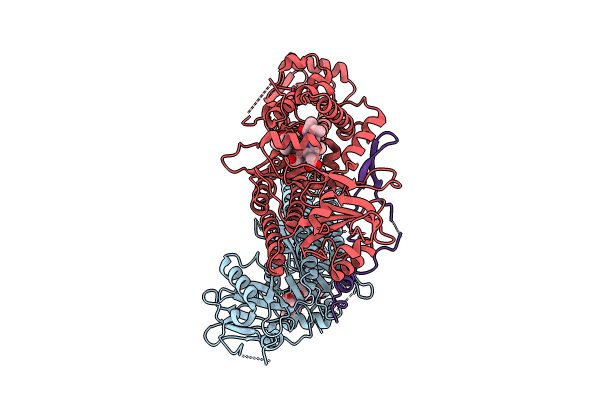
8YB4 image
Deposition Date 2024-02-11
Release Date 2024-10-02
Last Version Date 2024-11-20
Entry Detail
PDB ID:
8YB4
Keywords:
Title:
Pfr conformer of Arabidopsis thaliana phytochrome B in complex with phytochrome-interacting factor 6
Biological Source:
Source Organism:
Host Organism:
Method Details:
Experimental Method:
Resolution:
3.10 Å
Aggregation State:
PARTICLE
Reconstruction Method:
SINGLE PARTICLE

Macromolecular Entities
Structures with similar UniProt ID
Protein Blast
Polymer Type:polypeptide(L)
Molecule:phytochrome B
Gene (Uniprot):PHYB
Chain IDs:A (auth: B), B (auth: A)
Chain Length:1177
Number of Molecules:2
Biological Source:Arabidopsis thaliana
Structures with similar UniProt ID
Protein Blast
Polymer Type:polypeptide(L)
Molecule:phytochrome-interacting factor 6
Gene (Uniprot):PIF6
Chain IDs:C
Chain Length:105
Number of Molecules:1
Biological Source:Arabidopsis thaliana
Ligand Molecules
Primary Citation
Light-induced remodeling of phytochrome B enables signal transduction by phytochrome-interacting factor.
Cell 187 6235 6250.e19 (2024)
PMID: 39317197 DOI: 10.1016/j.cell.2024.09.005

Abstact

Phytochrome B (phyB) and phytochrome-interacting factors (PIFs) constitute a well-established signaling module critical for plants adapting to ambient light. However, mechanisms underlying phyB photoactivation and PIF binding for signal transduction remain elusive. Here, we report the cryo-electron microscopy (cryo-EM) structures of the photoactivated phyB or the constitutively active phyBY276H mutant in complex with PIF6, revealing a similar trimer. The light-induced configuration switch of the chromophore drives a conformational transition of the nearby tongue signature within the phytochrome-specific (PHY) domain of phyB. The resulting α-helical PHY tongue further disrupts the head-to-tail dimer of phyB in the dark-adapted state. These structural remodelings of phyB facilitate the induced-fit recognition of PIF6, consequently stabilizing the N-terminal extension domain and a head-to-head dimer of activated phyB. Interestingly, the phyB dimer exhibits slight asymmetry, resulting in the binding of only one PIF6 molecule. Overall, our findings solve a key question with respect to how light-induced remodeling of phyB enables PIF signaling in phytochrome research.

Legend

Protein

Chemical

Disease

Primary Citation of related structures
Feedback Form
Name
Email
Institute
Feedback