8Y1V image
Deposition Date 2024-01-25
Release Date 2025-01-22
Last Version Date 2026-02-04
Entry Detail
PDB ID:
8Y1V
Title:
Structure of GluN1b-GluN2D NMDA receptor in complex with competitive antagonist R-CPP and allosteric inhibitor YY-23
Biological Source:
Source Organism(s):
Homo sapiens (Taxon ID: 9606)
Expression System(s):
Method Details:
Experimental Method:
Resolution:
4.20 Å
Aggregation State:
PARTICLE
Reconstruction Method:
SINGLE PARTICLE
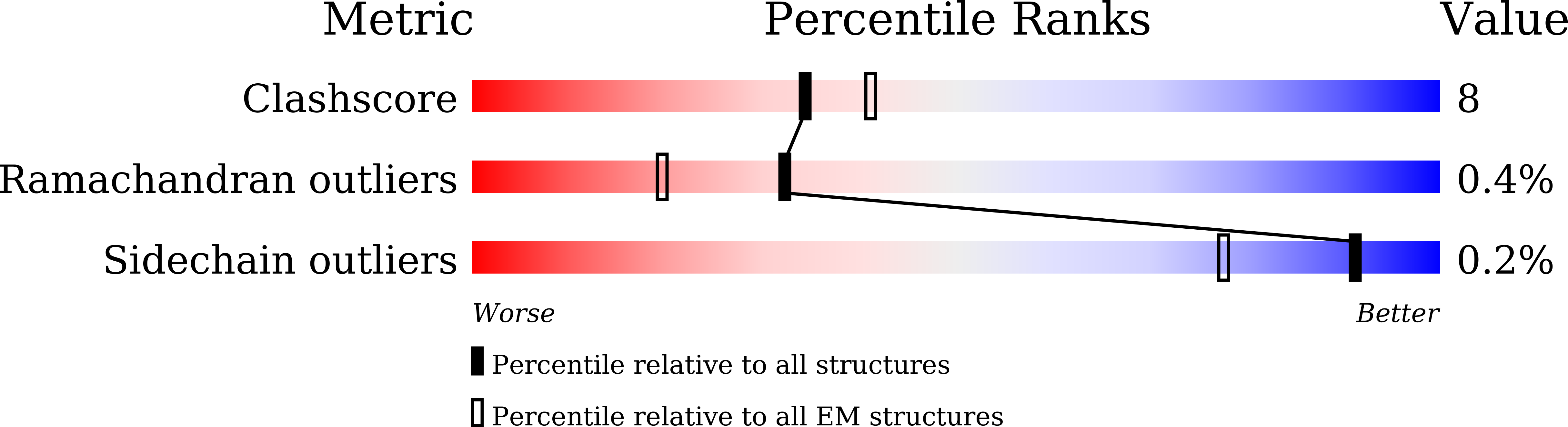
Macromolecular Entities
Structures with similar UniProt ID
Protein Blast
Polymer Type:polypeptide(L)
Molecule:Isoform 6 of Glutamate receptor ionotropic, NMDA 1
Gene (Uniprot):GRIN1
Chain IDs:A, C
Chain Length:868
Number of Molecules:2
Biological Source:Homo sapiens
Structures with similar UniProt ID
Protein Blast
Polymer Type:polypeptide(L)
Molecule:Glutamate receptor ionotropic, NMDA 2D
Gene (Uniprot):GRIN2D
Chain IDs:B, D
Chain Length:911
Number of Molecules:2
Biological Source:Homo sapiens
Primary Citation
An antidepressant mechanism underlying the allosteric inhibition of GluN2D-incorporated NMDA receptors at GABAergic interneurons.
Sci Adv 11 eadq0444 eadq0444 (2025)
PMID: 40043126 DOI: 10.1126/sciadv.adq0444

Abstact

N-methyl-d-aspartate receptors (NMDARs), key excitatory ion channels, have gained attention as anti-depression targets. NMDARs consist of two GluN1 and two GluN2 subunits (2A-2D), which determine their pharmacological properties. Few compounds selectively targeting GluN2 subunits with antidepressant effects have been identified. Here, we present YY-23, a compound that selectively inhibits GluN2C- or GluN2D-containing NMDARs. Cryo-EM analysis revealed that YY-23 binds to the transmembrane domain of the GluN2D subunit. YY-23 primarily affects GluN2D-containing NMDARs on GABAergic interneurons in the prefrontal cortex, suppressing GABAergic neurotransmission and enhancing excitatory transmission. Behavioral assays demonstrate YY-23's rapid antidepressant effects in both stress-naïve and stress-exposed models, which are lost in mice with global or selective knockout of the grin2d gene in parvalbumin-positive interneurons. These findings highlight GluN2D-containing NMDARs on GABAergic interneurons as potential depression treatment targets.

Legend

Protein

Chemical

Disease

Primary Citation of related structures
Feedback Form
Name
Email
Institute
Feedback