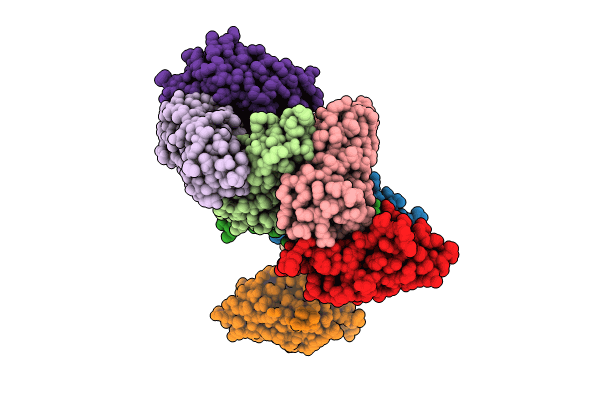
8X7N image
Deposition Date 2023-11-24
Release Date 2024-07-17
Last Version Date 2026-01-28
Entry Detail
PDB ID:
8X7N
Title:
Cell-cell adhesion Nanobody/Antigen Pair
Biological Source:
Method Details:
Experimental Method:
Resolution:
3.67 Å
R-Value Free:
0.28
R-Value Work:
0.25
R-Value Observed:
0.26
Space Group:
P 21 21 21
Macromolecular Entities
Structures with similar UniProt ID
Protein Blast
Polymer Type:polypeptide(L)
Molecule:Conjugative transfer: aggregate stability
Gene (Uniprot):traN
Chain IDs:A, C, E, G, I
Chain Length:135
Number of Molecules:5
Biological Source:Salmonella enterica subsp. enterica serovar Typhimurium str. LT2
Polymer Type:polypeptide(L)
Molecule:Nb-TraN
Chain IDs:B, D, F, H, J
Chain Length:123
Number of Molecules:5
Biological Source:synthetic construct
Ligand Molecules
Primary Citation
A whole-cell platform for discovering synthetic cell adhesion molecules in bacteria.
Nat Commun 15 6568 6568 (2024)
PMID: 39095377 DOI: 10.1038/s41467-024-51017-1

Abstact

Developing programmable bacterial cell-cell adhesion is of significant interest due to its versatile applications. Current methods that rely on presenting cell adhesion molecules (CAMs) on bacterial surfaces are limited by the lack of a generalizable strategy to identify such molecules targeting bacterial membrane proteins in their natural states. Here, we introduce a whole-cell screening platform designed to discover CAMs targeting bacterial membrane proteins within a synthetic bacteria-displayed nanobody library. Leveraging the potency of the bacterial type IV secretion system-a contact-dependent DNA delivery nanomachine-we have established a positive feedback mechanism to selectively enrich for bacteria displaying nanobodies that target antigen-expressing cells. Our platform successfully identified functional CAMs capable of recognizing three distinct outer membrane proteins (TraN, OmpA, OmpC), demonstrating its efficacy in CAM discovery. This approach holds promise for engineering bacterial cell-cell adhesion, such as directing the antibacterial activity of programmed inhibitor cells toward target bacteria in mixed populations.

Legend

Protein

Chemical

Disease

Primary Citation of related structures
Feedback Form
Name
Email
Institute
Feedback