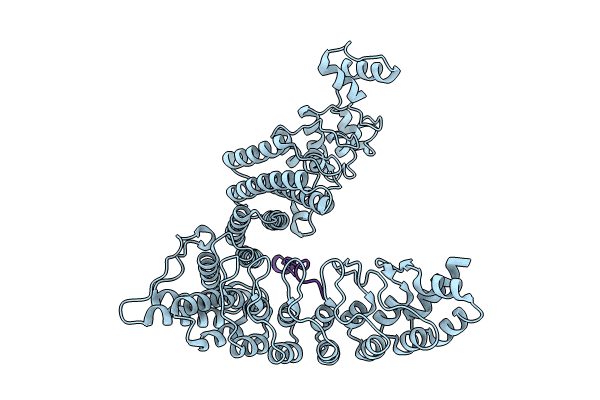
8WQD image
Deposition Date 2023-10-11
Release Date 2024-04-03
Last Version Date 2024-05-08
Entry Detail
PDB ID:
8WQD
Keywords:
Title:
Local refinement of FEM1B bound with the C-degron of CCC89
Biological Source:
Source Organism:
Homo sapiens (Taxon ID: 9606)
Host Organism:
Method Details:
Experimental Method:
Resolution:
3.55 Å
Aggregation State:
PARTICLE
Reconstruction Method:
SINGLE PARTICLE

Macromolecular Entities
Structures with similar UniProt ID
Protein Blast
Polymer Type:polypeptide(L)
Molecule:Protein fem-1 homolog B
Gene (Uniprot):FEM1B
Chain IDs:A (auth: D)
Chain Length:627
Number of Molecules:1
Biological Source:Homo sapiens
Structures with similar UniProt ID
Protein Blast
Polymer Type:polypeptide(L)
Molecule:Coiled-coil domain-containing protein 89
Gene (Uniprot):CCDC89
Chain IDs:B (auth: G)
Chain Length:31
Number of Molecules:1
Biological Source:Homo sapiens
Ligand Molecules
Primary Citation
Mechanism of Psi-Pro/C-degron recognition by the CRL2 FEM1B ubiquitin ligase.
Nat Commun 15 3558 3558 (2024)
PMID: 38670995 DOI: 10.1038/s41467-024-47890-5

Abstact

The E3 ligase-degron interaction determines the specificity of the ubiquitin‒proteasome system. We recently discovered that FEM1B, a substrate receptor of Cullin 2-RING ligase (CRL2), recognizes C-degrons containing a C-terminal proline. By solving several cryo-EM structures of CRL2FEM1B bound to different C-degrons, we elucidate the dimeric assembly of the complex. Furthermore, we reveal distinct dimerization states of unmodified and neddylated CRL2FEM1B to uncover the NEDD8-mediated activation mechanism of CRL2FEM1B. Our research also indicates that, FEM1B utilizes a bipartite mechanism to recognize both the C-terminal proline and an upstream aromatic residue within the substrate. These structural findings, complemented by in vitro ubiquitination and in vivo cell-based assays, demonstrate that CRL2FEM1B-mediated polyubiquitination and subsequent protein turnover depend on both FEM1B-degron interactions and the dimerization state of the E3 ligase complex. Overall, this study deepens our molecular understanding of how Cullin-RING E3 ligase substrate selection mediates protein turnover.

Legend

Protein

Chemical

Disease

Primary Citation of related structures
Feedback Form
Name
Email
Institute
Feedback