8WJB image
Deposition Date 2023-09-25
Release Date 2024-10-02
Last Version Date 2025-04-16
Entry Detail
PDB ID:
8WJB
Keywords:
Title:
Structural insights into the Langya virus attachment glycoprotein
Biological Source:
Source Organism(s):
Henipavirus (Taxon ID: 260964)
Expression System(s):
Method Details:
Experimental Method:
Resolution:
2.75 Å
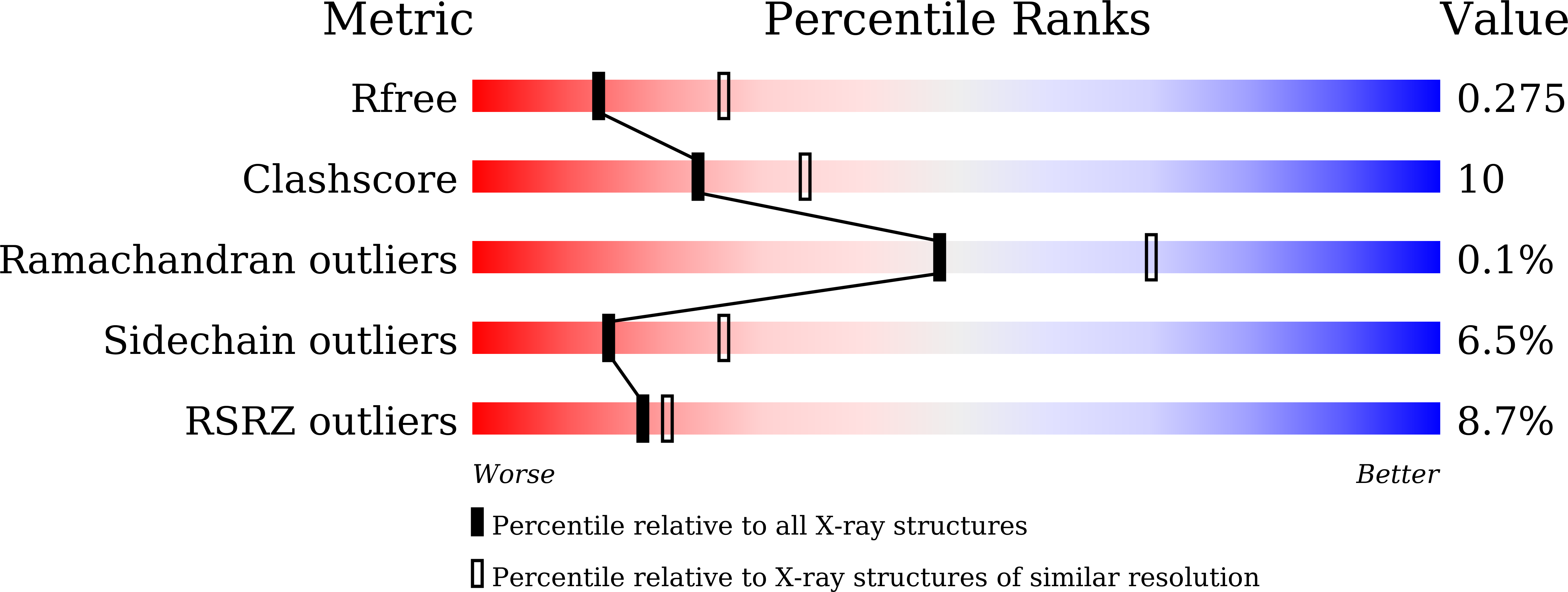
R-Value Free:
0.27
R-Value Work:
0.21
R-Value Observed:
0.21
Space Group:
C 1 2 1
Macromolecular Entities
Structures with similar UniProt ID
Protein Blast
Polymer Type:polypeptide(L)
Molecule:Attachment glycoprotein
Chain IDs:A, B
Chain Length:424
Number of Molecules:2
Biological Source:Henipavirus
Ligand Molecules
Primary Citation
Structural insights into the Langya virus attachment glycoprotein.
Structure 32 1090 1098.e3 (2024)
PMID: 38815575 DOI: 10.1016/j.str.2024.05.003

Abstact

Langya virus (LayV) was recently detected in patients with acute pneumonic diseases in China. Genome alignment indicated that LayV is a type of zoonotic henipavirus (HNV) that might also infect domestic animals. Previous studies revealed that HNVs mainly use ephrin-B1, ephrin-B2, or ephrin-B3 as cell receptors and the attachment glycoprotein (G) is the host cell receptor-binding protein. However, the LayV receptor remains unknown. Here, we present the 2.77 Å crystal structure of the LayV G C-terminal domain (CTD). We show that the LayV G protein CTD possesses a similar architecture as the Mojiang virus (MojV) G protein but is markedly different from the Nipah virus (NiV), Hendra virus (HeV), and Cedar virus (CedV) G proteins. Surface plasmon resonance (SPR) experiments indicate that LayV G does not bind ephrin-B proteins. Steric hindrance may prevent interactions between LayV G and ephrin-B. Our data might facilitate drug development targeting LayV.

Legend

Protein

Chemical

Disease

Primary Citation of related structures
Feedback Form
Name
Email
Institute
Feedback