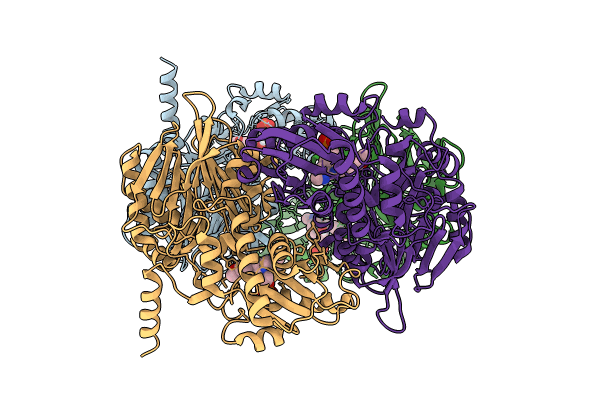
8W7D image
Deposition Date 2023-08-30
Release Date 2023-12-13
Last Version Date 2023-12-27
Entry Detail
PDB ID:
8W7D
Keywords:
Title:
Crystal structure of EcPPAT-FR901483 complex
Biological Source:
Source Organism:
Host Organism:
Method Details:
Experimental Method:
Resolution:
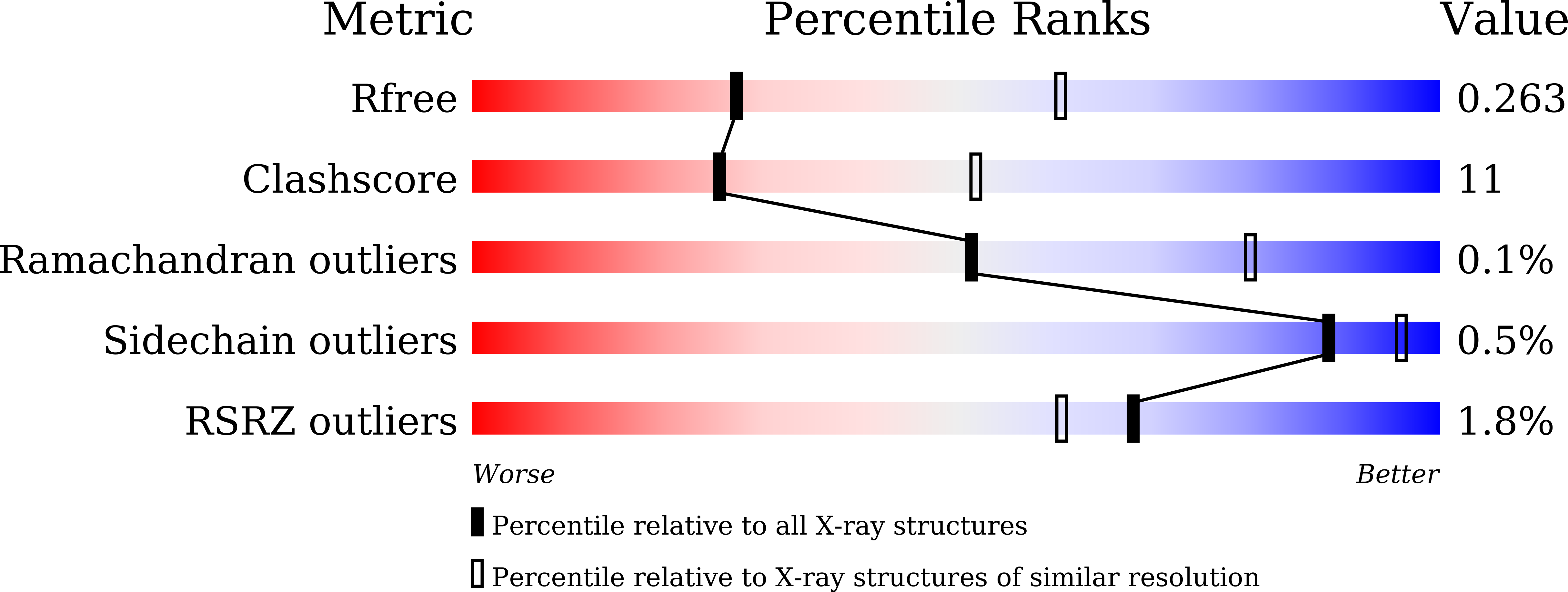
2.81 Å
R-Value Free:
0.26
R-Value Work:
0.20
R-Value Observed:
0.20
Space Group:
P 21 21 2
Macromolecular Entities
Structures with similar UniProt ID
Protein Blast
Polymer Type:polypeptide(L)
Molecule:Amidophosphoribosyltransferase
Gene (Uniprot):purF
Chain IDs:A, B, C, D
Chain Length:516
Number of Molecules:4
Biological Source:Escherichia coli K-12
Ligand Molecules
Primary Citation
Uncommon Arrangement of Self-resistance Allows Biosynthesis of de novo Purine Biosynthesis Inhibitor that Acts as an Immunosuppressor.
J.Am.Chem.Soc. 145 26883 26889 (2023)
PMID: 38051581 DOI: 10.1021/jacs.3c09600

Abstact

(-)-FR901483 (1) isolated from the fungus Cladobotryum sp. No.11231 achieves immunosuppression via nucleic acid biosynthesis inhibition rather than IL-2 production inhibition as accomplished by FK506 and cyclosporin A. Recently, we identified the frz gene cluster for the biosynthesis of 1. It contains frzK, a gene homologous to phosphoribosyl pyrophosphate amidotransferase (PPAT)that catalyzes the initial step of de novo purine biosynthesis. We speculated that frzK encodes a PPAT that escapes inhibition by 1 and functions as a self-resistance enzyme (SRE) for the producing host. Nevertheless, details remained elusive. Here, we report the biochemical and structural analyses of FrzK and its Escherichia coli counterpart, PurF. Recombinantly produced FrzK exhibited PPAT activity, albeit weaker than PurF, but evaded strong inhibition by 1. These results confirmed that the target of 1 is PPAT, and FrzK acts as an SRE by maintaining the de novo purine biosynthetic capability in the presence of 1. To understand how FrzK evades inhibition by 1, we determined the crystal structure of PurF in the complex with 1 and constructed a homology model of FrzK. Sequence and structural analyses of various PPATs identified that many residues unique to FrzK occur near the Flexible Loop that remains disordered when inactive but becomes ordered and covers up the active site upon activation by substrate binding. Kinetic characterizations of mutants of the unique residues revealed that the resistance of FrzK against 1 may be conferred by structurally predisposing the Flexible Loop to the active, closed conformation even in the presence of 1.

Legend

Protein

Chemical

Disease

Primary Citation of related structures
Feedback Form
Name
Email
Institute
Feedback