8VVN image
Deposition Date 2024-01-31
Release Date 2025-02-05
Last Version Date 2025-06-04
Entry Detail
PDB ID:
8VVN
Title:
Cryo-EM structure of a type I ZorAB complex from Shewanella sp. strain ANA-3
Biological Source:
Source Organism:
Host Organism:
Method Details:
Experimental Method:
Resolution:
2.20 Å
Aggregation State:
PARTICLE
Reconstruction Method:
SINGLE PARTICLE
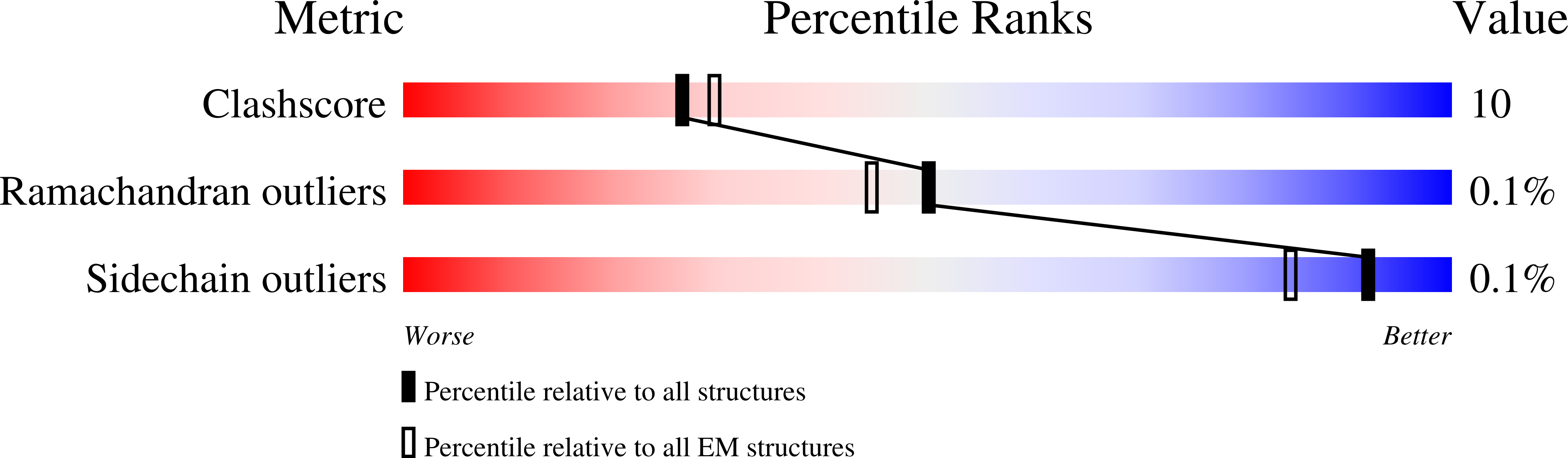
Macromolecular Entities
Structures with similar UniProt ID
Protein Blast
Polymer Type:polypeptide(L)
Molecule:Chemotaxis protein MotB-related protein
Gene (Uniprot):Shewana3_3786
Chain IDs:A (auth: B), B (auth: A)
Chain Length:282
Number of Molecules:2
Biological Source:Shewanella sp. ANA-3
Structures with similar UniProt ID
Protein Blast
Polymer Type:polypeptide(L)
Molecule:MotA/TolQ/ExbB proton channel domain-containing protein
Gene (Uniprot):Shewana3_3785
Chain IDs:C, D, E, F, G
Chain Length:696
Number of Molecules:5
Biological Source:Shewanella sp. ANA-3
Ligand Molecules
Primary Citation
Modularity of Zorya defense systems during phage inhibition.
Nat Commun 16 2344 2344 (2025)
PMID: 40057510 DOI: 10.1038/s41467-025-57397-2

Abstact

Bacteria have evolved an extraordinary diversity of defense systems against bacteriophage (phage) predation. However, the molecular mechanisms underlying these anti-phage systems often remain elusive. Here, we provide mechanistic and structural insights into Zorya phage defense systems. Using cryo-EM structural analyses, we show that the Zorya type I and II core components, ZorA and ZorB, assemble in a 5:2 complex that is similar to inner-membrane ion-driven, rotary motors that power flagellar rotation, type 9 secretion, gliding and the Ton nutrient uptake systems. The ZorAB complex has an elongated cytoplasmic tail assembled by bundling the C-termini of the five ZorA subunits. Mutagenesis demonstrates that peptidoglycan binding by the periplasmic domains of ZorB, the structured cytoplasmic tail of ZorA, and ion flow through the motor is important for function in both type I and II systems. Furthermore, we identify ZorE as the effector module of the Zorya II system, possessing nickase activity. Our work reveals the molecular basis of the activity of Zorya systems and highlights the ZorE nickase as crucial for population-wide immunity in the type II system.

Legend

Protein

Chemical

Disease

Primary Citation of related structures
Feedback Form
Name
Email
Institute
Feedback