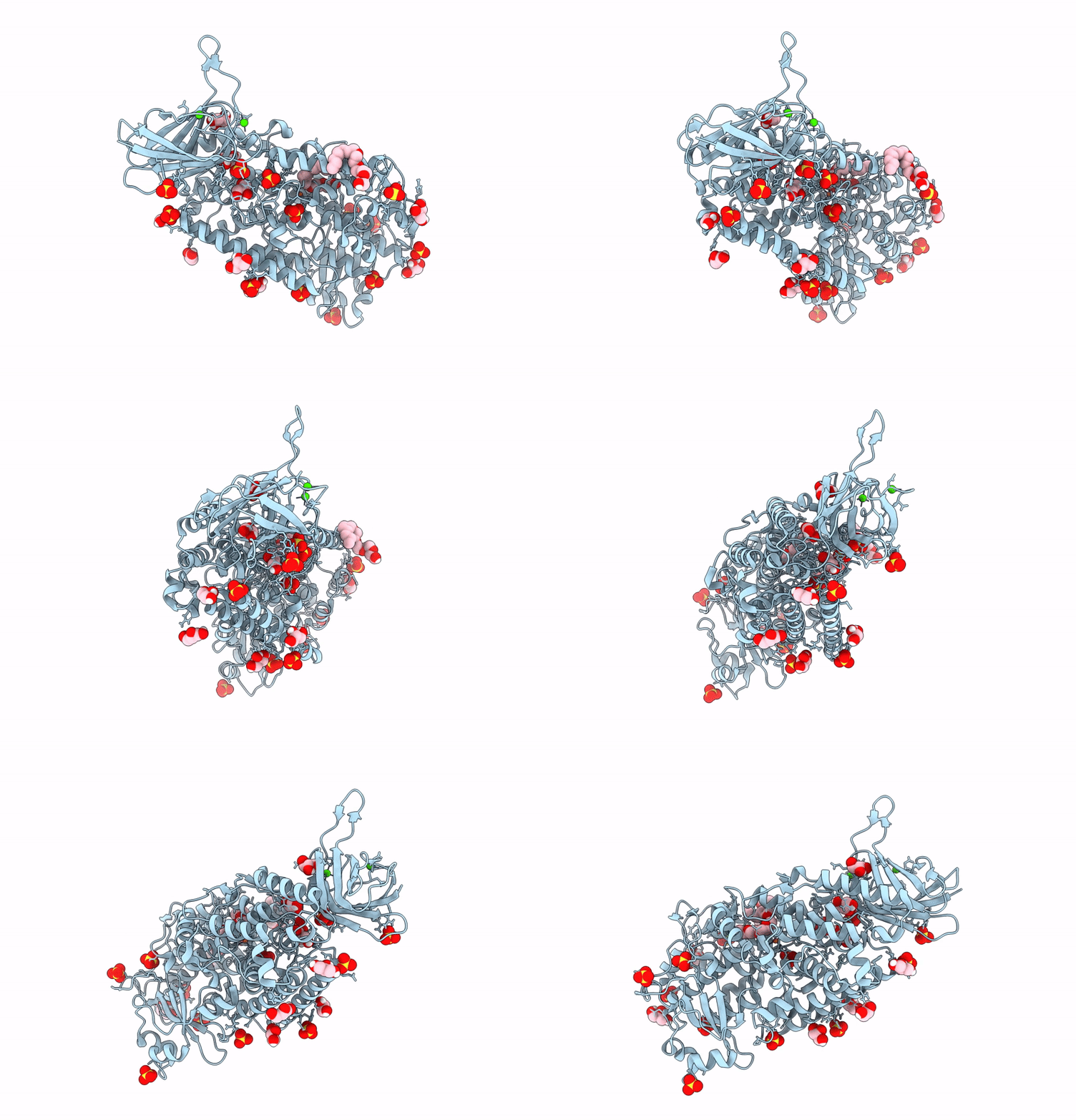
8VIY image
Deposition Date 2024-01-05
Release Date 2024-12-11
Last Version Date 2024-12-11
Entry Detail
PDB ID:
8VIY
Keywords:
Title:
15-Lipoxygenase-2 V427L
Biological Source:
Source Organism:
Homo sapiens (Taxon ID: 9606)
Host Organism:
Method Details:
Experimental Method:
Resolution:
2.34 Å
R-Value Free:
0.22
R-Value Work:
0.18
R-Value Observed:
0.18
Space Group:
H 3 2
Macromolecular Entities
Structures with similar UniProt ID
Protein Blast
Polymer Type:polypeptide(L)
Molecule:Polyunsaturated fatty acid lipoxygenase ALOX15B
Gene (Uniprot):ALOX15B
Mutagens:V427L
Chain IDs:A
Chain Length:696
Number of Molecules:1
Biological Source:Homo sapiens
Primary Citation
Identification of the Thermal Activation Network in Human 15-Lipoxygenase-2: Divergence from Plant Orthologs and Its Relationship to Hydrogen Tunneling Activation Barriers.
Acs Catalysis 14 5444 5457 (2024)
PMID: 38601784 DOI: 10.1021/acscatal.4c00439

Abstact

The oxidation of polyunsaturated fatty acids by lipoxygenases (LOXs) is initiated by a C-H cleavage step in which the hydrogen atom is transferred quantum mechanically (i.e., via tunneling). In these reactions, protein thermal motions facilitate the conversion of ground-state enzyme-substrate complexes to tunneling-ready configurations and are thus important for transferring energy from the solvent to the active site for the activation of catalysis. In this report, we employed temperature-dependent hydrogen-deuterium exchange mass spectrometry (TDHDX-MS) to identify catalytically linked, thermally activated peptides in a representative animal LOX, human epithelial 15-LOX-2. TDHDX-MS of wild-type 15-LOX-2 was compared to two active site mutations that retain structural stability but have increased activation energies (Ea) of catalysis. The Ea value of one variant, V427L, is implicated to arise from suboptimal substrate positioning by increased active-site side chain rotamer dynamics, as determined by X-ray crystallography and ensemble refinement. The resolved thermal network from the comparative Eas of TDHDX-MS between wild-type and V426A is localized along the front face of the 15-LOX-2 catalytic domain. The network contains a clustering of isoleucine, leucine, and valine side chains within the helical peptides. This thermal network of 15-LOX-2 is different in location, area, and backbone structure compared to a model plant lipoxygenase from soybean that exhibits a low Ea value of catalysis compared to the human ortholog. The presented data provide insights into the divergence of thermally activated protein motions in plant and animal LOXs and their relationships to the enthalpic barriers for facilitating hydrogen tunneling.

Legend

Protein

Chemical

Disease

Primary Citation of related structures
Feedback Form
Name
Email
Institute
Feedback