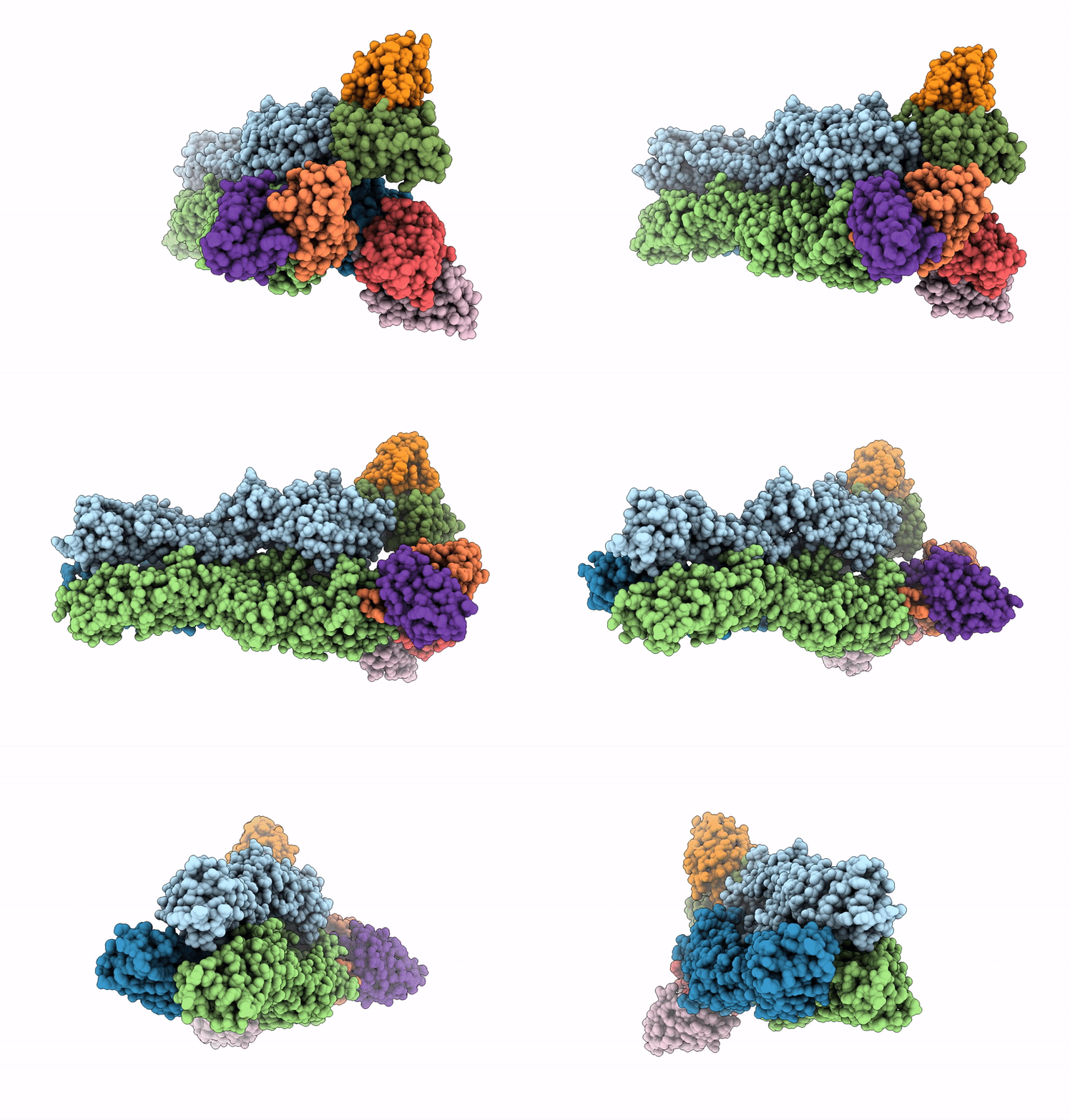
8V7O image
Deposition Date 2023-12-04
Release Date 2024-04-10
Last Version Date 2024-11-06
Entry Detail
PDB ID:
8V7O
Title:
Fab fragment of human mAb #58 in complex with computationally optimized broadly reactive H1 influenza hemagglutinin X6
Biological Source:
Source Organism:
Influenza A virus (Taxon ID: 11320)
Homo sapiens (Taxon ID: 9606)
Host Organism:
Method Details:
Experimental Method:
Resolution:
3.57 Å
Aggregation State:
PARTICLE
Reconstruction Method:
SINGLE PARTICLE
Macromolecular Entities
Structures with similar UniProt ID
Protein Blast
Polymer Type:polypeptide(L)
Molecule:Hemagglutinin
Gene (Uniprot):HA
Chain IDs:A, B, C
Chain Length:555
Number of Molecules:3
Biological Source:Influenza A virus
Polymer Type:polypeptide(L)
Molecule:#58 heavy chain
Chain IDs:D (auth: H), E (auth: I), F (auth: J)
Chain Length:125
Number of Molecules:3
Biological Source:Homo sapiens
Polymer Type:polypeptide(L)
Molecule:#58 light chain
Chain IDs:G (auth: L), H (auth: M), I (auth: N)
Chain Length:109
Number of Molecules:3
Biological Source:Homo sapiens
Ligand Molecules
Primary Citation
Structural basis for the broad antigenicity of the computationally optimized influenza hemagglutinin X6.
Structure 32 1079 ? (2024)
PMID: 38810648 DOI: 10.1016/j.str.2024.05.001

Abstact

Influenza causes significant morbidity and mortality. As an alternative approach to current seasonal vaccines, the computationally optimized broadly reactive antigen (COBRA) platform has been previously applied to hemagglutinin (HA). This approach integrates wild-type HA sequences into a single immunogen to expand the breadth of accessible antibody epitopes. Adding to previous studies of H1, H3, and H5 COBRA HAs, we define the structural features of another H1 subtype COBRA, X6, that incorporates HA sequences from before and after the 2009 H1N1 influenza pandemic. We determined structures of this antigen alone and in complex with COBRA-specific as well as broadly reactive and functional antibodies, analyzing its antigenicity. We found that X6 possesses features representing both historic and recent H1 HA strains, enabling binding to both head- and stem-reactive antibodies. Overall, these data confirm the integrity of broadly reactive antibody epitopes of X6 and contribute to design efforts for a next-generation vaccine.

Legend

Protein

Chemical

Disease

Primary Citation of related structures
Feedback Form
Name
Email
Institute
Feedback