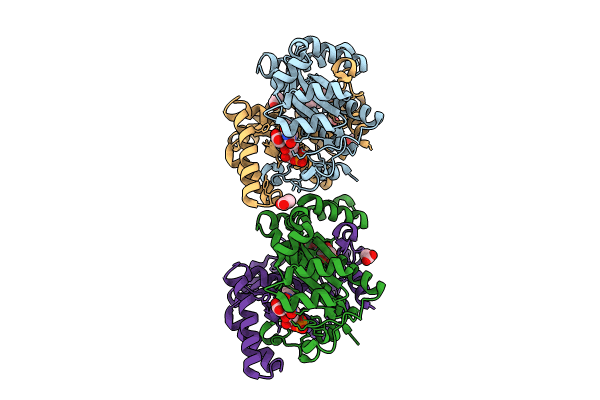
8V5B image
Deposition Date 2023-11-30
Release Date 2024-10-09
Last Version Date 2024-10-09
Entry Detail
PDB ID:
8V5B
Keywords:
Title:
Structure of the oxygen-insensitive NAD(P)H-dependent nitroreductase NfsB_Ec F70A/F108Y in complex with FMN
Biological Source:
Source Organism:
Escherichia coli (Taxon ID: 562)
Method Details:
Experimental Method:
Resolution:
1.98 Å
R-Value Free:
0.21
R-Value Work:
0.17
R-Value Observed:
0.17
Space Group:
P 21 21 21

Macromolecular Entities
Structures with similar UniProt ID
Protein Blast
Polymer Type:polypeptide(L)
Molecule:Dihydropteridine reductase
Mutagens:F70A, F108Y
Chain IDs:A, B, C, D
Chain Length:217
Number of Molecules:4
Biological Source:Escherichia coli
Primary Citation
Structural Evaluation of a Nitroreductase Engineered for Improved Activation of the 5-Nitroimidazole PET Probe SN33623.
Int J Mol Sci 25 ? ? (2024)
PMID: 38928299 DOI: 10.3390/ijms25126593

Abstact

Bacterial nitroreductase enzymes capable of activating imaging probes and prodrugs are valuable tools for gene-directed enzyme prodrug therapies and targeted cell ablation models. We recently engineered a nitroreductase (E. coli NfsB F70A/F108Y) for the substantially enhanced reduction of the 5-nitroimidazole PET-capable probe, SN33623, which permits the theranostic imaging of vectors labeled with oxygen-insensitive bacterial nitroreductases. This mutant enzyme also shows improved activation of the DNA-alkylation prodrugs CB1954 and metronidazole. To elucidate the mechanism behind these enhancements, we resolved the crystal structure of the mutant enzyme to 1.98 Å and compared it to the wild-type enzyme. Structural analysis revealed an expanded substrate access channel and new hydrogen bonding interactions. Additionally, computational modeling of SN33623, CB1954, and metronidazole binding in the active sites of both the mutant and wild-type enzymes revealed key differences in substrate orientations and interactions, with improvements in activity being mirrored by reduced distances between the N5-H of isoalloxazine and the substrate nitro group oxygen in the mutant models. These findings deepen our understanding of nitroreductase substrate specificity and catalytic mechanisms and have potential implications for developing more effective theranostic imaging strategies in cancer treatment.

Legend

Protein

Chemical

Disease

Primary Citation of related structures
Feedback Form
Name
Email
Institute
Feedback