8V1I image
Deposition Date 2023-11-20
Release Date 2024-07-10
Last Version Date 2024-11-27
Entry Detail
PDB ID:
8V1I
Keywords:
Title:
Crystal structure of human mascRNA
Biological Source:
Source Organism:
Homo sapiens (Taxon ID: 9606)
Host Organism:
Method Details:
Experimental Method:
Resolution:
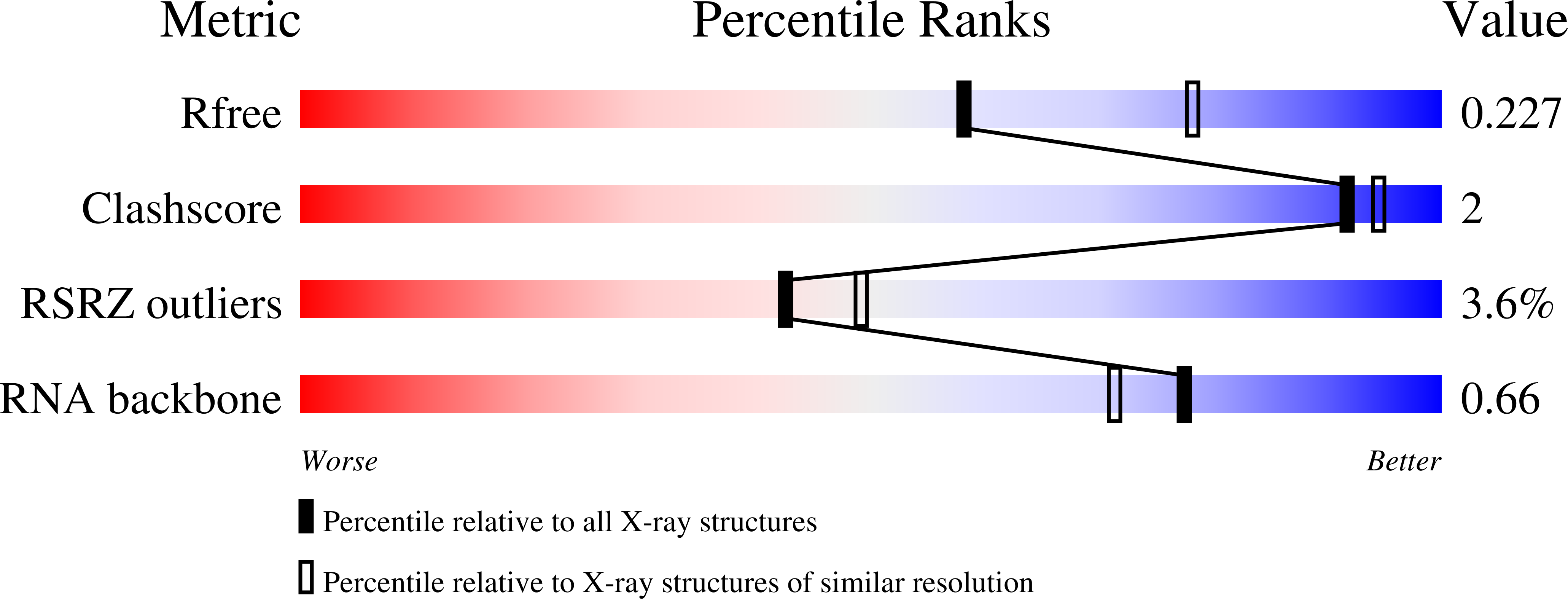
2.30 Å
R-Value Free:
0.22
R-Value Work:
0.21
R-Value Observed:
0.21
Space Group:
H 3 2
Macromolecular Entities
Polymer Type:polyribonucleotide
Molecule:mascRNA
Chain IDs:A (auth: B), B (auth: A)
Chain Length:57
Number of Molecules:2
Biological Source:Homo sapiens
Modified Residue
Compound ID Chain ID Parent Comp ID Details 2D Image
GTP A G modified residue
Primary Citation
Structural basis of MALAT1 RNA maturation and mascRNA biogenesis.
Nat.Struct.Mol.Biol. 31 1655 1668 (2024)
PMID: 38956168 DOI: 10.1038/s41594-024-01340-4

Abstact

The metastasis-associated lung adenocarcinoma transcript 1 (MALAT1) long noncoding RNA (lncRNA) has key roles in regulating transcription, splicing, tumorigenesis, etc. Its maturation and stabilization require precise processing by RNase P, which simultaneously initiates the biogenesis of a 3' cytoplasmic MALAT1-associated small cytoplasmic RNA (mascRNA). mascRNA was proposed to fold into a transfer RNA (tRNA)-like secondary structure but lacks eight conserved linking residues required by the canonical tRNA fold. Here we report crystal structures of human mascRNA before and after processing, which reveal an ultracompact, quasi-tRNA-like structure. Despite lacking all linker residues, mascRNA faithfully recreates the characteristic 'elbow' feature of tRNAs to recruit RNase P and ElaC homolog protein 2 (ELAC2) for processing, which exhibit distinct substrate specificities. Rotation and repositioning of the D-stem and anticodon regions preclude mascRNA from aminoacylation, avoiding interference with translation. Therefore, a class of metazoan lncRNA loci uses a previously unrecognized, unusually streamlined quasi-tRNA architecture to recruit select tRNA-processing enzymes while excluding others to drive bespoke RNA biogenesis, processing and maturation.

Legend

Protein

Chemical

Disease

Primary Citation of related structures
Feedback Form
Name
Email
Institute
Feedback