8URG image
Deposition Date 2023-10-25
Release Date 2025-01-22
Last Version Date 2025-03-12
Entry Detail
PDB ID:
8URG
Keywords:
Title:
Human mitochondrial calcium uniporter crystal structure (residues 74-165 resolved) with lithium
Biological Source:
Source Organism:
Homo sapiens (Taxon ID: 9606)
Host Organism:
Method Details:
Experimental Method:
Resolution:
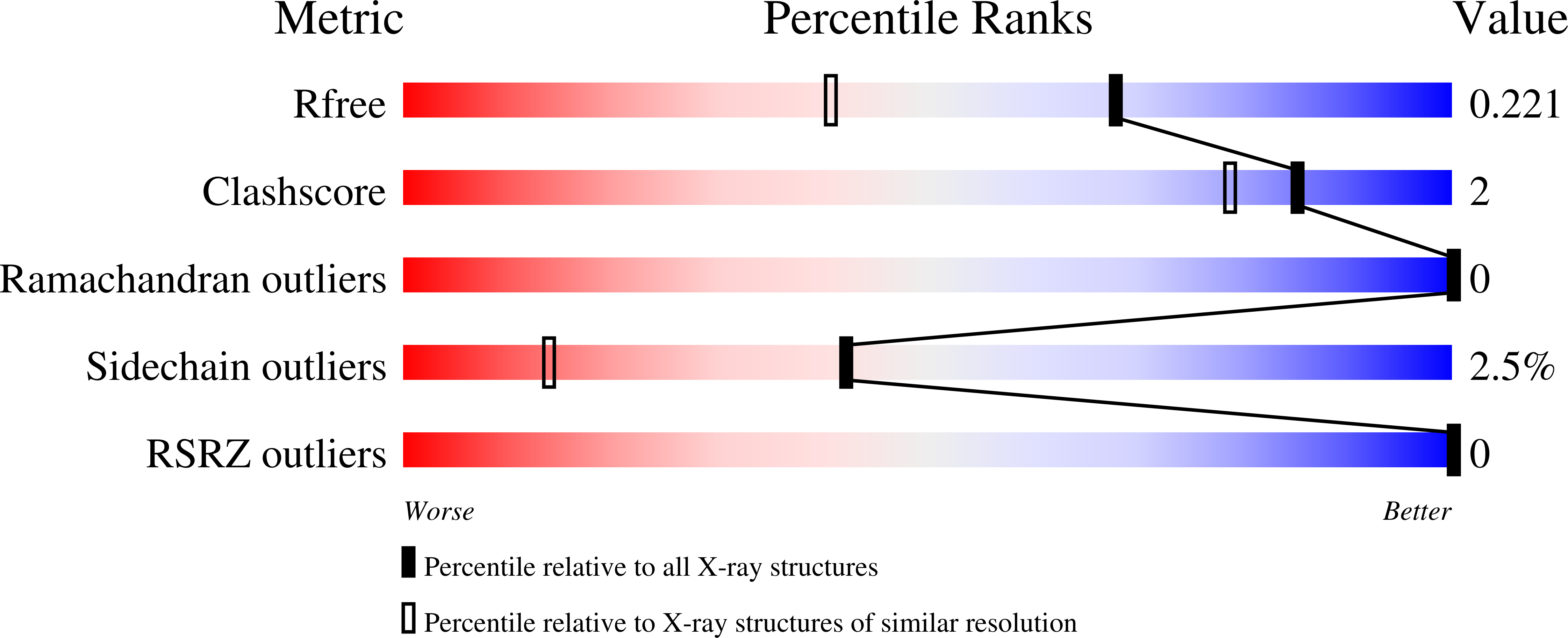
1.63 Å
R-Value Free:
0.22
R-Value Work:
0.19
R-Value Observed:
0.20
Space Group:
P 65
Macromolecular Entities
Structures with similar UniProt ID
Protein Blast
Polymer Type:polypeptide(L)
Molecule:Calcium uniporter protein, mitochondrial
Gene (Uniprot):MCU
Chain IDs:A
Chain Length:124
Number of Molecules:1
Biological Source:Homo sapiens
Primary Citation
Disrupting the network of co-evolving amino terminal domain residues relieves mitochondrial calcium uptake inhibition by MCUb.
Comput Struct Biotechnol J 27 190 213 (2025)
PMID: 40017731 DOI: 10.1016/j.csbj.2024.12.007

Abstact

The regulatory mechanisms of the mitochondrial calcium uniporter complex (mtCU), the predominant channel mediating calcium (Ca2 +) flux into the matrix, are critical for bioenergetics and cell fate. The pore-forming components of mtCU are the mitochondrial Ca2+ uniporter (MCU) subunit and the MCU dominant-negative beta (MCUb) subunit. Despite both MCU paralogs having conserved Asp-Ile-Met-Glu motifs responsible for Ca2+ selectivity, MCUb mediates only low Ca2+ conduction and has been characterized as an inhibitory subunit. We previously identified the MCU amino-terminal domain (NTD) as a negative feedback regulator of mtCU upon divalent cation binding but the role of the MCUb-NTD remains unknown. Thus, to gain mechanistic insight into the competing MCU and MCUb functions, we here studied the divalent cation binding properties of the MCU- and MCUb-NTDs that tightly interact within and between tetrameric channels. First, we resolved a high-resolution MCU-NTD crystal structure in the absence of divalent ions at 1.6 Å, using this structure to model the homologous MCUb-NTD. Further, we conducted 1 μs all-atom molecular dynamics (MD) simulations in the presence and absence of Ca2+ and Mg2+ ions, not only finding increased MCU-NTD stability at high temperatures compared to MCUb-NTD but also discrete Ca2+-binding sites on the two domains. Remarkably, the distinct Ca2+ binding site on the central α-helix of MCUb-NTD was also identified in a functional sector of co-evolving residues, with either direct mutation to the coordinating residues or mutation to a separate site within the sector disrupting Ca2+ binding in silico and in vitro as well as enhancing mitochondrial Ca2+ uptake in cellulo. Thus, we reveal that matrix Ca2+ binding to both the MCU-NTD and MCUb-NTD promote mtCU inhibition through disparate interaction sites, highlighting the evolution of discrete feedback regulation mechanisms to precisely control mtCU function.

Legend

Protein

Chemical

Disease

Primary Citation of related structures
Feedback Form
Name
Email
Institute
Feedback