8UG8 image
Deposition Date 2023-10-05
Release Date 2024-08-21
Last Version Date 2025-05-28
Entry Detail
PDB ID:
8UG8
Title:
Mus musculus Otopetrin 2 (mOTOP2) in pH 7.0, intermediate state
Biological Source:
Source Organism:
Mus musculus (Taxon ID: 10090)
Host Organism:
Method Details:
Experimental Method:
Resolution:
3.79 Å
Aggregation State:
PARTICLE
Reconstruction Method:
SINGLE PARTICLE
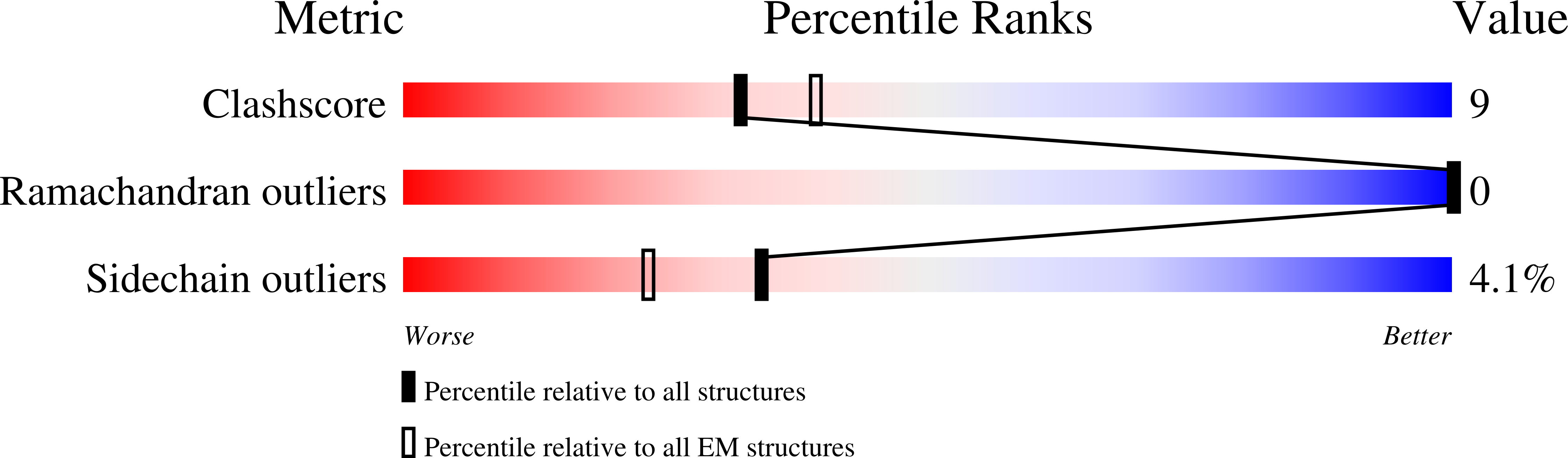
Macromolecular Entities
Structures with similar UniProt ID
Protein Blast
Polymer Type:polypeptide(L)
Molecule:Proton channel OTOP2
Gene (Uniprot):Otop2
Chain IDs:A, B
Chain Length:563
Number of Molecules:2
Biological Source:Mus musculus
Ligand Molecules
Primary Citation
Structural mechanism of proton conduction in otopetrin proton channel.
Nat Commun 15 7250 7250 (2024)
PMID: 39179582 DOI: 10.1038/s41467-024-51803-x

Abstact

The otopetrin (OTOP) proteins were recently characterized as extracellular proton-activated proton channels. Several recent OTOP channel structures demonstrated that the channels form a dimer with each subunit adopting a double-barrel architecture. However, the structural mechanisms underlying some basic functional properties of the OTOP channels remain unresolved, including extracellular pH activation, proton conducting pathway, and rapid desensitization. In this study, we performed structural and functional characterization of the Caenorhabditis elegans OTOP8 (CeOTOP8) and mouse OTOP2 (mOTOP2) and illuminated a set of conformational changes related to the proton-conducting process in OTOP. The structures of CeOTOP8 reveal the conformational change at the N-terminal part of TM12 that renders the channel in a transiently proton-transferring state, elucidating an inter-barrel, Glu/His-bridged proton passage within each subunit. The structures of mOTOP2 reveal the conformational change at the N-terminal part of TM6 that exposes the central glutamate to the extracellular solution for protonation. In addition, the structural comparison between CeOTOP8 and mOTOP2, along with the structure-based mutagenesis, demonstrates that an inter-subunit movement at the OTOP channel dimer interface plays a central role in regulating channel activity. Combining the structural information from both channels, we propose a working model describing the multi-step conformational changes during the proton conducting process.

Legend

Protein

Chemical

Disease

Primary Citation of related structures
Feedback Form
Name
Email
Institute
Feedback