8UBR image
Deposition Date 2023-09-24
Release Date 2024-02-21
Last Version Date 2024-03-20
Entry Detail
PDB ID:
8UBR
Title:
Complex of the phosphorylated human cystic fibrosis transmembrane conductance regulator (CFTR) with CFTRinh-172 and ATP/Mg
Biological Source:
Source Organism:
Homo sapiens (Taxon ID: 9606)
Host Organism:
Method Details:
Experimental Method:
Resolution:
2.70 Å
Aggregation State:
PARTICLE
Reconstruction Method:
SINGLE PARTICLE
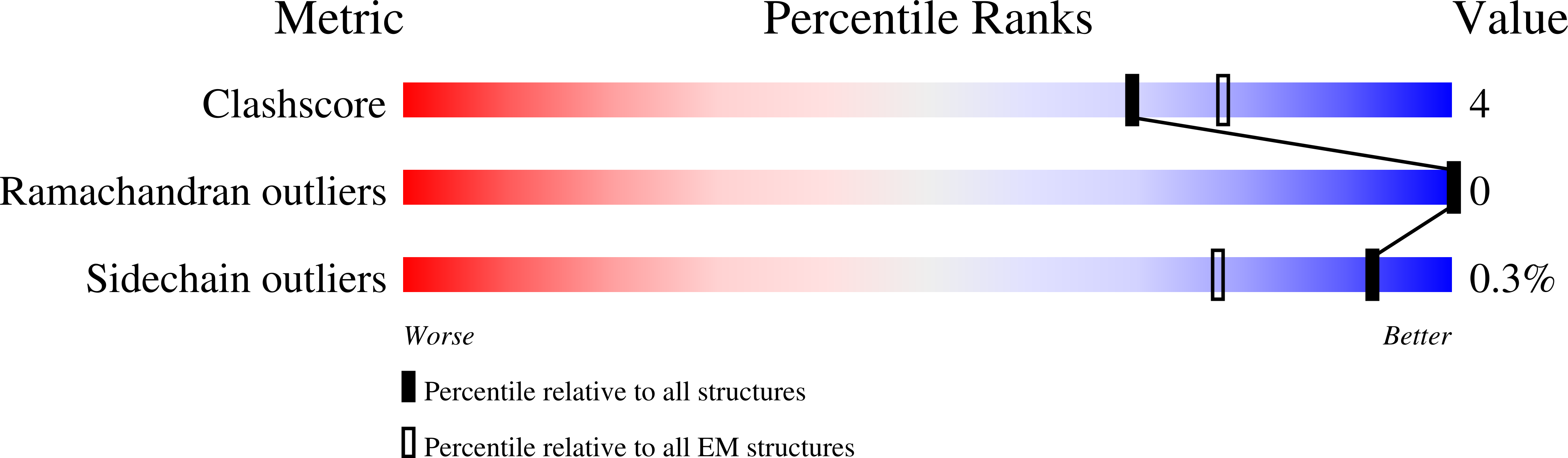
Macromolecular Entities
Structures with similar UniProt ID
Protein Blast
Polymer Type:polypeptide(L)
Molecule:Cystic fibrosis transmembrane conductance regulator
Gene (Uniprot):CFTR
Mutagens:E1371Q
Chain IDs:A
Chain Length:1480
Number of Molecules:1
Biological Source:Homo sapiens
Primary Citation
Structural basis for CFTR inhibition by CFTR inh -172.
Proc.Natl.Acad.Sci.USA 121 e2316675121 e2316675121 (2024)
PMID: 38422021 DOI: 10.1073/pnas.2316675121

Abstact

The cystic fibrosis transmembrane conductance regulator (CFTR) is an anion channel that regulates electrolyte and fluid balance in epithelial tissues. While activation of CFTR is vital to treating cystic fibrosis, selective inhibition of CFTR is a potential therapeutic strategy for secretory diarrhea and autosomal dominant polycystic kidney disease. Although several CFTR inhibitors have been developed by high-throughput screening, their modes of action remain elusive. In this study, we determined the structure of CFTR in complex with the inhibitor CFTRinh-172 to an overall resolution of 2.7 Å by cryogenic electron microscopy. We observe that CFTRinh-172 binds inside the pore near transmembrane helix 8, a critical structural element that links adenosine triphosphate hydrolysis with channel gating. Binding of CFTRinh-172 stabilizes a conformation in which the chloride selectivity filter is collapsed, and the pore is blocked from the extracellular side of the membrane. Single-molecule fluorescence resonance energy transfer experiments indicate that CFTRinh-172 inhibits channel gating without compromising nucleotide-binding domain dimerization. Together, these data reconcile previous biophysical observations and provide a molecular basis for the activity of this widely used CFTR inhibitor.

Legend

Protein

Chemical

Disease

Primary Citation of related structures
Feedback Form
Name
Email
Institute
Feedback