8U9L image
Deposition Date 2023-09-19
Release Date 2024-10-02
Last Version Date 2025-05-14
Entry Detail
PDB ID:
8U9L
Title:
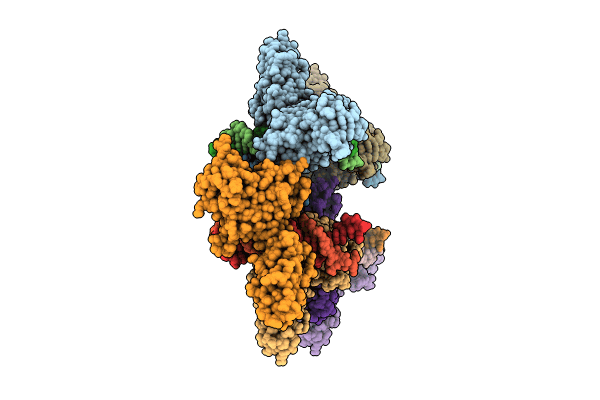
Crystal Structure of RelA-cRel chimera complex with DNA
Biological Source:
Source Organism:
Mus musculus (Taxon ID: 10090)
Homo sapiens (Taxon ID: 9606)
Host Organism:
Method Details:
Experimental Method:
Resolution:
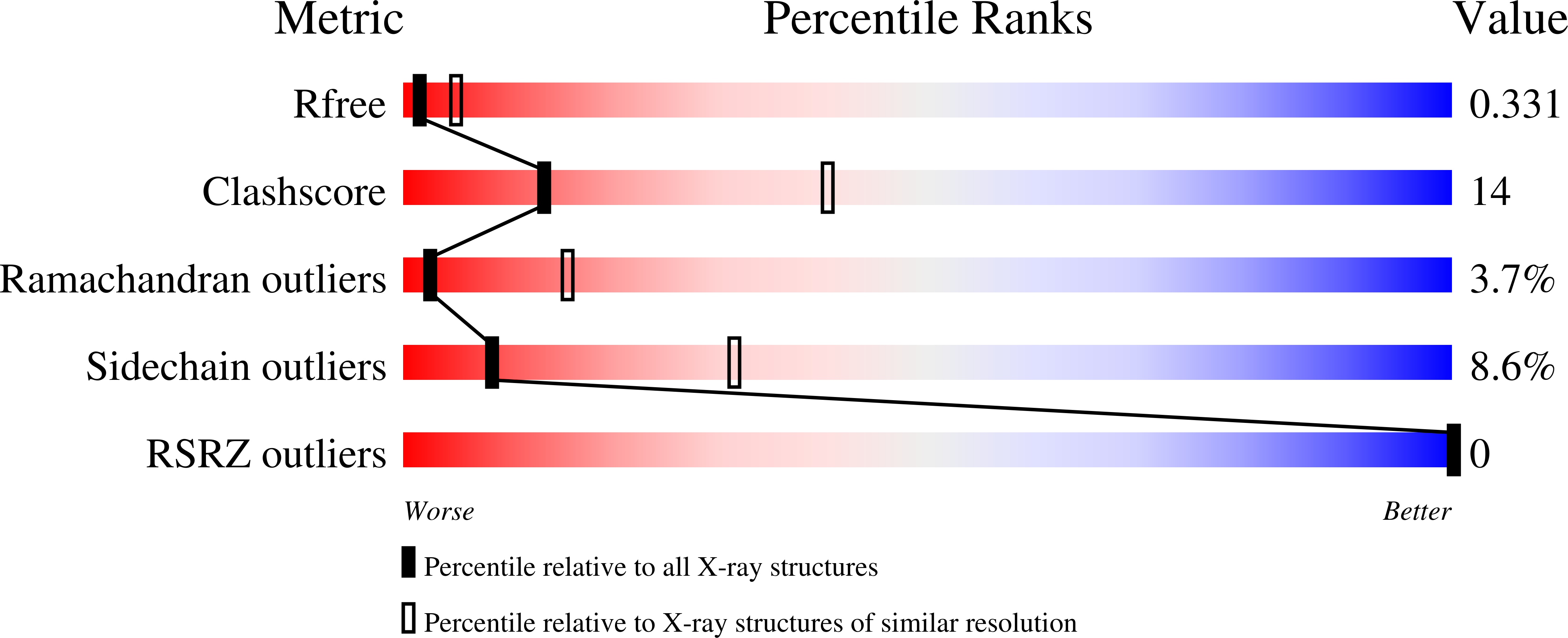
3.09 Å
R-Value Free:
0.32
R-Value Work:
0.27
R-Value Observed:
0.27
Space Group:
P 1
Macromolecular Entities
Protein Blast
Polymer Type:polypeptide(L)
Molecule:Transcription factor p65,Proto-oncogene c-Rel chimera
Gene (Uniprot):Rel, Rela
Chain IDs:C (auth: A), D (auth: B), G, H, K, L, O, P
Chain Length:277
Number of Molecules:8
Biological Source:Mus musculus
Polymer Type:polydeoxyribonucleotide
Molecule:DNA (5'-D(P*TP*TP*GP*AP*TP*GP*GP*GP*AP*AP*TP*TP*TP*CP*CP*GP*AP*TP*TP*C)-3')
Chain IDs:A (auth: E), E (auth: C), I, M
Chain Length:20
Number of Molecules:4
Biological Source:Homo sapiens
Polymer Type:polydeoxyribonucleotide
Molecule:DNA (5'-D(P*GP*AP*AP*TP*CP*GP*GP*AP*AP*AP*TP*TP*CP*CP*CP*AP*TP*CP*AP*A)-3')
Chain IDs:B (auth: F), F (auth: D), J, N
Chain Length:20
Number of Molecules:4
Biological Source:Homo sapiens
Ligand Molecules
Primary Citation
Stepwise neofunctionalization of the NF-kappa B family member Rel during vertebrate evolution.
Nat.Immunol. 26 760 774 (2025)
PMID: 40307452 DOI: 10.1038/s41590-025-02138-2

Abstact

Adaptive immunity and the five vertebrate NF-κB family members first emerged in cartilaginous fish, suggesting that NF-κB family divergence helped to facilitate adaptive immunity. One specialized function of the NF-κB Rel protein in macrophages is activation of Il12b, which encodes a key regulator of T cell development. We found that Il12b exhibits much greater Rel dependence than inducible innate immunity genes in macrophages, with the unique function of Rel dimers depending on a heightened intrinsic DNA-binding affinity. Chromatin immunoprecipitation followed by sequencing experiments defined differential DNA-binding preferences of NF-κB family members genome-wide, and X-ray crystallography revealed a key residue that supports the heightened DNA-binding affinity of Rel dimers. Unexpectedly, this residue, the heightened affinity of Rel dimers, and the portion of the Il12b promoter bound by Rel dimers were largely restricted to mammals. Our findings reveal major structural transitions in an NF-κB family member and one of its key target promoters at a late stage of vertebrate evolution that apparently contributed to immunoregulatory rewiring in mammalian species.

Legend

Protein

Chemical

Disease

Primary Citation of related structures
Feedback Form
Name
Email
Institute
Feedback