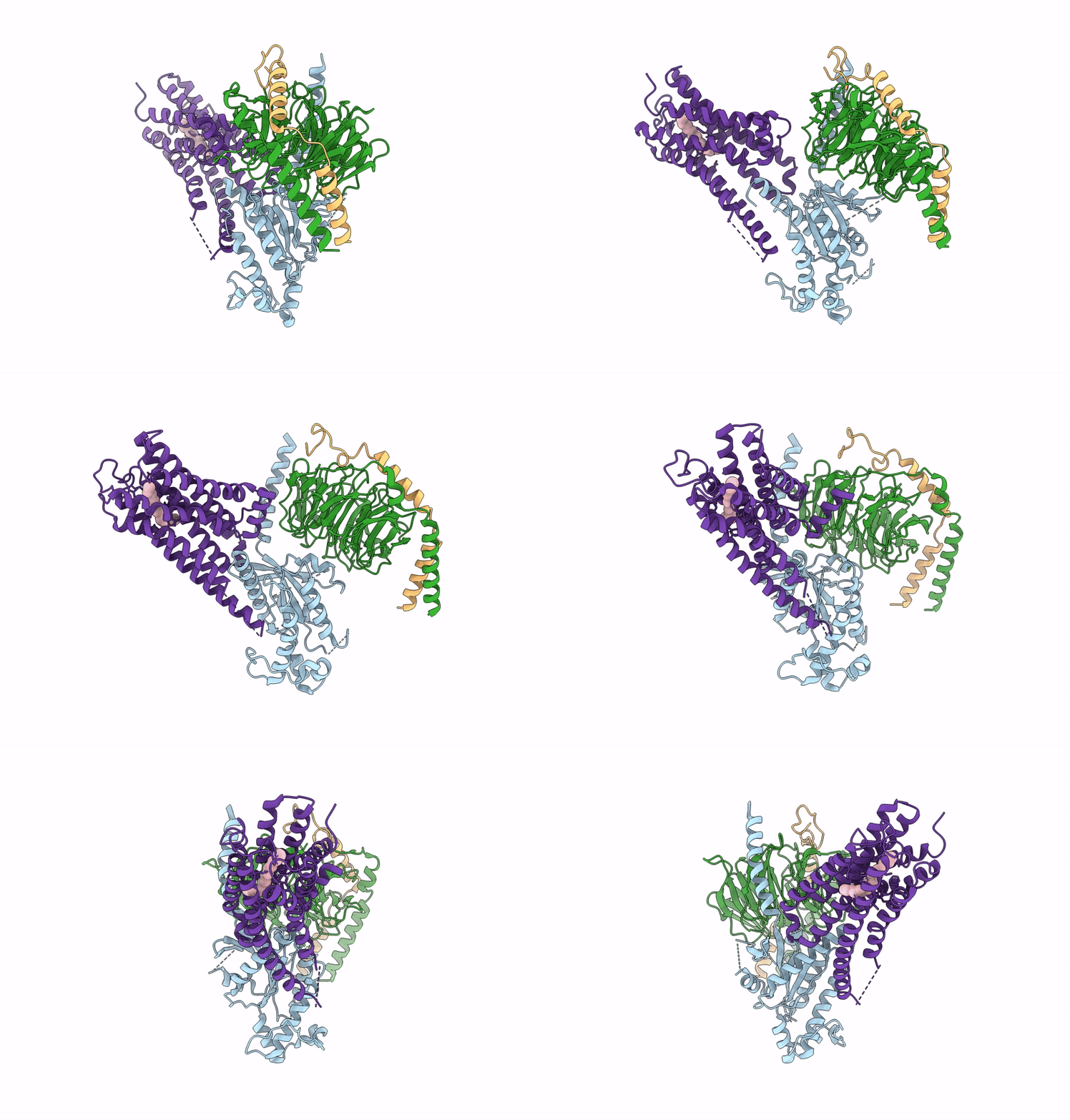
8U8F image
Deposition Date 2023-09-17
Release Date 2024-03-06
Last Version Date 2025-05-21
Entry Detail
PDB ID:
8U8F
Title:
GPR3 Orphan G-coupled Protein Receptor in complex with Dominant Negative Gs.
Biological Source:
Source Organism:
Homo sapiens (Taxon ID: 9606)
Host Organism:
Method Details:
Experimental Method:
Resolution:
3.49 Å
Aggregation State:
PARTICLE
Reconstruction Method:
SINGLE PARTICLE
Macromolecular Entities
Structures with similar UniProt ID
Protein Blast
Polymer Type:polypeptide(L)
Molecule:Guanine nucleotide-binding protein G(s) subunit alpha isoforms short
Gene (Uniprot):GNAS
Chain IDs:A
Chain Length:394
Number of Molecules:1
Biological Source:Homo sapiens
Structures with similar UniProt ID
Protein Blast
Polymer Type:polypeptide(L)
Molecule:Guanine nucleotide-binding protein G(I)/G(S)/G(T) subunit beta-1
Gene (Uniprot):GNB1
Chain IDs:B
Chain Length:340
Number of Molecules:1
Biological Source:Homo sapiens
Structures with similar UniProt ID
Protein Blast
Polymer Type:polypeptide(L)
Molecule:Guanine nucleotide-binding protein G(I)/G(S)/G(O) subunit gamma-2
Gene (Uniprot):GNG2
Chain IDs:C (auth: G)
Chain Length:58
Number of Molecules:1
Biological Source:Homo sapiens
Structures with similar UniProt ID
Protein Blast
Polymer Type:polypeptide(L)
Molecule:G-protein coupled receptor 3
Gene (Uniprot):GPR3
Chain IDs:D (auth: R)
Chain Length:390
Number of Molecules:1
Biological Source:Homo sapiens
Ligand Molecules
Primary Citation
Lipid-Dependent Activation of the Orphan G Protein-Coupled Receptor, GPR3.
Biochemistry 63 625 631 (2024)
PMID: 38376112 DOI: 10.1021/acs.biochem.3c00647

Abstact

The class A orphan G protein-coupled receptor (GPCR), GPR3, has been implicated in a variety of conditions, including Alzheimer's and premature ovarian failure. GPR3 constitutively couples with Gαs, resulting in the production of cAMP in cells. While tool compounds and several putative endogenous ligands have emerged for the receptor, its endogenous ligand, if it exists, remains a mystery. As novel potential drug targets, the structures of orphan GPCRs have been of increasing interest, revealing distinct modes of activation, including autoactivation, presence of constitutively activating mutations, or via cryptic ligands. Here, we present a cryo-electron microscopy (cryo-EM) structure of the orphan GPCR, GPR3 in complex with DNGαs and Gβ1γ2. The structure revealed clear density for a lipid-like ligand that bound within an extended hydrophobic groove, suggesting that the observed "constitutive activity" was likely due to activation via a lipid that may be ubiquitously present. Analysis of conformational variance within the cryo-EM data set revealed twisting motions of the GPR3 transmembrane helices that appeared coordinated with changes in the lipid-like density. We propose a mechanism for the binding of a lipid to its putative orthosteric binding pocket linked to the GPR3 dynamics.

Legend

Protein

Chemical

Disease

Primary Citation of related structures
Feedback Form
Name
Email
Institute
Feedback