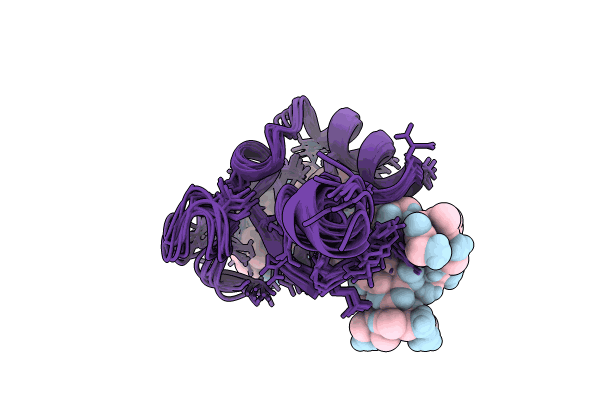
8U2Y image
Deposition Date 2023-09-06
Release Date 2024-06-19
Last Version Date 2024-06-19
Entry Detail
PDB ID:
8U2Y
Keywords:
Title:
Solution structure of the PHD6 finger of MLL4 bound to TET3
Biological Source:
Source Organism:
Homo sapiens (Taxon ID: 9606)
Method Details:
Experimental Method:
Conformers Calculated:
100
Conformers Submitted:
10
Selection Criteria:
structures with the least restraint violations

Macromolecular Entities
Structures with similar UniProt ID
Protein Blast
Polymer Type:polypeptide(L)
Molecule:Methylcytosine dioxygenase TET3
Gene (Uniprot):TET3
Chain IDs:A
Chain Length:9
Number of Molecules:1
Biological Source:Homo sapiens
Structures with similar UniProt ID
Protein Blast
Polymer Type:polypeptide(L)
Molecule:Histone-lysine N-methyltransferase 2D
Gene (Uniprot):KMT2D
Chain IDs:B
Chain Length:60
Number of Molecules:1
Biological Source:Homo sapiens
Ligand Molecules
Primary Citation

Abstact

Human mixed lineage leukemia 4 (MLL4), also known as KMT2D, regulates cell type specific transcriptional programs through enhancer activation. Along with the catalytic methyltransferase domain, MLL4 contains seven less characterized plant homeodomain (PHD) fingers. Here, we report that the sixth PHD finger of MLL4 (MLL4PHD6) binds to the hydrophobic motif of ten-eleven translocation 3 (TET3), a dioxygenase that converts methylated cytosine into oxidized derivatives. The solution NMR structure of the TET3-MLL4PHD6 complex and binding assays show that, like histone H4 tail, TET3 occupies the hydrophobic site of MLL4PHD6, and that this interaction is conserved in the seventh PHD finger of homologous MLL3 (MLL3PHD7). Analysis of genomic localization of endogenous MLL4 and ectopically expressed TET3 in mouse embryonic stem cells reveals a high degree overlap on active enhancers and suggests a potential functional relationship of MLL4 and TET3.

Legend

Protein

Chemical

Disease

Primary Citation of related structures
Feedback Form
Name
Email
Institute
Feedback