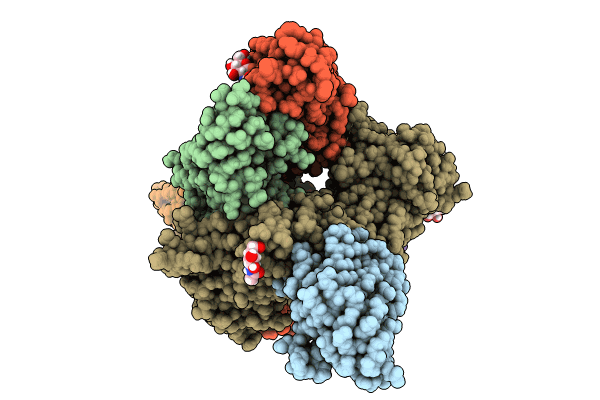
8TW3 image
Deposition Date 2023-08-19
Release Date 2024-01-24
Last Version Date 2024-10-16
Entry Detail
PDB ID:
8TW3
Title:
hMPV fusion protein complexed with single domain antibodies sdHMPV16 and sdHMPV12
Biological Source:
Source Organism:
Host Organism:
Method Details:
Experimental Method:
Resolution:
2.90 Å
R-Value Free:
0.23
R-Value Work:
0.19
R-Value Observed:
0.19
Space Group:
P 21 21 21

Macromolecular Entities
Polymer Type:polypeptide(L)
Molecule:Single domain antibody sdHMPV12
Chain IDs:A, E (auth: Y)
Chain Length:193
Number of Molecules:2
Biological Source:Lama glama
Polymer Type:polypeptide(L)
Molecule:Single domain antibody sdHMPV16
Chain IDs:B, F (auth: Z)
Chain Length:192
Number of Molecules:2
Biological Source:Lama glama
Structures with similar UniProt ID
Protein Blast
Polymer Type:polypeptide(L)
Molecule:Fusion glycoprotein
Chain IDs:C (auth: F), D (auth: X)
Chain Length:542
Number of Molecules:2
Biological Source:Human metapneumovirus A
Ligand Molecules
Primary Citation
A neutralizing single-domain antibody that targets the trimer interface of the human metapneumovirus fusion protein.
Mbio 15 e0212223 e0212223 (2024)
PMID: 38117059 DOI: 10.1128/mbio.02122-23

Abstact

Human metapneumovirus (hMPV) is an important respiratory pathogen for which no licensed antivirals or vaccines exist. Single-domain antibodies represent promising antiviral biologics that can be easily produced and formatted. We describe the isolation and detailed characterization of two hMPV-neutralizing single-domain antibodies that are directed against the fusion protein F. One of these single-domain antibodies broadly neutralizes hMPV A and B strains, can prevent proteolytic maturation of F, and binds to an epitope in the F trimer interface. This suggests that hMPV pre-F undergoes trimer opening or "breathing" on infectious virions, exposing a vulnerable site for neutralizing antibodies. Finally, we show that this single-domain antibody, fused to a human IgG1 Fc, can protect cotton rats against hMPV replication, an important finding for potential future clinical applications.

Legend

Protein

Chemical

Disease

Primary Citation of related structures
Feedback Form
Name
Email
Institute
Feedback