8TUC image
Deposition Date 2023-08-16
Release Date 2023-12-13
Last Version Date 2024-10-30
Entry Detail
PDB ID:
8TUC
Title:
Unphosphorylated CaMKK2 in complex with CC-8977
Biological Source:
Source Organism:
Homo sapiens (Taxon ID: 9606)
Host Organism:
Method Details:
Experimental Method:
Resolution:
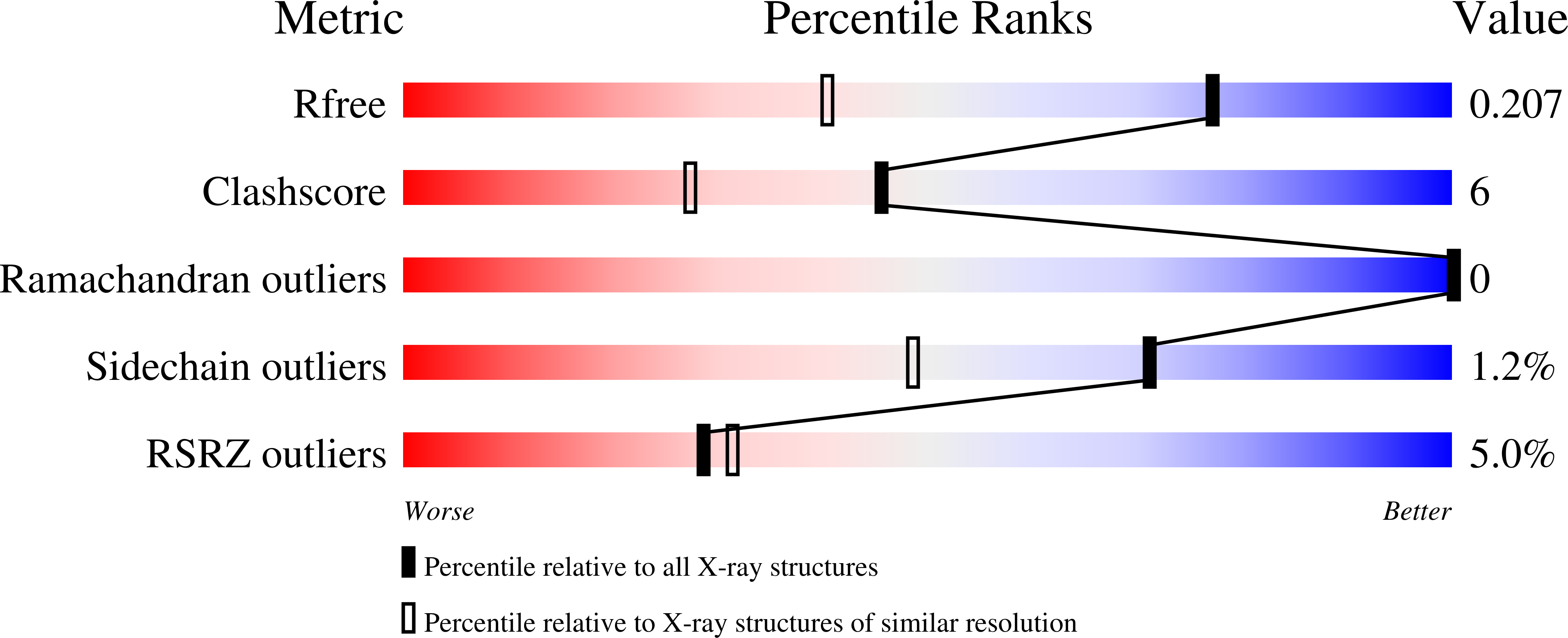
1.50 Å
R-Value Free:
0.20
R-Value Work:
0.16
R-Value Observed:
0.16
Space Group:
P 43 21 2
Macromolecular Entities
Structures with similar UniProt ID
Protein Blast
Polymer Type:polypeptide(L)
Molecule:Calcium/calmodulin-dependent protein kinase kinase 2
Gene (Uniprot):CAMKK2
Chain IDs:A
Chain Length:291
Number of Molecules:1
Biological Source:Homo sapiens
Primary Citation
Identification of Small Molecule Inhibitors and Ligand Directed Degraders of Calcium/Calmodulin Dependent Protein Kinase Kinase 1 and 2 (CaMKK1/2).
J.Med.Chem. 66 15750 15760 (2023)
PMID: 38009718 DOI: 10.1021/acs.jmedchem.3c01137

Abstact

CaMKK2 signals through AMPK-dependent and AMPK-independent pathways to trigger cellular outputs including proliferation, differentiation, and migration, resulting in changes to metabolism, bone mass accrual, neuronal function, hematopoiesis, and immunity. CAMKK2 is upregulated in tumors including hepatocellular carcinoma, prostate, breast, and gastric cancer, and genetic deletion in myeloid cells results in increased antitumor immunity in several syngeneic models. Validation of the biological roles of CaMKK2 has relied on genetic deletion or small molecule inhibitors with activity against several biological targets. We sought to generate selective inhibitors and degraders to understand the biological impact of inhibiting catalytic activity and scaffolding and the potential therapeutic benefits of targeting CaMKK2. We report herein selective, ligand-efficient inhibitors and ligand-directed degraders of CaMKK2 that were used to probe immune and tumor intrinsic biology. These molecules provide two distinct strategies for ablating CaMKK2 signaling in vitro and in vivo.

Legend

Protein

Chemical

Disease

Primary Citation of related structures
Feedback Form
Name
Email
Institute
Feedback