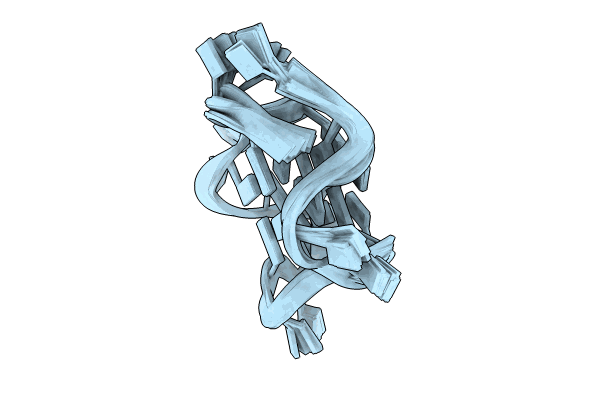
8TNS image
Deposition Date 2023-08-02
Release Date 2023-11-15
Last Version Date 2024-05-15
Entry Detail
PDB ID:
8TNS
Keywords:
Title:
Solution structure of poly(UG) RNA (GU)12 G-quadruplex
Biological Source:
Source Organism:
Method Details:
Experimental Method:
Conformers Calculated:
100
Conformers Submitted:
20
Selection Criteria:
structures with the least restraint violations
Macromolecular Entities
Polymer Type:polyribonucleotide
Molecule:RNA (5'-R(*GP*UP*GP*UP*GP*UP*GP*UP*GP*UP*GP*UP*GP*UP*GP*UP*GP*UP*GP*UP*GP*UP*GP*U)-3')
Chain IDs:A
Chain Length:24
Number of Molecules:1
Biological Source:Caenorhabditis elegans
Ligand Molecules
Primary Citation
Solution Structure of Poly(UG) RNA.
J.Mol.Biol. 435 168340 168340 (2023)
PMID: 37924862 DOI: 10.1016/j.jmb.2023.168340

Abstact

Poly(UG) or "pUG" RNAs are UG or GU dinucleotide repeat sequences which are highly abundant in eukaryotes. Post-transcriptional addition of pUGs to RNA 3' ends marks mRNAs as vectors for gene silencing in C. elegans. We previously determined the crystal structure of pUG RNA bound to the ligand N-methyl mesoporphyrin IX (NMM), but the structure of free pUG RNA is unknown. Here we report the solution structure of the free pUG RNA (GU)12, as determined by nuclear magnetic resonance spectroscopy and small and wide-angle x-ray scattering (NMR-SAXS-WAXS). The low complexity sequence and 4-fold symmetry of the structure result in overlapped NMR signals that complicate chemical shift assignment. We therefore utilized single site-specific deoxyribose modifications which did not perturb the structure and introduced well-resolved methylene signals that are easily identified in NMR spectra. The solution structure ensemble has a root mean squared deviation (RMSD) of 0.62 Å and is a compact, left-handed quadruplex with a Z-form backbone, or "pUG fold." Overall, the structure agrees with the crystal structure of (GU)12 bound to NMM, indicating the pUG fold is unaltered by docking of the NMM ligand. The solution structure reveals conformational details that could not be resolved by x-ray crystallography, which explain how the pUG fold can form within longer RNAs.

Legend

Protein

Chemical

Disease

Primary Citation of related structures
Feedback Form
Name
Email
Institute
Feedback