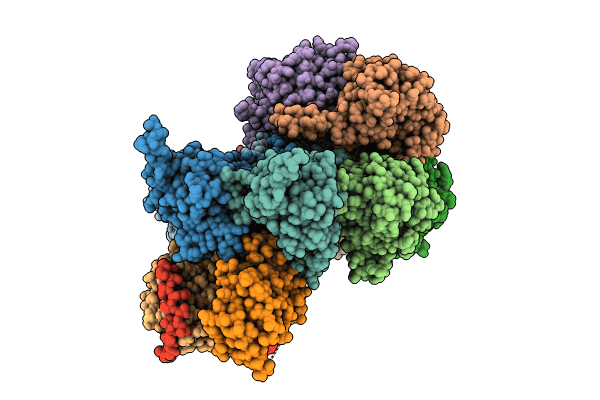
8TM5 image
Deposition Date 2023-07-28
Release Date 2024-10-23
Last Version Date 2025-05-14
Entry Detail
PDB ID:
8TM5
Keywords:
Title:
Human mixed 13S proteasome assembly intermediate
Biological Source:
Source Organism(s):
Homo sapiens (Taxon ID: 9606)
Method Details:
Experimental Method:
Resolution:
3.00 Å
Aggregation State:
PARTICLE
Reconstruction Method:
SINGLE PARTICLE
Macromolecular Entities
Structures with similar UniProt ID
Protein Blast
Polymer Type:polypeptide(L)
Molecule:Proteasome subunit alpha type-2
Gene (Uniprot):PSMA2
Chain IDs:A
Chain Length:234
Number of Molecules:1
Biological Source:Homo sapiens
Structures with similar UniProt ID
Protein Blast
Polymer Type:polypeptide(L)
Molecule:Proteasome subunit alpha type-4
Gene (Uniprot):PSMA4
Chain IDs:B
Chain Length:261
Number of Molecules:1
Biological Source:Homo sapiens
Structures with similar UniProt ID
Protein Blast
Polymer Type:polypeptide(L)
Molecule:Proteasome subunit alpha type-7
Gene (Uniprot):PSMA7
Chain IDs:C
Chain Length:248
Number of Molecules:1
Biological Source:Homo sapiens
Structures with similar UniProt ID
Protein Blast
Polymer Type:polypeptide(L)
Molecule:Proteasome subunit alpha type-5
Gene (Uniprot):PSMA5
Chain IDs:D
Chain Length:264
Number of Molecules:1
Biological Source:Homo sapiens
Structures with similar UniProt ID
Protein Blast
Polymer Type:polypeptide(L)
Molecule:Proteasome subunit alpha type-1
Gene (Uniprot):PSMA1
Chain IDs:E
Chain Length:263
Number of Molecules:1
Biological Source:Homo sapiens
Structures with similar UniProt ID
Protein Blast
Polymer Type:polypeptide(L)
Molecule:Proteasome subunit alpha type-3
Gene (Uniprot):PSMA3
Chain IDs:F
Chain Length:255
Number of Molecules:1
Biological Source:Homo sapiens
Structures with similar UniProt ID
Protein Blast
Polymer Type:polypeptide(L)
Molecule:Proteasome subunit alpha type-6
Gene (Uniprot):PSMA6
Chain IDs:G
Chain Length:246
Number of Molecules:1
Biological Source:Homo sapiens
Structures with similar UniProt ID
Protein Blast
Polymer Type:polypeptide(L)
Molecule:Proteasome subunit beta type-7
Gene (Uniprot):PSMB7
Chain IDs:H
Chain Length:277
Number of Molecules:1
Biological Source:Homo sapiens
Structures with similar UniProt ID
Protein Blast
Polymer Type:polypeptide(L)
Molecule:Proteasome subunit beta type-3
Gene (Uniprot):PSMB3
Chain IDs:I
Chain Length:205
Number of Molecules:1
Biological Source:Homo sapiens
Structures with similar UniProt ID
Protein Blast
Polymer Type:polypeptide(L)
Molecule:Proteasome subunit beta type-2
Gene (Uniprot):PSMB2
Chain IDs:J
Chain Length:201
Number of Molecules:1
Biological Source:Homo sapiens
Structures with similar UniProt ID
Protein Blast
Polymer Type:polypeptide(L)
Molecule:Proteasome assembly chaperone 1
Gene (Uniprot):PSMG1
Chain IDs:K (auth: c)
Chain Length:248
Number of Molecules:1
Biological Source:Homo sapiens
Structures with similar UniProt ID
Protein Blast
Polymer Type:polypeptide(L)
Molecule:Proteasome assembly chaperone 2
Gene (Uniprot):PSMG2
Chain IDs:L (auth: d)
Chain Length:264
Number of Molecules:1
Biological Source:Homo sapiens
Structures with similar UniProt ID
Protein Blast
Polymer Type:polypeptide(L)
Molecule:Proteasome maturation protein
Gene (Uniprot):POMP
Chain IDs:M (auth: e)
Chain Length:263
Number of Molecules:1
Biological Source:Homo sapiens
Ligand Molecules
Primary Citation
Structural basis of human 20S proteasome biogenesis.
Nat Commun 15 8184 8184 (2024)
PMID: 39294158 DOI: 10.1038/s41467-024-52513-0

Abstact

New proteasomes are produced to accommodate increases in cellular catabolic demand and prevent the accumulation of cytotoxic proteins. Formation of the proteasomal 20S core complex relies on the function of the five chaperones PAC1-4 and POMP. Here, to understand how these chaperones facilitate proteasome assembly, we tagged the endogenous chaperones using CRISPR/Cas gene editing and examined the chaperone-bound complexes by cryo-EM. We observe an early α-ring intermediate subcomplex that is stabilized by PAC1-4, which transitions to β-ring assembly upon dissociation of PAC3/PAC4 and rearrangement of the PAC1 N-terminal tail. Completion of the β-ring and dimerization of half-proteasomes repositions critical lysine K33 to trigger cleavage of the β pro-peptides, leading to the concerted dissociation of POMP and PAC1/PAC2 to yield mature 20S proteasomes. This study reveals structural insights into critical points along the assembly pathway of the human proteasome and provides a molecular blueprint for 20S biogenesis.

Legend

Protein

Chemical

Disease

Primary Citation of related structures
Feedback Form
Name
Email
Institute
Feedback