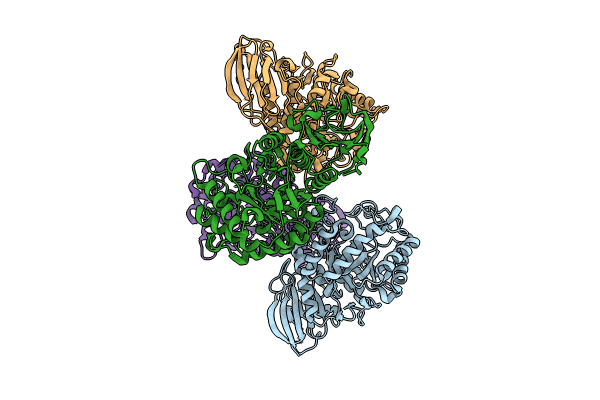
8T9W image
Deposition Date 2023-06-26
Release Date 2024-02-07
Last Version Date 2024-11-13
Entry Detail
PDB ID:
8T9W
Keywords:
Title:
Crystal structure of a GH140 apiosidase derived from a lignocellulolytic enriched mangrove metagenome.
Biological Source:
Source Organism:
metagenome (Taxon ID: 256318)
Host Organism:
Method Details:
Experimental Method:
Resolution:
2.20 Å
R-Value Free:
0.23
R-Value Work:
0.20
R-Value Observed:
0.20
Space Group:
P 21 21 21
Macromolecular Entities
Polymer Type:polypeptide(L)
Molecule:Apiosidase
Chain IDs:A, B, C, D
Chain Length:434
Number of Molecules:4
Biological Source:metagenome
Primary Citation
Discovery, structural characterization, and functional insights into a novel apiosidase from the GH140 family, isolated from a lignocellulolytic-enriched mangrove microbial community.
Biotechnol.Lett. 46 201 211 (2024)
PMID: 38280177 DOI: 10.1007/s10529-023-03460-1

Abstact

OBJECTIVES Apiosidases are enzymes that cleave the glycosidic bond between the monosaccharides linked to apiose, a branched chain furanose found in the cell walls of vascular plants and aquatic monocots. There is biotechnological interest in this enzyme group because apiose is the flavor-active compound of grapes, fruit juice, and wine, and the monosaccharide is found to be a plant secondary metabolite with pharmaceutical properties. However, functional and structural studies of this enzyme family are scarce. Recently, a glycoside hydrolase family member GH140 was isolated from Bacteroides thetaiotaomicron and identified as an endo-apiosidase. RESULTS The structural characterization and functional identification of a second GH140 family enzyme, termed MmApi, discovered through mangrove soil metagenomic approach, are described. Among the various substrates tested, MmApi exhibited activity on an apiose-containing oligosaccharide derived from the pectic polysaccharide rhamnogalacturonan-II. While the crystallographic model of MmApi was similar to the endo-apiosidase from Bacteroides thetaiotaomicron, differences in the shape of the binding sites indicated that MmApi could cleave apioses within oligosaccharides of different compositions. CONCLUSION This enzyme represents a novel tool for researchers interested in studying the physiology and structure of plant cell walls and developing biocatalytic strategies for drug and flavor production.

Legend

Protein

Chemical

Disease

Primary Citation of related structures
Feedback Form
Name
Email
Institute
Feedback