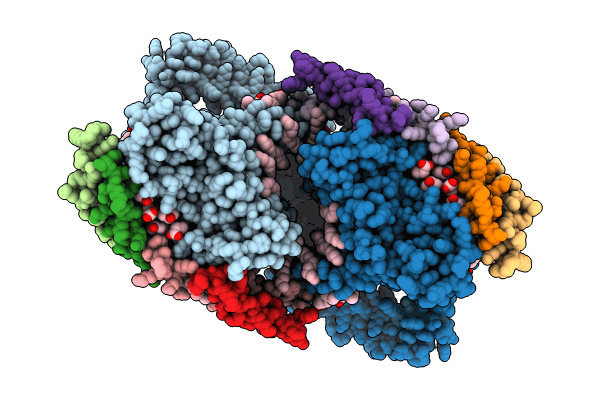
8T56 image
Deposition Date 2023-06-12
Release Date 2023-12-27
Last Version Date 2024-02-14
Entry Detail
PDB ID:
8T56
Title:
Structure of mechanically activated ion channel OSCA1.2 in peptidiscs
Biological Source:
Source Organism:
Host Organism:
Method Details:
Experimental Method:
Resolution:
2.80 Å
Aggregation State:
PARTICLE
Reconstruction Method:
SINGLE PARTICLE
Macromolecular Entities
Structures with similar UniProt ID
Protein Blast
Polymer Type:polypeptide(L)
Molecule:Calcium permeable stress-gated cation channel 1
Gene (Uniprot):OSCA1.2
Chain IDs:A, B
Chain Length:781
Number of Molecules:2
Biological Source:Arabidopsis thaliana
Polymer Type:polypeptide(L)
Molecule:NSPr peptide
Chain IDs:C, D, E, F, G, H, I, J
Chain Length:37
Number of Molecules:8
Biological Source:synthetic construct
Primary Citation
Structure of mechanically activated ion channel OSCA2.3 reveals mobile elements in the transmembrane domain.
Structure 32 157 ? (2024)
PMID: 38103547 DOI: 10.1016/j.str.2023.11.009

Abstact

Members of the OSCA/TMEM63 family are mechanically activated ion channels and structures of some OSCA members have revealed the architecture of these channels and structural features that are potentially involved in mechanosensation. However, these structures are all in a similar state and information about the motion of different elements of the structure is limited, preventing a deeper understanding of how these channels work. Here, we used cryoelectron microscopy to determine high-resolution structures of Arabidopsis thaliana OSCA1.2 and OSCA2.3 in peptidiscs. The structure of OSCA1.2 matches previous structures of the same protein in different environments. Yet, in OSCA2.3, the TM6a-TM7 linker adopts a different conformation that constricts the pore on its cytoplasmic side. Furthermore, coevolutionary sequence analysis uncovered a conserved interaction between the TM6a-TM7 linker and the beam-like domain (BLD). Our results reveal conformational heterogeneity and differences in conserved interactions between the TMD and BLD among members of the OSCA family.

Legend

Protein

Chemical

Disease

Primary Citation of related structures
Feedback Form
Name
Email
Institute
Feedback