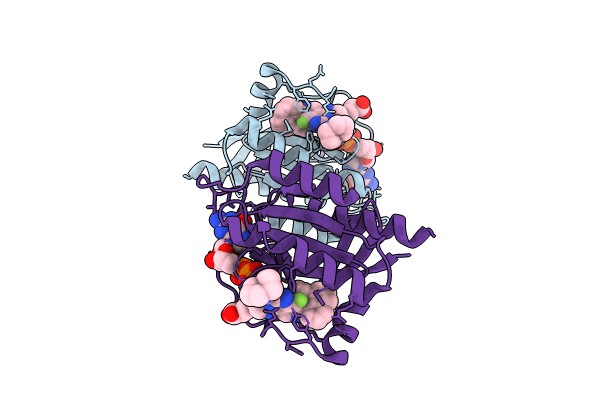
8T4V image
Deposition Date 2023-06-10
Release Date 2024-03-13
Last Version Date 2024-10-16
Entry Detail
PDB ID:
8T4V
Title:
Crystal structure of compound 1 bound to K-Ras(G12D)
Biological Source:
Source Organism:
Homo sapiens (Taxon ID: 9606)
Method Details:
Experimental Method:
Resolution:
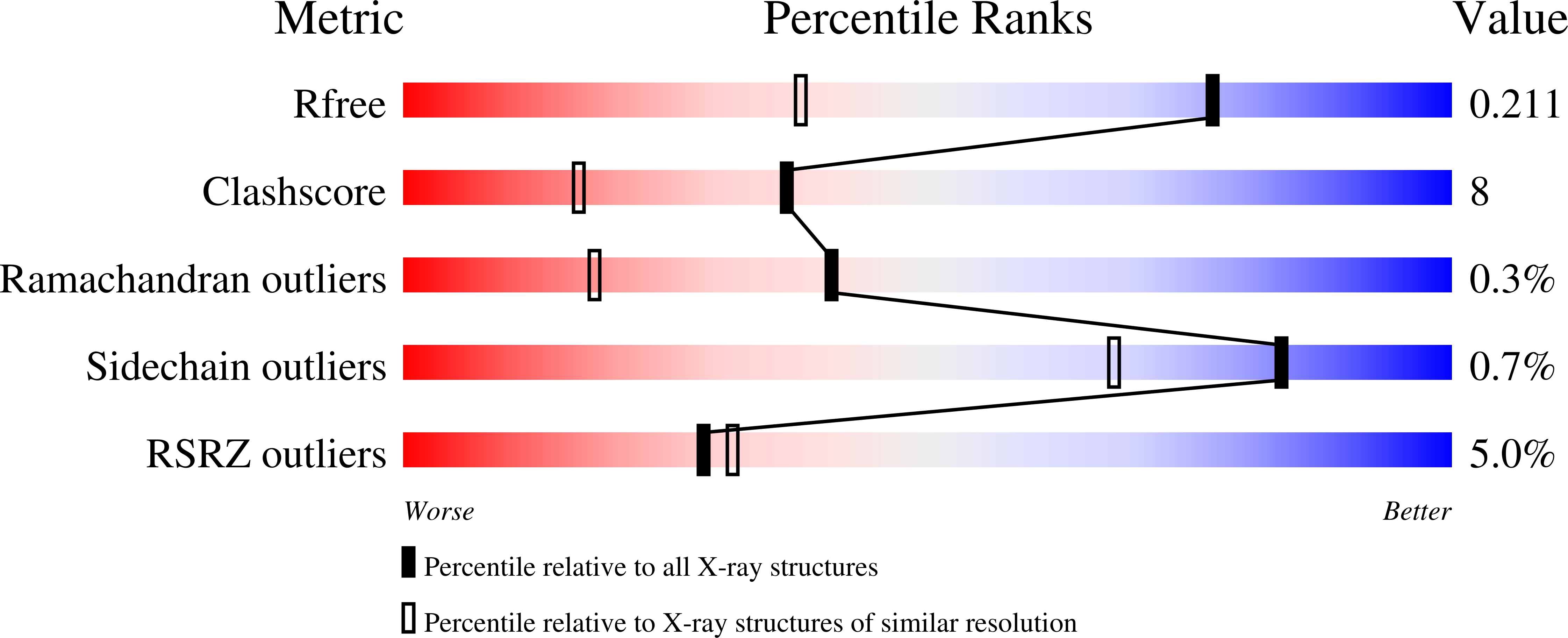
1.47 Å
R-Value Free:
0.21
R-Value Work:
0.18
R-Value Observed:
0.19
Space Group:
P 1 21 1
Macromolecular Entities
Structures with similar UniProt ID
Protein Blast
Polymer Type:polypeptide(L)
Molecule:GTPase KRas
Gene (Uniprot):KRAS
Mutagens:G12D
Chain IDs:A, B
Chain Length:187
Number of Molecules:2
Biological Source:Homo sapiens
Primary Citation
Strain-release alkylation of Asp12 enables mutant selective targeting of K-Ras-G12D.
Nat.Chem.Biol. 20 1114 1122 (2024)
PMID: 38443470 DOI: 10.1038/s41589-024-01565-w

Abstact

K-Ras is the most commonly mutated oncogene in human cancer. The recently approved non-small cell lung cancer drugs sotorasib and adagrasib covalently capture an acquired cysteine in K-Ras-G12C mutation and lock it in a signaling-incompetent state. However, covalent inhibition of G12D, the most frequent K-Ras mutation particularly prevalent in pancreatic ductal adenocarcinoma, has remained elusive due to the lack of aspartate-targeting chemistry. Here we present a set of malolactone-based electrophiles that exploit ring strain to crosslink K-Ras-G12D at the mutant aspartate to form stable covalent complexes. Structural insights from X-ray crystallography and exploitation of the stereoelectronic requirements for attack of the electrophile allowed development of a substituted malolactone that resisted attack by aqueous buffer but rapidly crosslinked with the aspartate-12 of K-Ras in both GDP and GTP state. The GTP-state targeting allowed effective suppression of downstream signaling, and selective inhibition of K-Ras-G12D-driven cancer cell proliferation in vitro and xenograft growth in mice.

Legend

Protein

Chemical

Disease

Primary Citation of related structures
Feedback Form
Name
Email
Institute
Feedback