8T2J image
Deposition Date 2023-06-06
Release Date 2024-06-12
Last Version Date 2024-10-23
Entry Detail
PDB ID:
8T2J
Keywords:
Title:
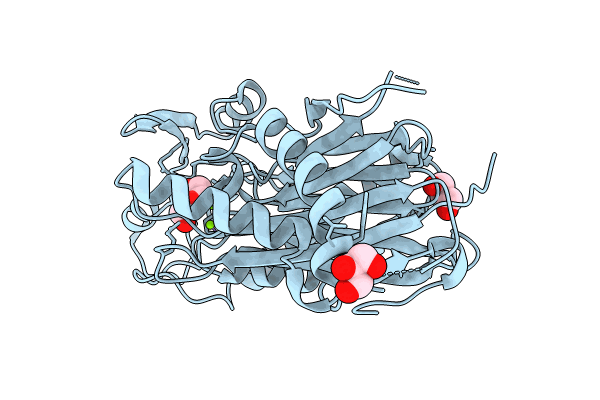
Structure of the catalytic domain of PPM1D/Wip1 serine/threonine phosphatase
Biological Source:
Source Organism:
Homo sapiens (Taxon ID: 9606)
Method Details:
Experimental Method:
Resolution:
1.80 Å
R-Value Free:
0.21
R-Value Work:
0.17
R-Value Observed:
0.17
Space Group:
P 1 21 1
Macromolecular Entities
Structures with similar UniProt ID
Protein Blast
Polymer Type:polypeptide(L)
Molecule:Protein phosphatase 1D
Gene (Uniprot):PPM1D
Mutagens:G8R, P33E, R250A, R258A, R259A
Chain IDs:A
Chain Length:345
Number of Molecules:1
Biological Source:Homo sapiens
Modified Residue
Compound ID Chain ID Parent Comp ID Details 2D Image
CSO A CYS modified residue
Primary Citation
Crystal structure and mechanistic studies of the PPM1D serine/threonine phosphatase catalytic domain.
J.Biol.Chem. 300 107561 107561 (2024)
PMID: 39002674 DOI: 10.1016/j.jbc.2024.107561

Abstact

Protein phosphatase 1D (PPM1D, Wip1) is induced by the tumor suppressor p53 during DNA damage response signaling and acts as an oncoprotein in several human cancers. Although PPM1D is a potential therapeutic target, insights into its atomic structure were challenging due to flexible regions unique to this family member. Here, we report the first crystal structure of the PPM1D catalytic domain to 1.8 Å resolution. The structure reveals the active site with two Mg2+ ions bound, similar to other structures. The flap subdomain and B-loop, which are crucial for substrate recognition and catalysis, were also resolved, with the flap forming two short helices and three short β-strands that are followed by an irregular loop. Unexpectedly, a nitrogen-oxygen-sulfur bridge was identified in the catalytic domain. Molecular dynamics simulations and kinetic studies provided further mechanistic insights into the regulation of PPM1D catalytic activity. In particular, the kinetic experiments demonstrated a magnesium concentration-dependent lag in PPM1D attaining steady-state velocity, a feature of hysteretic enzymes that show slow transitions compared with catalytic turnover. All combined, these results advance the understanding of PPM1D function and will support the development of PPM1D-targeted therapeutics.

Legend

Protein

Chemical

Disease

Primary Citation of related structures
Feedback Form
Name
Email
Institute
Feedback