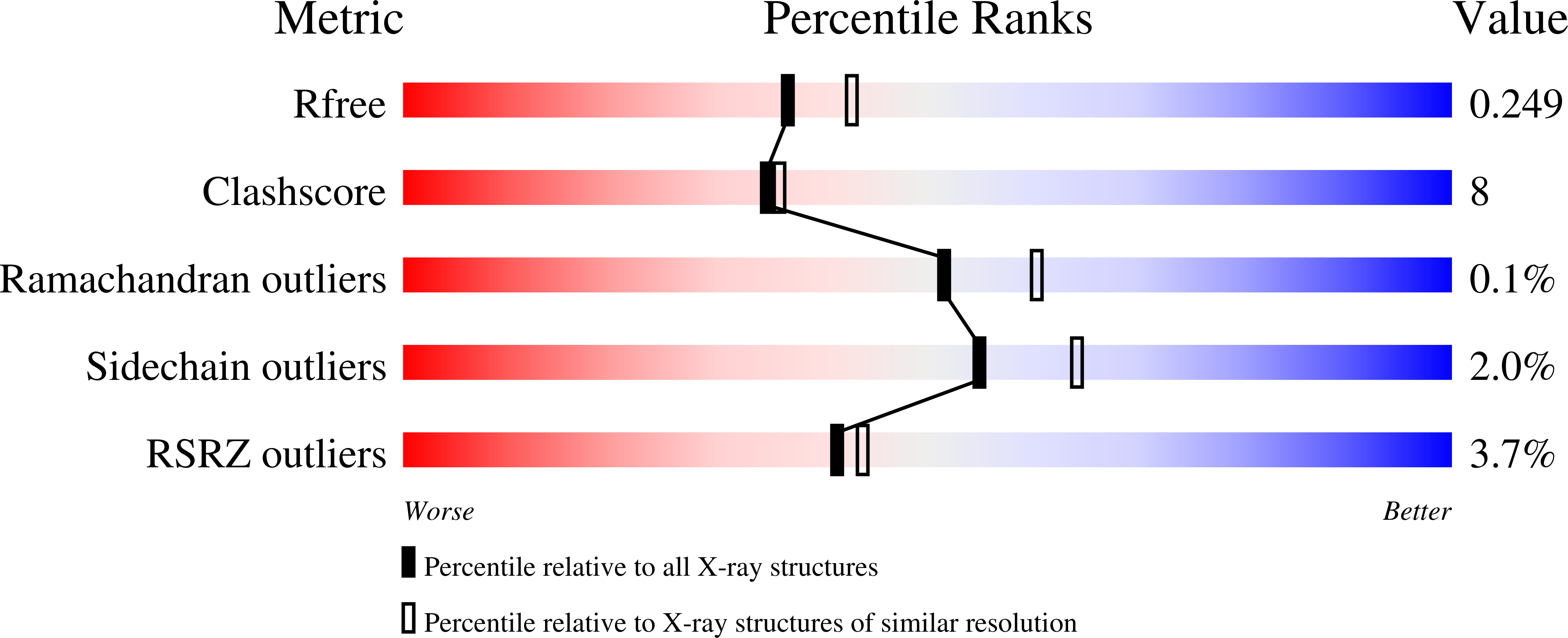
8SS0 image
Deposition Date 2023-05-08
Release Date 2024-01-17
Last Version Date 2024-03-06
Entry Detail
PDB ID:
8SS0
Keywords:
Title:
Human sterol 14 alpha-demethylase (CYP51) in complex with the reaction intermediate 14 alpha-aldehyde dihydrolanosterol
Biological Source:
Source Organism:
Homo sapiens (Taxon ID: 9606)
Host Organism:
Method Details:
Experimental Method:
Resolution:
2.25 Å
R-Value Free:
0.24
R-Value Work:
0.21
R-Value Observed:
0.21
Space Group:
P 62 2 2
Macromolecular Entities
Structures with similar UniProt ID
Protein Blast
Polymer Type:polypeptide(L)
Molecule:Lanosterol 14-alpha demethylase
Gene (Uniprot):CYP51A1
Mutagens:D231A, H314A
Chain IDs:A, B
Chain Length:458
Number of Molecules:2
Biological Source:Homo sapiens
Primary Citation
Oxygen-18 Labeling Reveals a Mixed Fe-O Mechanism in the Last Step of Cytochrome P450 51 Sterol 14 alpha-Demethylation.
Angew.Chem.Int.Ed.Engl. 63 e202317711 e202317711 (2024)
PMID: 38206808 DOI: 10.1002/anie.202317711

Abstact

The 14α-demethylation step is critical in eukaryotic sterol biosynthesis, catalyzed by cytochrome P450 (P450) Family 51 enzymes, for example, with lanosterol in mammals. This conserved three-step reaction terminates in a C-C cleavage step that generates formic acid, the nature of which has been controversial. Proposed mechanisms involve roles of P450 Compound 0 (ferric peroxide anion, FeO2 -) or Compound I (perferryl oxygen, FeO3+) reacting with either the aldehyde or its hydrate, respectively. Analysis of 18 O incorporation into formic acid from 18 O2 provides a means of distinguishing the two mechanisms. Human P450 51A1 incorporated 88 % 18 O (one atom) into formic acid, consistent with a major but not exclusive FeO2 - mechanism. Two P450 51 orthologs from amoeba and yeast showed similar results, while two orthologs from pathogenic trypanosomes showed roughly equal contributions of both mechanisms. An X-ray crystal structure of the human enzyme showed the aldehyde oxygen atom 3.5 Å away from the heme iron atom. Experiments with human P450 51A1 and H2 18 O yielded primarily one 18 O atom but 14 % of the formic acid product with two 18 O atoms, indicative of a minor contribution of a Compound I mechanism. LC-MS evidence for a Compound 0-derived Baeyer-Villiger reaction product (a 14α-formyl ester) was also found.

Legend

Protein

Chemical

Disease

Primary Citation of related structures
Feedback Form
Name
Email
Institute
Feedback