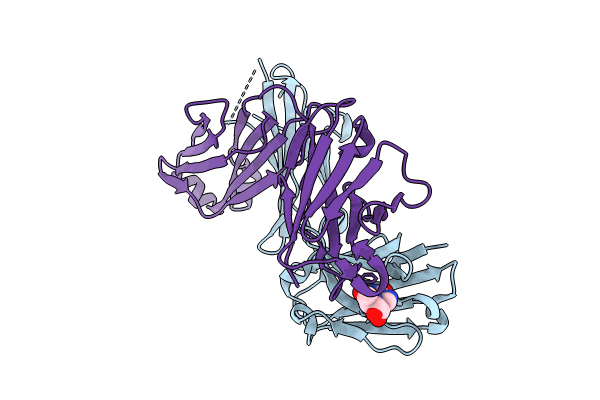
8SIP image
Deposition Date 2023-04-16
Release Date 2024-02-07
Last Version Date 2025-08-20
Entry Detail
PDB ID:
8SIP
Keywords:
Title:
Structure of a mouse IgG antibody fragment that binds Inosine, an RNA modification
Biological Source:
Source Organism:
Mus musculus (Taxon ID: 10090)
Host Organism:
Method Details:
Experimental Method:
Resolution:
1.94 Å
R-Value Free:
0.24
R-Value Work:
0.20
R-Value Observed:
0.20
Space Group:
P 1
Macromolecular Entities
Polymer Type:polypeptide(L)
Molecule:Inosine binding IgG Fab, heavy chain
Chain IDs:A (auth: H)
Chain Length:222
Number of Molecules:1
Biological Source:Mus musculus
Polymer Type:polypeptide(L)
Molecule:Inosine binding IgG Fab, kappa chain
Chain IDs:B (auth: L)
Chain Length:219
Number of Molecules:1
Biological Source:Mus musculus
Ligand Molecules
Primary Citation
In silico lambda-dynamics predicts protein binding specificities to modified RNAs.
Nucleic Acids Res. 53 ? ? (2025)
PMID: 40066880 DOI: 10.1093/nar/gkaf166

Abstact

RNA modifications shape gene expression through a variety of chemical changes to canonical RNA bases. Although numbering in the hundreds, only a few RNA modifications are well characterized, in part due to the absence of methods to identify modification sites. Antibodies remain a common tool to identify modified RNA and infer modification sites through straightforward applications. However, specificity issues can result in off-target binding and confound conclusions. This work utilizes in silico λ-dynamics to efficiently estimate binding free energy differences of modification-targeting antibodies between a variety of naturally occurring RNA modifications. Crystal structures of inosine and N6-methyladenosine (m6A) targeting antibodies bound to their modified ribonucleosides were determined and served as structural starting points. λ-Dynamics was utilized to predict RNA modifications that permit or inhibit binding to these antibodies. In vitro RNA-antibody binding assays supported the accuracy of these in silico results. High agreement between experimental and computed binding propensities demonstrated that λ-dynamics can serve as a predictive screen for antibody specificity against libraries of RNA modifications. More importantly, this strategy is an innovative way to elucidate how hundreds of known RNA modifications interact with biological molecules without the limitations imposed by in vitro or in vivo methodologies.

Legend

Protein

Chemical

Disease

Primary Citation of related structures
Feedback Form
Name
Email
Institute
Feedback