8SHI image
Deposition Date 2023-04-14
Release Date 2023-06-28
Last Version Date 2023-07-26
Entry Detail
PDB ID:
8SHI
Keywords:
Title:
Valpha3S1 Vbeta13S1 HLA C 0602 VRSRRCLRL
Biological Source:
Source Organism:
Homo sapiens (Taxon ID: 9606)
Method Details:
Experimental Method:
Resolution:
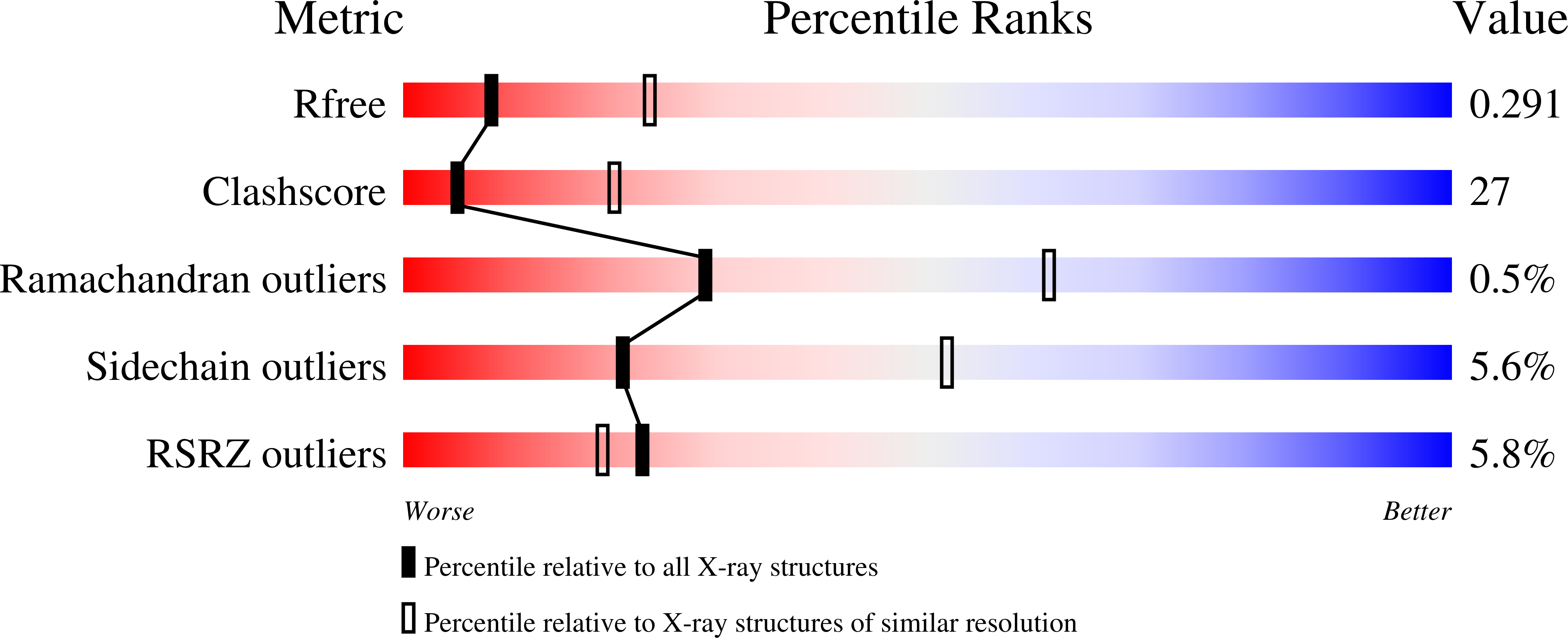
2.90 Å
R-Value Free:
0.29
R-Value Work:
0.23
R-Value Observed:
0.23
Space Group:
I 2 2 2
Macromolecular Entities
Structures with similar UniProt ID
Protein Blast
Polymer Type:polypeptide(L)
Molecule:MHC class I antigen (Fragment)
Gene (Uniprot):HLA-C
Mutagens:C2S
Chain IDs:A, D
Chain Length:277
Number of Molecules:2
Biological Source:Homo sapiens
Structures with similar UniProt ID
Protein Blast
Polymer Type:polypeptide(L)
Molecule:Beta-2-microglobulin
Gene (Uniprot):B2M
Chain IDs:B, E
Chain Length:100
Number of Molecules:2
Biological Source:Homo sapiens
Polymer Type:polypeptide(L)
Molecule:VAL-ARG-SER-ARG-ARG-ABA-LEU-ARG-LEU
Chain IDs:C, F
Chain Length:9
Number of Molecules:2
Biological Source:Homo sapiens
Polymer Type:polypeptide(L)
Molecule:T cell receptor alpha
Chain IDs:G, I
Chain Length:196
Number of Molecules:2
Biological Source:Homo sapiens
Polymer Type:polypeptide(L)
Molecule:T cell receptor beta
Mutagens:S169C
Chain IDs:H, J
Chain Length:242
Number of Molecules:2
Biological Source:Homo sapiens
Primary Citation
Complimentary electrostatics dominate T-cell receptor binding to a psoriasis-associated peptide antigen presented by human leukocyte antigen C∗06:02.
J.Biol.Chem. 299 104930 104930 (2023)
PMID: 37330172 DOI: 10.1016/j.jbc.2023.104930

Abstact

Psoriasis is a chronic skin disease characterized by hyperproliferative epidermal lesions infiltrated by autoreactive T cells. Individuals expressing the human leukocyte antigen (HLA) C∗06:02 allele are at highest risk for developing psoriasis. An autoreactive T cell clone (termed Vα3S1/Vβ13S1) isolated from psoriatic plaques is selective for HLA-C∗06:02, presenting a peptide derived from the melanocyte-specific autoantigen ADAMTSL5 (VRSRRCLRL). Here we determine the crystal structure of this psoriatic TCR-HLA-C∗06:02 ADAMTSL5 complex with a stabilized peptide. Docking of the TCR involves an extensive complementary charge network formed between negatively charged TCR residues interleaving with exposed arginine residues from the self-peptide and the HLA-C∗06:02 α1 helix. We probed these interactions through mutagenesis and activation assays. The charged interface spans the polymorphic region of the C1/C2 HLA group. Notably the peptide-binding groove of HLA-C∗06:02 appears exquisitely suited for presenting highly charged Arg-rich epitopes recognized by this acidic psoriatic TCR. Overall, we provide a structural basis for understanding the engagement of melanocyte antigen-presenting cells by a TCR implicated in psoriasis while simultaneously expanding our knowledge of how TCRs engage HLA-C.

Legend

Protein

Chemical

Disease

Primary Citation of related structures
Feedback Form
Name
Email
Institute
Feedback