8SBM image
Deposition Date 2023-04-03
Release Date 2023-11-08
Last Version Date 2023-11-29
Entry Detail
PDB ID:
8SBM
Keywords:
Title:
Crystal structure of the wild-type Catalytic ATP-binding domain of Mtb DosS
Biological Source:
Source Organism:
Host Organism:
Method Details:
Experimental Method:
Resolution:
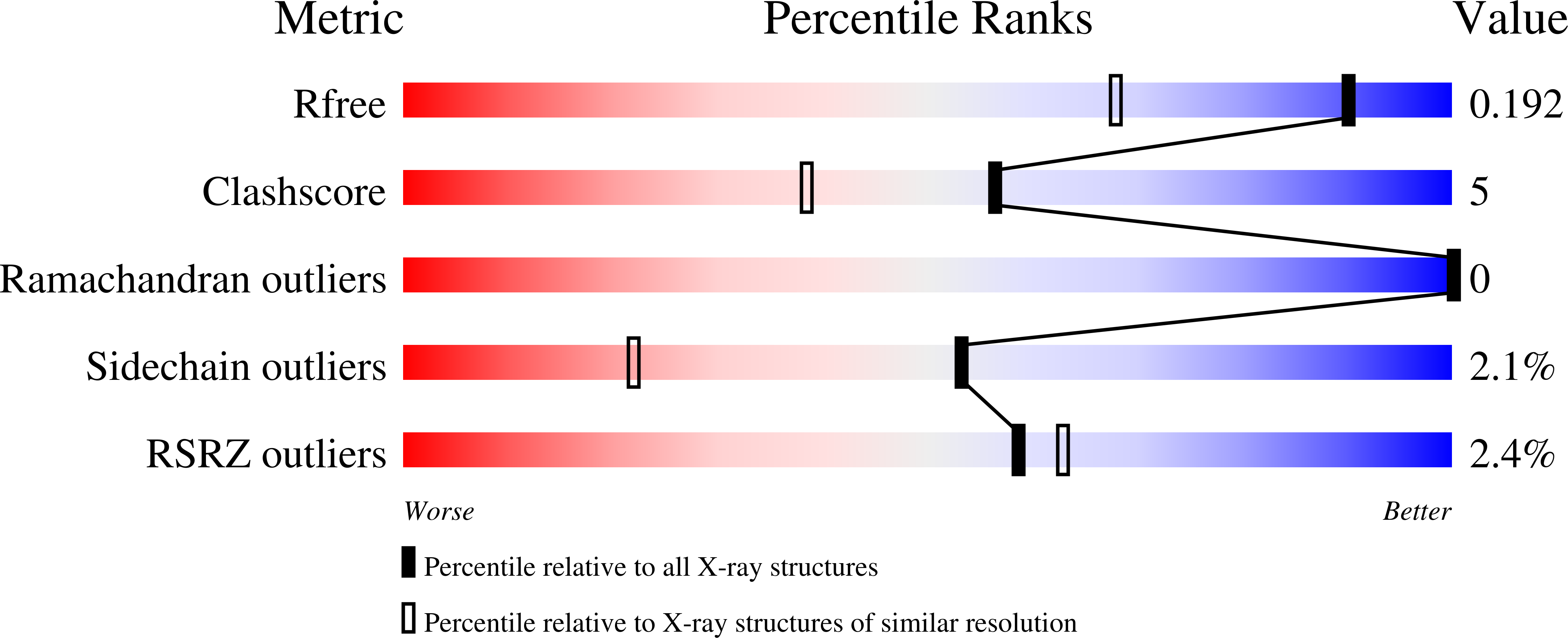
1.47 Å
R-Value Free:
0.19
R-Value Work:
0.15
R-Value Observed:
0.15
Space Group:
C 1 2 1
Macromolecular Entities
Structures with similar UniProt ID
Protein Blast
Polymer Type:polypeptide(L)
Molecule:GAF domain-containing protein
Chain IDs:A, B
Chain Length:126
Number of Molecules:2
Biological Source:Mycobacterium tuberculosis
Primary Citation
Understanding ATP Binding to DosS Catalytic Domain with a Short ATP-Lid.
Biochemistry 62 3283 3292 (2023)
PMID: 37905955 DOI: 10.1021/acs.biochem.3c00306

Abstact

DosS is a heme-containing histidine kinase that triggers dormancy transformation inMycobacterium tuberculosis. Sequence comparison of the catalytic ATP-binding (CA) domain of DosS to other well-studied histidine kinases reveals a short ATP-lid. This feature has been thought to block binding of ATP to DosS's CA domain in the absence of interactions with DosS's dimerization and histidine phospho-transfer (DHp) domain. Here, we use a combination of computational modeling, structural biology, and biophysical studies to re-examine ATP-binding modalities in DosS. We show that the closed-lid conformation observed in crystal structures of DosS CA is caused by the presence of Zn2+ in the ATP binding pocket that coordinates with Glu537 on the ATP-lid. Furthermore, circular dichroism studies and comparisons of DosS CA's crystal structure with its AlphaFold model and homologous DesK reveal that residues 503-507 that appear as a random coil in the Zn2+-coordinated crystal structure are in fact part of the N-box α helix needed for efficient ATP binding. Such random-coil transformation of an N-box α helix turn and the closed-lid conformation are both artifacts arising from large millimolar Zn2+ concentrations used in DosS CA crystallization buffers. In contrast, in the absence of Zn2+, the short ATP-lid of DosS CA has significant conformational flexibility and can effectively bind AMP-PNP (Kd = 53 ± 13 μM), a non-hydrolyzable ATP analog. Furthermore, the nucleotide affinity remains unchanged when CA is conjugated to the DHp domain (Kd = 51 ± 6 μM). In all, our findings reveal that the short ATP-lid of DosS CA does not hinder ATP binding and provide insights that extend to 2988 homologous bacterial proteins containing such ATP-lids.

Legend

Protein

Chemical

Disease

Primary Citation of related structures
Feedback Form
Name
Email
Institute
Feedback