8SAJ image
Deposition Date 2023-04-01
Release Date 2024-04-03
Last Version Date 2025-04-16
Entry Detail
PDB ID:
8SAJ
Keywords:
Title:
Mycobacterium phage Adjutor
Biological Source:
Source Organism:
Method Details:
Experimental Method:
Resolution:
2.66 Å
Aggregation State:
PARTICLE
Reconstruction Method:
SINGLE PARTICLE
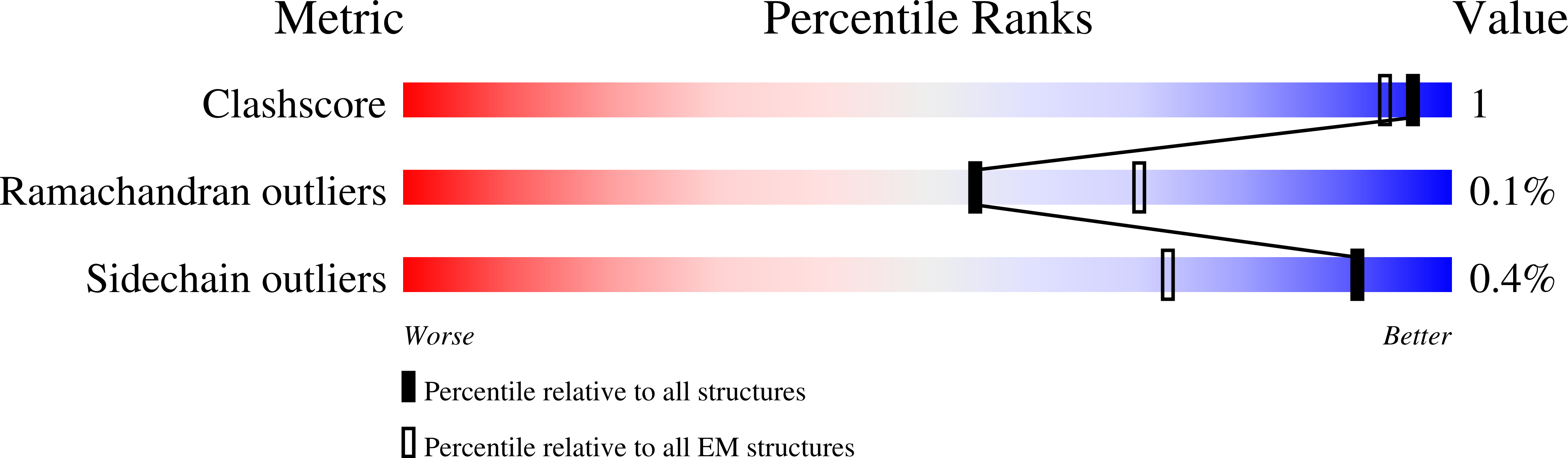
Macromolecular Entities
Structures with similar UniProt ID
Protein Blast
Polymer Type:polypeptide(L)
Molecule:gp_16 (Minor Capsid Protein)
Gene (Uniprot):16
Chain IDs:H (auth: 3), I (auth: 2), J (auth: 1), M (auth: 6), N (auth: 5), O (auth: 4), P (auth: 7)
Chain Length:139
Number of Molecules:7
Biological Source:Mycobacterium phage Adjutor
Structures with similar UniProt ID
Protein Blast
Polymer Type:polypeptide(L)
Molecule:Major capsid protein
Gene (Uniprot):17
Chain IDs:A, B, C, D, E, F, G
Chain Length:403
Number of Molecules:7
Biological Source:Mycobacterium phage Adjutor
Structures with similar UniProt ID
Protein Blast
Polymer Type:polypeptide(L)
Molecule:HNH endonuclease
Gene (Uniprot):4
Chain IDs:K (auth: Y), L (auth: Z)
Chain Length:54
Number of Molecules:2
Biological Source:Mycobacterium phage Adjutor
Ligand Molecules
Primary Citation
Stabilization mechanism accommodating genome length variation in evolutionarily related viral capsids.
Nat Commun 16 3145 3145 (2025)
PMID: 40175362 DOI: 10.1038/s41467-025-58298-0

Abstact

Tailed bacteriophages are one of the most numerous and diverse group of viruses. They store their genome at quasi-crystalline densities in capsids built from multiple copies of proteins adopting the HK97-fold. The high density of the genome exerts an internal pressure, requiring a maturation process that reinforces their capsids. However, it is unclear how capsid stabilization strategies have adapted to accommodate the evolution of larger genomes in this virus group. Here we characterize a capsid reinforcement mechanism in two evolutionary-related actinobacteriophages that modifies the length of a stabilization protein to accommodate a larger genome while maintaining the same capsid size. We use cryo-EM to reveal that capsids contain split hexamers of HK97-fold proteins with a stabilization protein in the chasm. The observation of split hexamers in mature capsids is unprecedented, so we rationalize this result mathematically, discovering that icosahedral capsids can be formed by all split or skewed hexamers as long as their T-number is not a multiple of three. Our results suggest that analogous stabilization mechanisms can be present in other icosahedral capsids, and they provide a strategy for engineering capsids accommodating larger DNA cargoes as gene delivery systems.

Legend

Protein

Chemical

Disease

Primary Citation of related structures
Feedback Form
Name
Email
Institute
Feedback