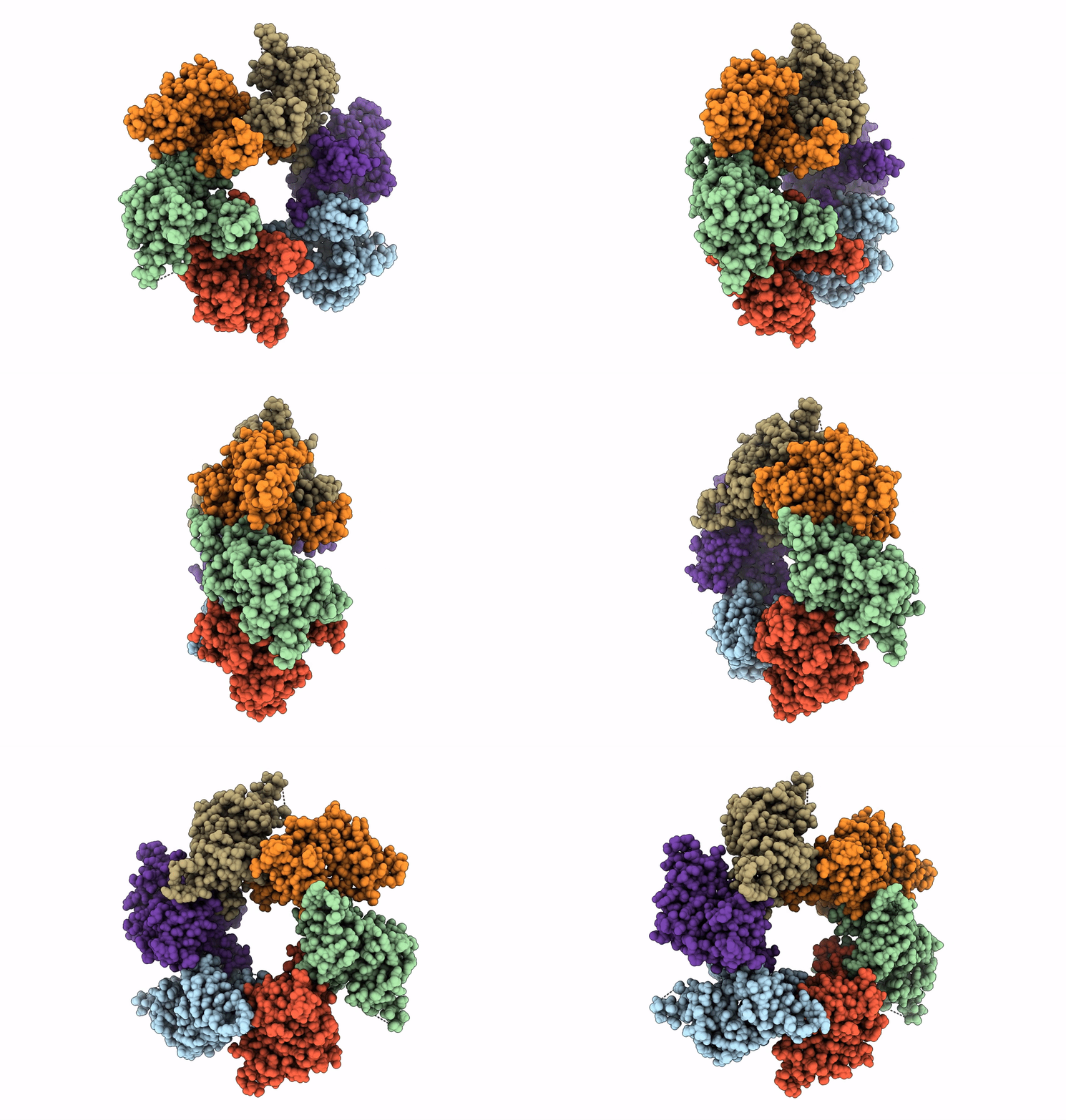
8S92 image
Deposition Date 2023-03-27
Release Date 2023-06-07
Last Version Date 2025-05-21
Entry Detail
PDB ID:
8S92
Title:
Structure of N-terminal domains of Walker B mutated MCM8/9 heterohexamer complex with ADP
Biological Source:
Source Organism:
Homo sapiens (Taxon ID: 9606)
Host Organism:
Method Details:
Experimental Method:
Resolution:
4.06 Å
Aggregation State:
PARTICLE
Reconstruction Method:
SINGLE PARTICLE

Macromolecular Entities
Structures with similar UniProt ID
Protein Blast
Polymer Type:polypeptide(L)
Molecule:DNA helicase MCM8
Gene (Uniprot):MCM8
Mutagens:E519Q
Chain IDs:A, C (auth: B), E (auth: C)
Chain Length:840
Number of Molecules:3
Biological Source:Homo sapiens
Structures with similar UniProt ID
Protein Blast
Polymer Type:polypeptide(L)
Molecule:DNA helicase MCM9
Gene (Uniprot):MCM9
Mutagens:E415Q
Chain IDs:B (auth: D), D (auth: E), F
Chain Length:1143
Number of Molecules:3
Biological Source:Homo sapiens
Ligand Molecules
Primary Citation
Activity, substrate preference and structure of the HsMCM8/9 helicase.
Nucleic Acids Res. 51 7330 7341 (2023)
PMID: 37309874 DOI: 10.1093/nar/gkad508

Abstact

The minichromosomal maintenance proteins, MCM8 and MCM9, are more recent evolutionary additions to the MCM family, only cooccurring in selected higher eukaryotes. Mutations in these genes are directly linked to ovarian insufficiency, infertility, and several cancers. MCM8/9 appears to have ancillary roles in fork progression and recombination of broken replication forks. However, the biochemical activity, specificities and structures have not been adequately illustrated, making mechanistic determination difficult. Here, we show that human MCM8/9 (HsMCM8/9) is an ATP dependent DNA helicase that unwinds fork DNA substrates with a 3'-5' polarity. High affinity ssDNA binding occurs in the presence of nucleoside triphosphates, while ATP hydrolysis weakens the interaction with DNA. The cryo-EM structure of the HsMCM8/9 heterohexamer was solved at 4.3 Å revealing a trimer of heterodimer configuration with two types of interfacial AAA+ nucleotide binding sites that become more organized upon binding ADP. Local refinements of the N or C-terminal domains (NTD or CTD) improved the resolution to 3.9 or 4.1 Å, respectively, and shows a large displacement in the CTD. Changes in AAA+ CTD upon nucleotide binding and a large swing between the NTD and CTD likely implies that MCM8/9 utilizes a sequential subunit translocation mechanism for DNA unwinding.

Legend

Protein

Chemical

Disease

Primary Citation of related structures
Feedback Form
Name
Email
Institute
Feedback