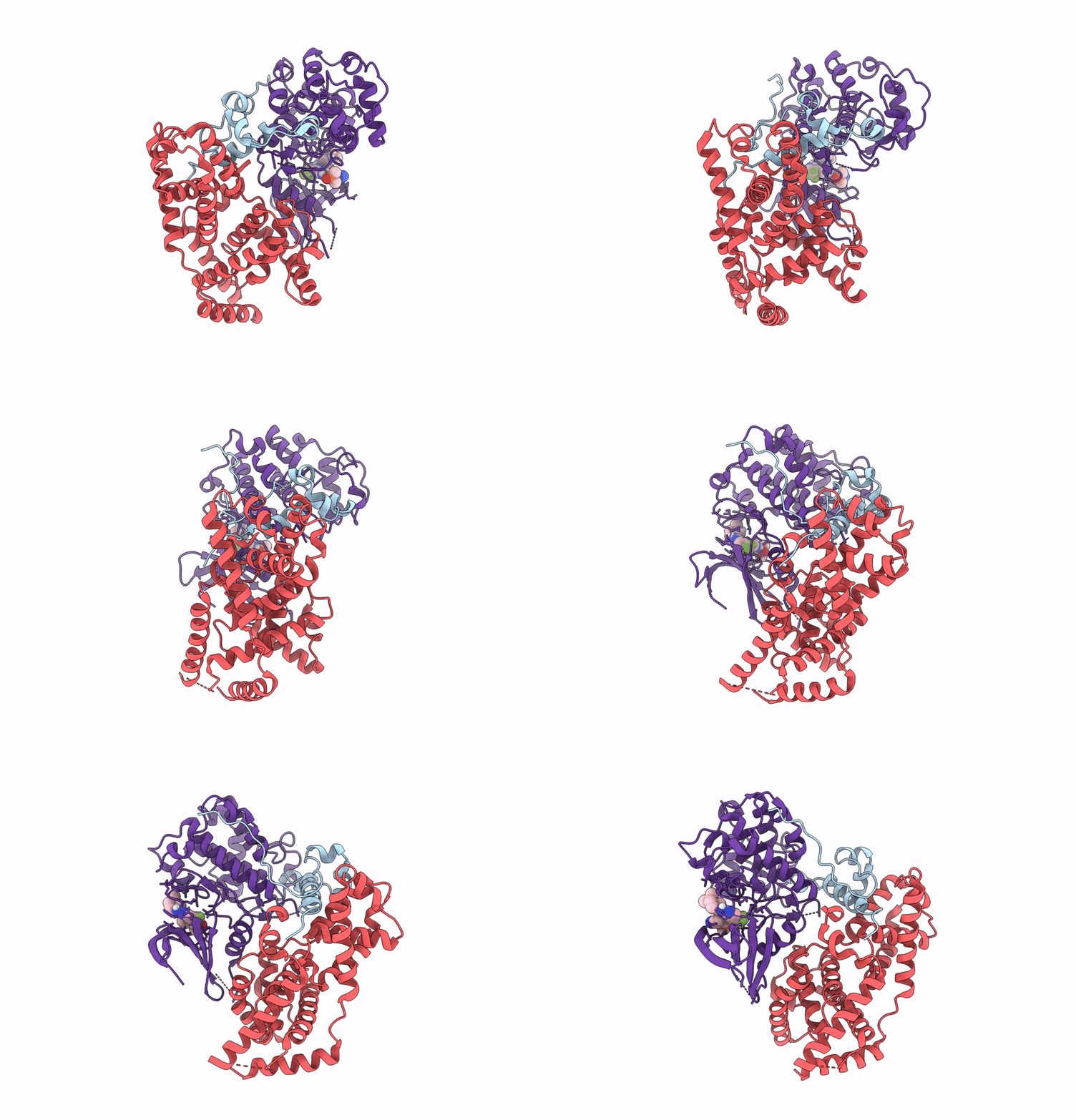
8S0T image
Deposition Date 2024-02-14
Release Date 2024-12-25
Last Version Date 2025-07-09
Entry Detail
PDB ID:
8S0T
Keywords:
Title:
Cryo-EM structure of CAK in complex with SY-5609
Biological Source:
Source Organism:
Homo sapiens (Taxon ID: 9606)
Host Organism:
Method Details:
Experimental Method:
Resolution:
2.30 Å
Aggregation State:
PARTICLE
Reconstruction Method:
SINGLE PARTICLE
Macromolecular Entities
Structures with similar UniProt ID
Protein Blast
Polymer Type:polypeptide(L)
Molecule:CDK-activating kinase assembly factor MAT1
Gene (Uniprot):MNAT1
Chain IDs:A (auth: H)
Chain Length:93
Number of Molecules:1
Biological Source:Homo sapiens
Structures with similar UniProt ID
Protein Blast
Polymer Type:polypeptide(L)
Molecule:Cyclin-H
Gene (Uniprot):CCNH
Chain IDs:B (auth: I)
Chain Length:324
Number of Molecules:1
Biological Source:Homo sapiens
Structures with similar UniProt ID
Protein Blast
Polymer Type:polypeptide(L)
Molecule:Cyclin-dependent kinase 7
Gene (Uniprot):CDK7
Chain IDs:C (auth: J)
Chain Length:349
Number of Molecules:1
Biological Source:Homo sapiens
Ligand Molecules
Primary Citation

Abstact

How cyclin-dependent kinase 7 (CDK7) coordinately regulates the cell cycle and RNA polymerase II transcription remains unclear. Here, high-resolution cryo-electron microscopy revealed how two clinically relevant inhibitors block CDK7 function. In cells, CDK7 inhibition rapidly suppressed transcription, but constitutively active genes were disproportionately affected versus stimulus-responsive. Distinct transcription factors (TFs) regulate constitutive versus stimulus-responsive genes. Accordingly, stimulus-responsive TFs were refractory to CDK7 inhibition whereas constitutively active "core" TFs were repressed. Core TFs (n = 78) are predominantly promoter associated and control cell cycle and proliferative gene expression programs across cell types. Mechanistically, rapid suppression of core TF function can occur through CDK7-dependent phosphorylation changes in core TFs and RB1. Moreover, CDK7 inhibition depleted core TF protein levels within hours, consistent with durable target gene suppression. Thus, a major but unappreciated biological function for CDK7 is regulation of a TF cohort that drives proliferation, revealing an apparent universal mechanism by which CDK7 coordinates RNAPII transcription with cell cycle CDK regulation.

Legend

Protein

Chemical

Disease

Primary Citation of related structures
Feedback Form
Name
Email
Institute
Feedback